 CravingMind AI
Intuitive eating is all about getting back in touch with your body’s built-in wisdom. Think of it as a self-care practice that helps you hear and honor your natural hunger and fullness cues. Instead of following a rigid set of external rules dictated by the latest diet fad, you learn to trust your own body to tell you what, when, and how much to eat. The goal is to build a healthier, more peaceful relationship with food and your body.
What Is Intuitive Eating Really About

At its heart, intuitive eating is the complete opposite of a diet. It’s not a secret weight-loss plan or another list of do’s and don’ts. It’s a personal journey of unlearning a lifetime of mixed messages from diet culture and rediscovering how to trust and respect your body again.
Remember being a kid? You ate when you were hungry and stopped when you were full. Intuitive eating is about finding your way back to that innate skill, which often gets drowned out by years of counting calories, labeling foods as “good” or “bad,” and feeling guilty for enjoying a meal.
The Philosophy Behind the Practice
The entire philosophy hinges on one powerful idea: you are the expert of your own body. No diet book, influencer, or meal plan knows your unique needs better than you do. This shift in mindset is incredibly freeing, allowing you to stop seeking outside approval and start listening to your own internal signals.
This evidence-based framework was first introduced by dietitians Evelyn Tribole and Elyse Resch back in 1995. Their approach is all about eating based on physical hunger and satiety cues rather than outside rules or emotional triggers.
Making this shift involves a few key changes in perspective:
- Trust Over Control: You learn to trust your body’s signals instead of trying to micromanage them with rigid rules.
- Compassion Over Judgment: It’s about approaching food with kindness and curiosity, not self-criticism.
- Satisfaction Over Restriction: The focus is on finding genuine pleasure and satisfaction in what you eat, moving away from a cycle of restriction and deprivation.
Intuitive Eating vs. Traditional Dieting at a Glance
To really get what intuitive eating is all about, it helps to put it side-by-side with conventional dieting. The differences are night and day, showing a profound shift from a mindset of external control to one of internal trust.
This comparison table breaks down the fundamental mindset shifts between the two philosophies.
| Concept | Intuitive Eating Approach | Traditional Dieting Approach |
|---|---|---|
| Food Rules | Rejects all external rules. Encourages listening to your body’s internal wisdom. | Relies on strict, external rules (e.g., calorie limits, forbidden foods, eating windows). |
| Body Trust | Builds deep trust in your body’s ability to know what it needs and regulate itself. | Creates distrust in your body. Hunger is seen as an enemy to be suppressed or ignored. |
| Success Metric | Success is measured by your internal state—well-being, peace with food, and body respect. | Success is measured by external numbers—the scale, clothing size, or calories burned. |
| Mindset | Fosters a flexible, compassionate, and curious attitude toward food and eating. | Promotes a rigid, all-or-nothing mindset that revolves around perfection and control. |
As you can see, intuitive eating isn’t just a different way to eat—it’s a completely different way to think about food, your body, and yourself. It’s about tuning in, not tuning out.
Exploring the 10 Principles of Intuitive Eating
To really get what intuitive eating is all about, you have to go beyond a simple definition and look at its framework. This framework is built on 10 core principles that act as a roadmap, helping you unlearn a lifetime of diet culture and start listening to your body again. Think of them less as rigid rules and more as different paths all leading back to a peaceful relationship with food.
These principles are designed to work together, each one building on the last to create a solid foundation of self-trust and body respect. They guide you from big-picture mindset shifts, like ditching diet culture for good, to more practical skills like tuning into your hunger and knowing when you’re full.
This infographic breaks down the foundational pillars of the intuitive eating journey.
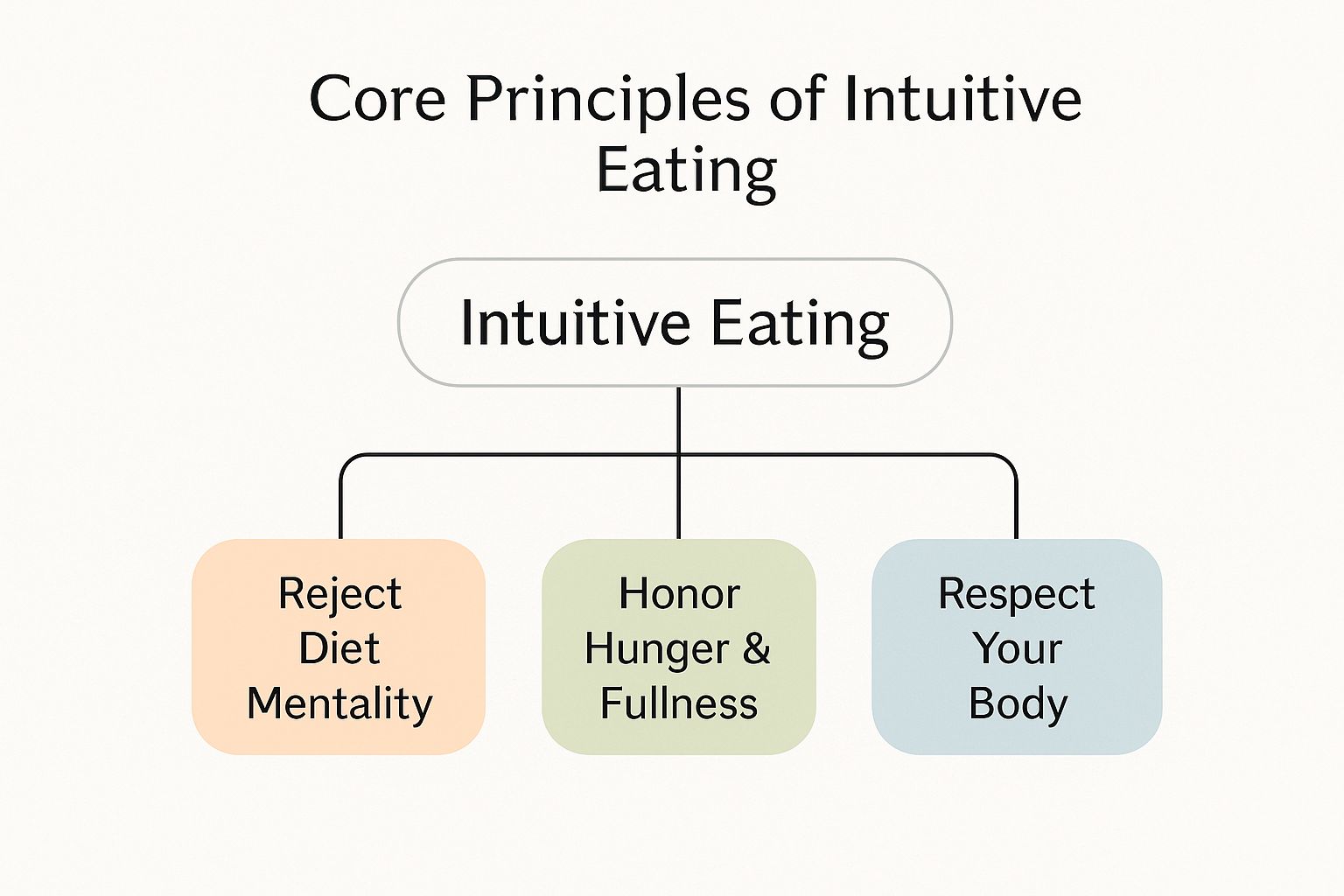
As you can see, core ideas like rejecting the diet mentality and honoring your body’s signals are the starting points for everything else that follows.
Principle 1: Reject the Diet Mentality
This is step one, and it’s a big one. You have to consciously decide to let go of the idea that some new diet holds the key to your happiness. The diet mentality is that nagging voice promising that restriction and weight loss will fix everything—a promise it never keeps.
Rejecting this means finally acknowledging the harm that dieting has caused. It’s about seeing the endless cycle for what it is: hope, restriction, perceived “failure,” and guilt that always leaves you feeling worse. It’s time to get angry at the lies diet culture has been selling for years.
How to put this into practice:
- Spot Diet-Culture Thoughts: Start noticing when you label foods “good” or “bad” or when guilt creeps in after you eat something.
- Toss the Dieting Tools: Get rid of the scale, calorie-counting apps, and anything else that gives external rules power over your body’s own wisdom.
- Be Kind to Yourself: Unlearning years of conditioning is tough work. Show yourself some compassion as you navigate this new mindset.
Principle 2: Honor Your Hunger
Hunger isn’t your enemy. It’s a basic, biological signal your body uses to protect you. For far too long, diets have taught us to ignore it, suppress it, or even fear it. Honoring your hunger means learning to listen for its early cues and responding by giving your body the fuel it needs.
When you constantly ignore your hunger, your body learns it can’t trust you to provide for it. This can kickstart a primal drive to overeat, which most people mistake for a lack of willpower. In reality, it’s just biology responding to what it perceives as starvation.
By keeping your body biologically fed, you lay the foundation for rebuilding trust with yourself and with food. Once your body knows it will consistently have access to energy, the intense, uncontrollable cravings often begin to subside.
Learning to recognize your unique hunger signals is key. It might be a gentle stomach growl, a dip in energy, trouble concentrating, or feeling a bit cranky. The goal is to eat when you feel pleasantly hungry, not wait until you’re ravenous.
Principle 3: Make Peace with Food
This principle can feel revolutionary. It means giving yourself unconditional permission to eat all foods. That’s right—no more “good” or “bad” foods. As soon as you label a food as forbidden, you create an intense craving for it, which just fuels a cycle of deprivation followed by out-of-control eating.
Making peace with food means calling a truce in the war you’ve been waging. When you genuinely know you can have a brownie or a bag of chips whenever you truly want one, they start to lose their power. This process, called habituation, is crucial. You might find yourself eating more of these formerly “off-limits” foods at first, but soon enough, they become just another option, losing their seductive allure.
Principle 4: Challenge the Food Police
The “Food Police” is that critical voice in your head that judges every single thing you eat. It’s the inner critic that congratulates you for eating a salad and shames you for having a cookie. This voice is a direct product of diet culture, and it’s full of nothing but unreasonable rules and rigid, black-and-white thinking.
Challenging it means you have to actively question these thoughts as they pop up. When a judgmental thought arises, ask yourself:
- Where did I learn this rule?
- Is it based on actual fact or just fear?
- Is this thought helping me or harming me?
The goal is to replace that criticism with neutral, compassionate language. For example, instead of, “I was so bad for eating that cake,” you can reframe it as, “I enjoyed a piece of cake at the party.”
Principle 5: Discover the Satisfaction Factor
In our endless pursuit of “health” or weight loss, we often forget one of the most important parts of eating: pleasure. The “satisfaction factor” is truly the heart of intuitive eating. When you eat what you really want in an enjoyable setting, you feel more content and satisfied.
Depriving yourself of satisfying foods usually backfires, leading you to search for something—anything—to fill that void, which often results in overeating. Ever eaten a “healthy” but bland meal, only to find yourself rummaging through the kitchen an hour later? That’s because your body got nutrients, but your mind never got satisfaction.
Principle 6: Feel Your Fullness
Just as it’s vital to honor your hunger, it’s equally important to respect your fullness. This is all about tuning into your body’s signals that tell you when you’ve had enough. To do this, you need to get in the habit of pausing partway through a meal to check in with yourself.
How does the food taste now? Where is your hunger level? Fullness isn’t a simple on/off switch; it’s a spectrum of sensations. The aim is to stop when you feel comfortably full, not stuffed. This skill gets a lot easier once you’ve made peace with food because the fear of not being “allowed” to eat again later is gone.
Principle 7: Cope with Your Emotions with Kindness
Emotional eating is an incredibly common coping mechanism. Food can be comforting, distracting, or even numbing. While there’s nothing wrong with using food for comfort occasionally—we’re all human—it becomes a problem when it’s your only tool for dealing with tough feelings.
This principle is about finding kinder ways to comfort yourself and work through your issues without food being the default solution. The first step is to simply ask, “What am I really feeling right now?” Once you can name the emotion—boredom, stress, loneliness—you can then ask, “What do I truly need?” Sometimes, you might still choose food, and that’s okay. Other times, you’ll realize what you actually need is a nap, a walk, or a chat with a friend.
Principle 8: Respect Your Body
This principle asks you to accept your genetic blueprint. Just like a person with size eight feet can’t expect to magically fit into a size six shoe, it’s both pointless and damaging to force your body into an unrealistic shape or size. Body respect is about treating your body with dignity and meeting its needs, no matter how you feel about its appearance on any given day.
Notice the word here is respect, not love. For many, body love can feel like too big of a leap. Respect is a much more realistic and powerful place to start. It means appreciating everything your body does for you and making a commitment to stop the negative self-talk.
Principle 9: Movement—Feel the Difference
It’s time to shift your focus from punishing exercise to joyful movement. Instead of obsessing over how many calories you’re burning, start paying attention to how it feels to move your body. Does a walk outside clear your head? Does dancing to your favorite music make you feel energized?
When you disconnect movement from the goal of weight loss, you open yourself up to its real benefits, like a better mood, deeper sleep, and more energy. The goal is to find ways of moving that you genuinely look forward to, turning it into a sustainable, life-affirming practice instead of just another chore on your to-do list.
Principle 10: Honor Your Health with Gentle Nutrition
The final principle is where nutrition comes back into the picture, but without the old diet-mentality rigidity. Gentle nutrition is all about making food choices that honor both your health and your taste buds. It’s about progress, not perfection. A single meal will not make or break your health. What matters is your overall pattern of eating over time.
These guidelines—from honoring hunger and making peace with food to respecting your body—are designed to help you build a healthier, happier relationship with food. To learn more about these core tenets, check out the great overview on BBC Good Food. By this stage in the journey, you’ve built a strong foundation of trust with your body, allowing you to choose foods that make you feel good without ever falling back into the dieting trap.
The Science-Backed Benefits of Listening to Your Body

Stepping away from the rigid world of diet culture isn’t just a massive relief—it’s a choice backed by a solid and growing body of scientific research. Intuitive eating is far more than a nice idea; it’s an evidence-based framework that leads to real, measurable improvements in both mental and physical health. Think of it as a credible path to finding the kind of harmony with food that most diets promise but almost never deliver.
By learning to tune into and trust your body’s internal signals, you’re not just making peace with food. You’re actively boosting your overall well-being. These aren’t just vague feelings; they are tangible outcomes that researchers see again and again in people who adopt this more compassionate approach to eating.
A Healthier, Happier Mind
One of the most immediate and profound benefits of intuitive eating is the positive ripple effect it has on your mental health. When you shift your focus away from weight and external food rules, you start to dismantle the anxiety and guilt that so often show up at mealtimes. People who practice intuitive eating consistently report feeling less stress around food.
This newfound mental freedom translates into some major upgrades:
- Higher Self-Esteem: You naturally cultivate a more positive self-image when you stop judging your body and your food choices. Respecting your body for what it can do, rather than fixating on how it looks, builds a foundation of confidence that dieting so often chips away at.
- Greater Life Satisfaction: Freed from the constant mental gymnastics of dieting, people often discover they have more energy for hobbies, relationships, and other parts of life that bring them genuine joy.
- Improved Body Image: Intuitive eating is all about appreciating your body, right here and now. Studies consistently show that intuitive eaters report a more positive body image and are less likely to internalize society’s unrealistic appearance ideals.
A landmark longitudinal study drove this point home, showing that higher intuitive eating scores are strongly linked to better psychological health. For instance, the study found that each one-point increase in a person’s intuitive eating score corresponded to a stunning 74% reduction in the odds of binge eating later on. The research also revealed lower chances of experiencing depression, low self-esteem, and body dissatisfaction. You can dive into these compelling research findings on psychological health for yourself.
Breaking Free From Disordered Eating
Intuitive eating directly confronts and helps dismantle the very behaviors that fuel disordered eating. The exhausting diet-binge cycle, for example, is often a direct result of restriction. The moment you give yourself unconditional permission to eat, those intense, desperate cravings for “forbidden” foods start to lose their power.
By honoring your hunger and making peace with all foods, you neutralize the emotional charge around eating. Food becomes just food again—not a source of shame or a reflection of your willpower.
Intuitive eating acts as a powerful antidote to the chronic dieting mindset. By fostering body trust and food neutrality, it systematically reduces the risk of developing behaviors like binge eating, emotional eating, and restrictive patterns.
This shift helps you reconnect with your innate hunger and fullness cues, which often get completely scrambled after years of dieting. The practice encourages a mindful awareness that helps you tell the difference between physical hunger and emotional triggers. This empowers you to address what you really need instead of defaulting to food as a coping mechanism.
Better Physical Health Markers
While intuitive eating is not a weight-loss diet, many people are surprised to see positive shifts in their physical health markers. By focusing on internal cues and gentle nutrition, they often gravitate toward a more balanced and varied diet over time—without the stress of forcing it.
Some of the physical benefits researchers have observed include:
- Stable Blood Sugar Levels: When you respond to hunger cues before you get ravenous, you can avoid the extreme blood sugar swings that lead to energy crashes and powerful cravings.
- Improved Cholesterol Levels: Research has linked intuitive eating with better cardiovascular health indicators, including healthier cholesterol profiles.
- Better Metabolic Health: Consistently trusting and nourishing your body—instead of putting it through cycles of restriction and overeating—supports a more stable and efficient metabolism.
Ultimately, the science confirms what so many intuitive eaters already know from experience: listening to your body is one of the most reliable things you can do for your quality of life. It builds a deep-seated trust that leads to more mental clarity, emotional resilience, and physical vitality.
Common Myths About Intuitive Eating Debunked

As intuitive eating starts getting the attention it deserves, a lot of myths and misunderstandings have popped up alongside it. This confusion often creates fear, holding people back from finding a truly peaceful relationship with food.
It’s time to clear the air. By tackling these common myths head-on, we can remove the mental roadblocks that stop so many from starting this journey. Getting clear on what intuitive eating is—and what it definitely isn’t—is the first real step toward building a more compassionate and confident approach to your well-being.
Let’s dive into some of the biggest misconceptions and separate fact from fiction.
Intuitive Eating Myth vs Reality
| Common Myth | The Reality of Intuitive Eating |
|---|---|
| “It’s just the ‘eat whatever you want’ diet.” | It’s about listening to your body’s signals for hunger, fullness, and satisfaction—not a free-for-all. |
| “You’ll just eat junk food all day.” | Initially, you might gravitate towards “forbidden” foods, but this phase passes. Eventually, you start craving balance. |
| “It means you can’t care about nutrition.” | Gentle nutrition is the final principle. It’s about making food choices that honor your health and your taste buds. |
| “It’s just another weight loss trick.” | Intuitive eating is weight-neutral. The goal is to heal your relationship with food, not to change your body size. |
These myths often come from a place of fear—fear of losing control, fear of weight gain, and fear of the unknown. But when you look closer, you see that intuitive eating is a structured, thoughtful process designed to bring you back to your body’s innate wisdom.
Myth 1: It’s Just a Disguised Weight Loss Plan
This is probably the most common and damaging myth out there. Let’s be crystal clear: intuitive eating is fundamentally not a diet. Its entire foundation is built on rejecting the diet mentality and the scale.
The real goal here is health gain, not weight loss. This means we shift our focus to internal signs of well-being, like having more stable energy, feeling less guilt around food, and developing a positive body image. Some people might lose weight, others might gain some, and many stay the same as their body finds its natural, comfortable set point.
The success of intuitive eating is measured by peace of mind and body respect, not by a number on the scale. Shifting the focus away from weight is essential for healing your relationship with food.
Myth 2: You Will Only Eat Junk Food Forever
The fear of giving yourself unconditional permission to eat often translates into a vision of a future filled with nothing but pizza, ice cream, and chips. And yes, in the beginning, you might find yourself eating more of these formerly “forbidden” foods. But that phase doesn’t last.
This initial period is a totally normal part of a process called habituation. Think about it: when you finally know, deep down, that you can have a brownie whenever you want one, it loses its power over you. The intense, restriction-fueled cravings start to fade. Over time, your body recalibrates and begins to crave variety because it learns what foods make it feel energized and truly good.
Myth 3: It’s a Free-For-All with No Regard for Nutrition
This myth couldn’t be further from the truth. It paints intuitive eating as an approach that throws health out the window, which simply isn’t the case. In fact, “gentle nutrition” is the tenth and final principle, and it’s placed there for a very important reason. It only comes into play after you’ve started to heal your relationship with food and your body.
Here’s how it’s different from diet-based nutrition rules:
- No Morality: Food isn’t labeled as “good” or “bad.” A salad isn’t virtuous, and a cookie isn’t a sin.
- Focus on Feeling: You start choosing foods based on how they make your body feel—energized, satisfied, and well.
- Flexibility Over Perfection: It’s about your overall eating patterns over time, not being perfect at every single meal.
Intuitive eating is about honoring your health in a way that also honors your satisfaction and taste. You learn to make food choices that feel good both physically and mentally, without the baggage of guilt and restriction. For a closer look at these concepts, check out this excellent breakdown of intuitive eating myths.
How to Begin Your Intuitive Eating Journey
So, the idea of food freedom sounds amazing, but you’re not quite sure where to start? That’s a completely normal, and honestly, expected feeling. We spend years learning to follow external food rules, so shifting to a practice of trusting our own bodies is a big deal. The good news? It doesn’t have to be complicated.
The secret is to start small. This isn’t about flipping a switch and being a perfect intuitive eater overnight. It’s a journey of practice, not performance. Think of yourself as a detective in the beginning—you’re just gathering clues about your body and your relationship with food, without any pressure to change anything just yet.
Start with Gentle Awareness Exercises
Before you can honor your body’s signals, you have to learn to actually hear them again. The first phase is all about listening. You can begin with some simple, no-judgment exercises designed to help you tune in to your internal world and notice the external noise that might be drowning it out.
Here are a few manageable first steps to try:
- Conduct a Diet Culture Audit: Seriously, take a look at your social media feeds. Who are you following? Unfollow any account that promotes restrictive eating, glorifies one specific body type, or just makes you feel bad about your food choices. This one small act can turn down the volume on external pressure in a huge way.
- Use a Hunger-Fullness Scale: This isn’t another rule to follow—it’s a tool for awareness. Before and after you eat, just mentally check in. On a scale of 1 (starving) to 10 (uncomfortably stuffed), where are you? Simply noticing this without judging yourself is a massive first step toward understanding your body’s unique language.
The point of these first exercises isn’t to eat perfectly. It’s to observe compassionately. Every meal becomes an opportunity to learn something new about yourself, free from the pressure of getting it “right.”
This whole process is really about reconnecting with an ability you were born with. By gently paying attention, you’re reawakening your body’s innate wisdom, one meal at a time. The Craving Mind app is a great companion for this, letting you log your mood and cravings to spot patterns without ever counting a single calorie.
Reintroduce a Forbidden Food Mindfully
One of the most powerful things you can do is to challenge the whole idea of “forbidden” foods. Diet culture gives certain foods—like cookies or pizza—an almost magical power by labeling them “bad.” You can start taking that power back by mindfully reintroducing one of them.
Pick one single food that you’ve told yourself you “shouldn’t” have. The goal is to eat it with full permission and without distraction.
- Set the Stage: Find a quiet, comfortable spot where you won’t be rushed.
- Serve Yourself: Put a normal-sized portion on a plate instead of eating from the bag or box. This helps make it a real, intentional experience.
- Engage Your Senses: Before you even take a bite, just look at it. Notice the smell, the texture, the colors.
- Savor the Experience: Eat slowly. Pay attention to the taste and how it feels in your mouth. Pause halfway through and just check in—how satisfied are you?
- Notice Without Judgment: When you’re done, just observe. How do you feel, physically and emotionally? There is no right or wrong answer here.
This exercise is less about the food itself and more about reclaiming your personal power over it. As you do this more often, you’ll find that these once-mighty foods become just… food again.
To go deeper, check out our guide to mindful eating techniques, which has even more strategies for making meals more present and peaceful. Just remember, this is your journey. Every small step is a win.
Your Intuitive Eating Questions Answered
It’s only natural to have questions as you start exploring intuitive eating. This is a huge shift from the diet culture most of us have been swimming in for years, so a little uncertainty is completely normal. Think of this as your go-to guide for those moments when you need some clarity.
Let’s tackle some of the most common questions that pop up on this journey.
What If I Never Stop Eating My “Forbidden” Foods?
This is probably the number one fear I hear. The idea of giving yourself unconditional permission to eat anything sounds like you’ll spend the rest of your life on the couch with a bag of chips. I get it.
But here’s what really happens: this initial free-for-all is a temporary—and totally necessary—part of the process called habituation.
When a food is no longer forbidden, it loses its power over you. That intense, psychological pull starts to fade. You might go hard on cookies and pizza at first, but eventually, the novelty wears off. Your body will naturally start asking for other things, including foods that make you feel energized and vibrant. You’ll find a balance that feels good, I promise.
How Is This Different from Mindful Eating?
This is a great question, as the two are often used interchangeably, but they aren’t the same. Think of it this way: mindful eating is a skill, while intuitive eating is the entire framework.
Mindful eating is all about being present with your food—tuning into the tastes, textures, and smells. It’s an incredibly powerful tool.
Intuitive eating is the bigger picture. It’s a self-care philosophy built on 10 core principles that guide you to heal your entire relationship with food, from rejecting the diet mentality to respecting your body. Mindful eating is just one piece of that beautiful puzzle.
Is It Possible to Practice Intuitive Eating on a Budget?
Absolutely, 100% yes. Intuitive eating is for every budget. In fact, it often helps you break free from the expensive myth that you need pricey, organic, or specialty “health” foods to be well.
A core tenet of intuitive eating is making food choices feel neutral, removing the guilt often associated with more affordable options. This allows you to focus on nourishment and satisfaction without financial pressure.
Honoring your hunger can be done with simple, budget-friendly staples like rice, beans, oats, and frozen vegetables. You’ll also find that planning meals based on what you actually enjoy—not what some diet plan dictates—helps you cut down on food waste and save money.
How Do I Know if I’m Experiencing Real Hunger?
Learning to hear your body’s signals again is a foundational skill. It takes practice.
Physical hunger tends to build gradually. You might feel an emptiness in your stomach, a dip in energy, or a little fogginess. It’s your body’s way of saying it needs fuel.
Emotional hunger, on the other hand, often hits you like a ton of bricks. It’s sudden, intense, and usually aimed at a very specific food. It’s often a response to feelings like stress, boredom, or sadness. Getting clear on the difference between emotional hunger vs. physical hunger is the first step in learning how to give your body what it truly needs in that moment.