 CravingMind AI
It really boils down to one core difference: physical hunger is a biological need for fuel that builds slowly, while emotional hunger is a psychological response to your feelings that hits you like a ton of bricks. The choice you make—to eat or not to eat—all comes down to whether your body is asking for nutrients or your mind is looking for comfort.
Understanding Your Body’s Hunger Signals
Learning to tell the difference between emotional and physical hunger is one of the most important skills you can develop for a healthier relationship with food. It’s the gap between eating to live and eating to cope.
True physical hunger is your body’s built-in survival tool. It’s a natural signal that you’re running low on energy and need to refuel. This feeling doesn’t demand you drop everything and eat right now. It’s patient and usually pretty open-minded about what you eat.
Emotional hunger, on the other hand, plays by a totally different set of rules. It’s an urgent, almost overwhelming craving for something very specific—you know the drill, usually something high in sugar, fat, or salt. This craving isn’t coming from an empty stomach. It’s stemming from an emotional void, where feelings like stress, boredom, sadness, or even happiness trigger a powerful impulse to eat.
Key Characteristics to Watch For
To figure out where your hunger is coming from, you have to tune into the subtle clues your body and mind are sending. Physical hunger usually comes with clear physical signs, like a growling stomach, feeling a bit lightheaded, or finding it hard to concentrate. It’s a straightforward request from your body.
In contrast, emotional hunger is often felt “above the neck”—a craving that starts as a thought in your head. It frequently leads to mindless eating, where you might polish off a whole bag of chips without really tasting them or feeling physically full afterward. Instead of satisfaction, it can leave you with a nasty serving of guilt or shame.
And these emotional triggers are powerful. One study found that about 53% of adults showed moderate to high emotional eating habits fueled by stress, anxiety, and depression.
The most reliable way to tell the difference is to pause and ask yourself: “What am I truly feeling right now?” If the answer is boredom, stress, or loneliness, the hunger is almost certainly emotional.
The infographic below does a great job of breaking down the onset, satisfaction, and triggers for each type of hunger.
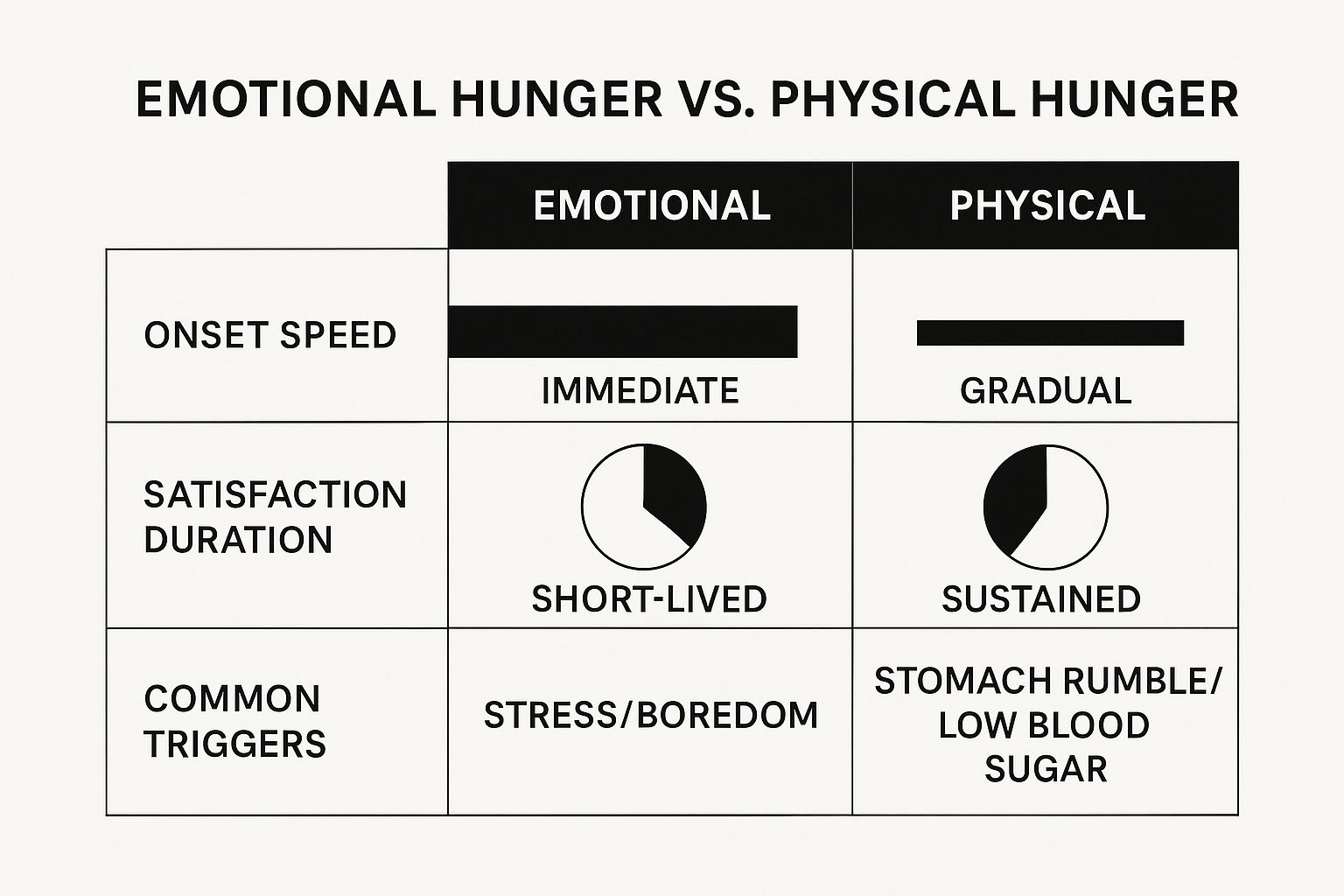
As you can see, the sudden rush of emotional hunger and its fleeting satisfaction are worlds apart from the gradual, fulfilling nature of physical hunger. Becoming aware of this is your first real step toward taking back control. Mastering this skill is a game-changer, and you can dive deeper by checking out our guide on how to control food cravings.
Quick Guide: Emotional Hunger vs Physical Hunger
To make it even simpler, here’s a quick side-by-side comparison. Keep this handy for the next time you feel a hunger pang and aren’t quite sure what’s really going on.
| Characteristic | Physical Hunger | Emotional Hunger |
|---|---|---|
| Onset | Builds up gradually over time. | Hits you suddenly and feels urgent. |
| Food Type | You’re open to different food options. | You crave a very specific comfort food. |
| Location | You feel it in your stomach (emptiness, growling). | You feel it in your head (a nagging thought). |
| Satisfaction | Ends when you feel comfortably full. | You might keep eating even when you’re stuffed. |
| Emotion After | You feel satisfied and energized. | You might feel guilty, ashamed, or powerless. |
Using this guide can help you pause and identify the root of your craving, empowering you to make a more conscious choice that aligns with your well-being.
The Science Behind Why You Feel Hungry

To really get a handle on the difference between emotional and physical hunger, it helps to peek under the hood and see what’s going on. These two feelings come from completely different places in your body. One is a finely-tuned biological process, and the other is a powerful reaction from your brain’s reward center.
Physical hunger is basically a conversation between your hormones, all working together to make sure your body has the fuel it needs to function. It’s a primal, deep-seated instinct for survival. When your body is low on energy, it’s not just a grumbling stomach—it’s your entire endocrine system sending out the call.
Understanding this complex communication network is the first step. It helps you recognize when your body is genuinely asking for fuel versus when your mind is just looking for a little comfort.
The Hormonal Orchestra of Physical Hunger
Think of ghrelin and leptin as the two main conductors in this hormonal orchestra. Ghrelin is essentially the “go” signal for eating. When your stomach is empty, it pumps ghrelin into your bloodstream. This hormone travels up to your brain and flips the hunger switch on.
On the flip side, leptin is the “stop” signal. It’s produced by your fat cells, and as you eat and get full, leptin levels rise. This tells your brain that you’ve got enough energy stored and it’s time to put the fork down. This hormonal feedback loop is incredibly efficient at managing your body’s energy balance—as long as other factors don’t get in the way.
The interplay between ghrelin and leptin is the core mechanism of physical hunger. Ghrelin drives you to seek food, while leptin tells you when you’re satisfied, creating a natural cycle of need and fulfillment.
This system is also why feeling intensely hungry can mess with your mood. You’ve probably heard of being “hangry”—a mix of hungry and angry. It’s not just in your head; it’s a genuine physiological response. Research has shown that low blood sugar from hunger can make you more irritable and stressed, turning physical hunger itself into an emotional trigger. You can learn more about the far-reaching effects of hunger on emotional wellbeing on Concern.net.
The Brain’s Reward System and Emotional Hunger
While physical hunger is a gut-to-brain conversation, emotional hunger is almost all in your head. It works by hijacking your body’s natural cues and tapping directly into the brain’s powerful reward system, which runs on a neurotransmitter called dopamine.
When you feel stressed, sad, or even just bored, your brain looks for a quick and easy way to feel better. This is where comfort foods come in. Foods high in sugar, fat, and salt are especially good at triggering a dopamine rush. This creates a wave of pleasure that temporarily numbs or distracts you from whatever negative emotion you’re experiencing.
This process can quickly become a hardwired habit. Your brain learns that eating a certain food brings a feeling of reward, which reinforces the behavior. Before you know it, just the thought of a stressful day can trigger a powerful craving for that comfort food, locking you into a cycle that can be tough to break.
Key Scientific Differentiators:
- Physical Hunger Driver: This is primarily hormonal (ghrelin and leptin) and is a direct response to your body’s physiological need for energy.
- Emotional Hunger Driver: This is mainly neurological (dopamine and the reward pathway) and comes from a psychological need for comfort, distraction, or pleasure.
At the end of the day, understanding this science shows why the battle between emotional and physical hunger can feel so overwhelming. You aren’t just fighting a lack of willpower; you’re dealing with complex hormones and deeply ingrained brain patterns. Learning to spot which system is at play is the key to responding with awareness instead of just reacting on autopilot.
How to Identify Your Personal Hunger Triggers

Knowing the difference between emotional and physical hunger is one thing; applying that knowledge to your own life is where the real work begins. This is your chance to become a detective of your own habits and uncover what truly drives you to eat. Pinpointing your personal triggers is how you shift from unconsciously reacting to making conscious, empowering choices.
These triggers are the unique mix of situations, feelings, or even people that make you want to eat when your body doesn’t need fuel. For one person, it might be the pressure of a big work deadline. For another, it’s the profound loneliness that can settle in on a quiet evening. Our goal here is to figure out the “why” that lives behind your specific cravings.
Uncovering Your Emotional Eating Patterns
Your emotional eating habits aren’t random; they’re tied to specific patterns that you might not have noticed before. Most of these triggers fall into a few common categories. See which of these feel familiar—it’s the first step toward finding the root cause.
- Emotional Triggers: These are the big, uncomfortable feelings we often try to push away. Sadness, anxiety, boredom, and frustration are all powerful motivators. Food can feel like a welcome distraction or a comforting friend in those moments.
- Situational Triggers: Some cravings are sparked by your environment or daily routines. Do you automatically reach for a snack bowl when you sit down to watch TV? Does a certain smell from a bakery on your commute home instantly make you want a treat? These are habits baked into your day-to-day life.
- Social Triggers: We often eat with others, but this can come with its own set of pressures. You might eat something you don’t really want just to fit in at a party, or find yourself overeating during a tense family dinner to cope with the stress.
Once you start seeing your cravings through this lens, you can connect the dots between the urge to eat and what’s really going on. That awareness is everything.
The real power comes not from resisting a craving, but from understanding what the craving is truly asking for. Is it nourishment, or is it comfort, distraction, or relief?
A Practical Journaling Framework to Find Your Triggers
One of the most powerful tools I’ve seen for uncovering personal triggers is journaling. It sounds simple, but it creates a tangible record of your habits, turning confusing feelings into clear, actionable data. Try it for just one week.
This is the exact philosophy behind the Craving Mind app, which streamlines this process into an effortless digital journal. You use photo-logging and quick mood check-ins, and its AI helps visualize the connections between your moods and food choices.
If you want to start with pen and paper, just create a simple log. Every time you feel a strong craving or find yourself eating when you know you aren’t truly hungry, pause and jot down the answers to these questions:
- What did I just eat (or what am I craving)? Be specific: a handful of salty chips, a square of dark chocolate.
- What was I doing right before the craving hit? Finishing a stressful work report, scrolling through social media, talking on the phone with my sister.
- What am I feeling right now? Dig a little deeper than just “bad.” Are you feeling lonely? Bored? Anxious? Unappreciated?
- On a scale of 1-10, how physically hungry am I? Let 1 be starving and 10 be uncomfortably full.
After just a few days of this practice, you’ll start to see patterns emerge from the noise. You might notice that your craving for crunchy, salty foods skyrockets after team meetings, or that boredom on a Sunday afternoon always sends you searching for sugar. These insights are your personal roadmap to lasting change.
Practical Ways to Manage Emotional Hunger

Once you get better at spotting your emotional triggers, the real work begins: building a toolkit of non-food coping strategies. This is all about learning to sit with your emotions and respond to them directly, rather than reaching for a snack on autopilot. The goal isn’t to banish emotional eating from your life forever, but to give yourself other options so food isn’t your only comfort.
Tackling the tangle of emotional hunger vs physical hunger means developing a new set of skills. By finding alternative ways to soothe yourself, you start addressing the root of the craving—the feeling itself. This puts you back in the driver’s seat, able to make a conscious choice that truly serves you.
Implement the Five-Minute Rule
One of the most effective strategies I’ve seen is also one of the simplest: the five-minute rule. The next time a sudden, intense craving hits, make a deal with yourself to wait just five minutes before acting on it. That small delay is everything; it creates a crucial buffer between the emotional impulse and your reaction.
This isn’t about gritting your teeth and resisting. Use those five minutes to genuinely check in. Ask yourself the questions we talked about earlier: “What am I really feeling right now?” and “Where is this urge coming from?”
More often than not, that brief pause is enough for the emotional storm to pass. It gives you the clarity to see the craving for what it truly is—a signal of boredom, anxiety, or procrastination, not actual physical hunger. You might realize you aren’t hungry at all.
The five-minute rule isn’t about denial; it’s about creating space for awareness. It’s the pause that allows your rational mind to catch up with your emotional impulse, giving you back the power of choice.
Build Your Non-Food Coping Toolkit
Because emotional hunger comes from an emotional need, the best solutions are the ones that meet that need head-on. The trick is to match the coping strategy to the emotion you’re feeling. Here’s a list of practical alternatives you can try, organized by the feeling you’re trying to soothe.
If you’re feeling stressed or anxious:
- Deep Breathing: Try a simple box breathing exercise. Inhale for a count of four, hold your breath for four, exhale for four, and hold again for four. A few rounds can work wonders on a frazzled nervous system.
- Listen to Calming Music: Cue up a playlist of relaxing instrumental tracks or nature sounds. It can actually help lower your stress hormones.
- Squeeze a Stress Ball: The physical act of tensing and releasing is a fantastic outlet for pent-up frustration. For more ideas on handling this specific trigger, check out our guide on how to stop stress eating.
If you’re feeling lonely or disconnected:
- Call or Text a Friend: Don’t just send a meme. Reach out to someone you trust and have a real back-and-forth. True connection is a powerful antidote to loneliness.
- Cuddle with a Pet: Spending time with an animal and getting that physical affection can release oxytocin, the “love hormone,” making you feel comforted and less alone.
- Look at Old Photos: Sometimes, flipping through photos of happy memories can bring back feelings of warmth and belonging when you need them most.
If you’re feeling bored or restless:
- Go for a Short Walk: Just five minutes of moving your body and changing your scenery can completely reset your brain.
- Engage in a Hobby: Pick up that book you started, sketch for a few minutes, or work on a puzzle. Actively engaging your mind is a much better fix for boredom than passive eating.
- Tackle a Small Task: Feeling stuck? Organize one drawer. Water your plants. That little hit of accomplishment can easily overpower the feeling of boredom.
Building this toolkit is a process of trial and error. The more you experiment, the more instinctive it will become to reach for one of these alternatives instead of food. Remember, this isn’t about being perfect. It’s about making progress, showing yourself compassion, and slowly rewiring your responses to build a healthier, more mindful relationship with yourself.
Here’s the rewritten section, designed to sound like it was written by an experienced human expert.
Cultivating a Healthier Relationship with Food
Let’s be real: the goal isn’t to win some imaginary war against emotional eating. It’s to move past the battle altogether. The final piece of the puzzle isn’t about perfectly controlling every craving, but about weaving this newfound awareness into your daily life for good. It’s time to shift from an emotional hunger vs physical hunger mindset to one where you simply understand and honor what your body needs in a given moment.
Nurturing this kind of balanced relationship with food is a practice, not a destination. It all starts with self-compassion. You have to accept that food can be a source of comfort without letting it become your only tool for coping. The aim here is to create peace with your plate, not declare war on it.
Ditch the “Good Food vs. Bad Food” Mentality
One of the most destructive habits I see is labeling foods as “good” or “bad.” This kind of black-and-white thinking is a fast track to guilt and shame, which are, ironically, powerful triggers for emotional eating. When you eat a “bad” food, you feel like you’ve failed, which makes it incredibly easy to just throw in the towel and keep eating emotionally.
Try reframing your thoughts around two simple concepts: nourishment and satisfaction. The truth is, all foods can fit into a healthy life. A brownie isn’t “bad”—it’s a source of pleasure and some quick energy. A salad isn’t inherently “good”—it’s a source of vitamins and fiber. This small but powerful shift in language strips the moral judgment right off your plate.
A healthier relationship with food is built on neutrality, not restriction. When you stop moralizing your meals, you take away the power that “forbidden” foods have over you, reducing the likelihood of a guilt-driven binge.
This perspective allows you to genuinely enjoy celebratory foods without the guilt and to choose nourishing foods because you want to feel good, not because you feel you have to.
Embrace Mindful Eating as a Daily Practice
Mindfulness is the bridge that connects your emotional state with your physical one. It’s simply the act of paying full attention to the present moment, which is an incredibly powerful skill to bring to the dinner table. Mindful eating isn’t some new-age diet; it’s a way of experiencing your food that honors both your body and your senses.
When you eat mindfully, you automatically slow down. This gives your body’s fullness signals—like the hormone leptin—enough time to travel to your brain and be heard. It’s a natural way to prevent the overeating that so often comes with emotional hunger.
Here are a few simple ways to start practicing this every day:
- Remove Distractions: When you eat, just eat. Turn off the TV, put your phone on silent, and step away from your work. This simple change allows you to actually focus on your meal and your body’s cues.
- Engage All Your Senses: Before that first bite, take a second to look at your food. Notice the colors and textures. Smell its aroma. As you chew, pay attention to the different flavors and how the food feels in your mouth.
- Chew Thoroughly: It sounds almost too simple, but the act of chewing more slowly can dramatically improve your digestion and heighten your awareness of when you’re becoming full.
- Check In Mid-Meal: Pause about halfway through your meal. Ask yourself, “On a scale of 1 to 10, how full am I?” This quick check-in helps you decide whether to keep eating based on actual physical hunger, not just the old habit of cleaning your plate.
By focusing on nourishment and practicing mindfulness, you begin to repair the disconnect between your mind and body. The conversation around emotional hunger vs physical hunger evolves from a conflict into a dialogue. You learn to truly listen to what your body is asking for, whether that’s a nutrient-dense meal, a moment of comfort, or a coping strategy that has nothing to do with food. This balanced approach is the real foundation for lasting well-being.
Frequently Asked Questions
It’s completely normal to feel confused by your body’s signals, especially when a powerful craving hits. Let’s walk through some of the most common questions that pop up as you learn to tell the difference between what your body truly needs and what your emotions are asking for. The aim here is to give you clear, practical answers that build your confidence in making conscious choices.
How Can I Tell the Difference if a Craving Feels Really Strong?
When a craving feels like an emergency—a sudden, overwhelming urge for a very specific food like pizza or ice cream—that’s almost always a tell-tale sign of emotional hunger. Real, physical hunger is different. It tends to build up slowly and is usually open to a variety of foods that would satisfy it. Think of it this way: physical hunger is patient, while emotional hunger is demanding and urgent.
If you’re still not sure, give the “five-minute rule” a try. Just pause. Ask yourself what you’re really feeling in that moment. Is it stress from a tough day at work? Boredom setting in while you’re on the couch? Often, just identifying and addressing the emotion head-on can cause that intense craving to simply melt away.
Can Lack of Sleep Make Emotional Hunger Worse?
Absolutely. A bad night’s sleep can completely throw your appetite-regulating hormones out of whack, specifically ghrelin and leptin. When you’re sleep-deprived, levels of ghrelin (the hormone that screams, “I’m hungry!”) go up, while leptin (the hormone that says, “I’m full, you can stop now”) goes down. This chemical imbalance is a perfect storm for feeling ravenous when you don’t actually need food.
A tired brain has much weaker impulse control and craves quick hits of energy. This is why you’re far more likely to get intense cravings for sugary, high-fat foods just to power through the fatigue, making it nearly impossible to tell if you’re emotionally hungry or physically hungry.
Making 7-9 hours of quality sleep a priority isn’t just a nice idea—it’s one of the most fundamental things you can do to effectively manage emotional eating.
Is It Ever Okay to Eat for Emotional Reasons?
Yes, of course. The goal here is awareness and balance, not rigid, joyless perfection. Food is a source of comfort, a part of celebration, and central to our cultures. It would be unrealistic and honestly, a bit sad, to try and strip all emotion away from eating. Enjoying birthday cake at a party with friends is fundamentally different from mindlessly eating an entire tub of ice cream alone after a bad day.
The trouble starts when food becomes your primary—or only—coping mechanism for dealing with life’s tough spots. The real aim is to build a whole toolkit of other ways to handle your emotions. That way, food becomes just one option you can consciously choose, not the only one you automatically turn to. It’s all about making a deliberate choice instead of reacting out of habit.