 CravingMind AI
It’s a familiar story. You’ve had a brutal day at work, a tense conversation with a partner, or maybe you’re just staring at the ceiling feeling bored and lonely. Before you know it, you’re halfway through a pint of ice cream, even though you just ate dinner. This is the classic comfort eating trap, and it’s less about your stomach and more about your heart.
Let’s be clear: this isn’t a willpower problem. It’s a deeply ingrained human response. We reach for food because, for a fleeting moment, it works. It soothes, distracts, and numbs the sharp edges of difficult feelings.
Why We Reach for Food When We’re Not Hungry
The whole thing hinges on a mix-up between two very different kinds of hunger. Real, physical hunger is a slow burn. It creeps up on you with a hollow feeling in your stomach or a dip in your energy. Emotional hunger, on the other hand, is a lightning strike—a sudden, intense urge for something very specific, usually something salty, sugary, or fatty.
This isn’t just in your head; there’s real brain science at play here.
The Food and Mood Connection
High-sugar and high-fat foods are masters of disguise. They trick your brain into releasing dopamine, the “feel-good” neurotransmitter, giving you an instant (but temporary) lift. When you’re stressed, that cookie doesn’t just taste good; it feels like a solution.
This creates a powerful, often unconscious, loop:
- A tough feeling hits—stress, sadness, boredom, you name it.
- Your brain, seeking a quick fix, screams for that one food that always makes you feel better.
- You eat, and for a few minutes, the negative feeling subsides. The habit is reinforced.
Over time, this becomes second nature. The real work is learning to press pause and become an observer of your own patterns, without judgment.
The most important thing to remember is that comfort eating is rarely about the food. It’s a signpost pointing to an unmet emotional need. Once you start addressing the real feeling, the power of the craving begins to fade.
Unpacking Emotional vs. Physical Hunger
Learning to tell these two signals apart is your first real superpower in this process. It’s the difference between your body asking for fuel and your emotions asking for comfort. Getting a handle on the nuances between emotional vs physical hunger is the foundational skill for breaking the cycle. It gives you the space to ask, “What am I really hungry for?”
And you’re not alone in this. Comfort eating is incredibly common. A 2020 study on women, for example, found that 40.4% were considered moderate emotional eaters, while another 12.4% were classified as high emotional eaters. The research also drew a strong line connecting this behavior to anxiety and depression, reminding us that tackling the root cause is often the most effective path forward.
To help you start spotting the difference in the moment, here’s a quick guide.
Emotional Hunger vs. Physical Hunger
This table breaks down the key differences to help you identify what you’re truly feeling next time a craving hits.
| Characteristic | Physical Hunger | Emotional Hunger |
|---|---|---|
| Onset | Develops gradually over time. | Hits suddenly, feels urgent. |
| Food Craving | Open to various food options. | Craves a specific comfort food. |
| Sensation | Felt in the stomach (growling, emptiness). | Felt “above the neck” (in your head/mouth). |
| Emotional Trigger | Comes from a biological need for energy. | Tied to an upsetting emotion (stress, sadness). |
| Mindfulness | You’re aware of what and how much you’re eating. | Often mindless, you might “zone out.” |
| Satisfaction | Ends when you feel full. | Doesn’t feel satisfied, even when full. |
| Aftermath | You feel satisfied and energized. | Often followed by guilt, shame, or regret. |
Recognizing these distinctions in real-time is a practice. The more you pay attention, the easier it becomes to know whether you need a meal or a moment of self-care.
Pinpointing Your Personal Eating Triggers
To get a handle on comfort eating, you first have to become a detective in your own life. It’s nearly impossible to change a habit if you don’t understand what sparks it in the first place. This is where you pivot from simply reacting to cravings to proactively understanding them, which gives you the power to finally break the cycle.
Your mission is to uncover your personal triggers—the specific feelings, situations, or even times of day that send you searching for a snack. This isn’t about judgment; it’s purely about gathering clues. The most effective tool for this is surprisingly simple: a Food and Mood Journal. You don’t need any fancy apps, just a basic notebook and a pen will do.
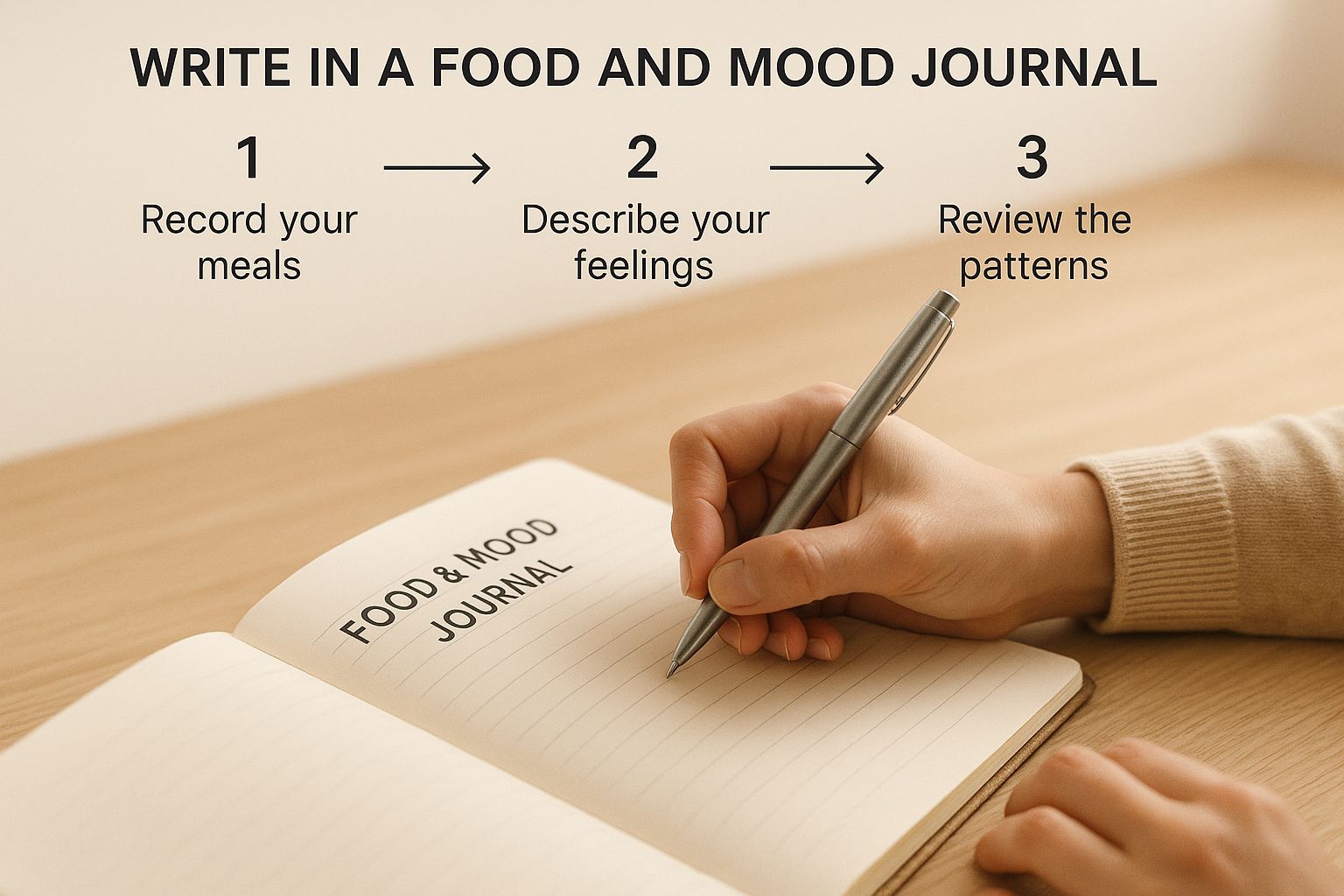
This simple practice turns your daily routine into a source of powerful insight. It’s all about connecting the dots between how you feel and what you eat.
How to Start Your Journal
For the next week, every time you eat—especially when you suspect it’s for comfort—take a moment to jot down a few key details. Be honest and approach it with curiosity.
- What did you eat? (e.g., a handful of potato chips, two chocolate cookies)
- What time was it? (e.g., 3:15 PM)
- What was happening right before? (e.g., “Just got off a stressful Zoom call with my boss.”)
- What were you feeling? Get specific here. Instead of just “bad,” try to name the emotion: “anxious,” “bored,” “lonely,” or “procrastinating on a tough project.”
- Rate your physical hunger on a scale of 1-10 (1 = starving, 10 = painfully full).
This exercise isn’t about counting calories. Think of it as collecting data on your emotional landscape. After just a few days, you’ll start to see patterns emerge from the noise. For a deeper dive into managing these urges once you spot them, our guide on how to control food cravings can really help.
Finding Your Patterns
At the end of the week, sit down and look over your notes. Do you notice any connections? Maybe you’ll find that every time you feel overwhelmed by your to-do list, you reach for something crunchy. Or perhaps feelings of loneliness on a Friday night consistently lead to ordering a pizza.
The goal here is to identify your unique emotional-eating signature. Realizing that “work stress consistently leads to mid-afternoon sugar cravings” is a massive breakthrough. It transforms a vague, powerful urge into a specific, predictable problem you can finally start to solve.
Once you’ve named your triggers, they lose a lot of their power over you. You’re no longer being ambushed by them; you can actually see them coming. This awareness is the crucial first step that makes every other strategy possible. After all, you can’t choose a different path until you know you’re standing at a crossroads.
Building Your Emotional First-Aid Kit
Okay, so you’re getting better at spotting your triggers. That’s a huge step. But what happens next, in that crucial moment when the urge to eat strikes? Relying on sheer willpower when you’re emotionally overwhelmed is a recipe for failure. It’s like trying to hold back a flood with a paper towel.
Instead, we need a plan. The secret is to have a personalized toolkit of non-food coping strategies ready to deploy at a moment’s notice. Think of it as your emotional first-aid kit. This isn’t about finding a single magic bullet; it’s about building a menu of options so the healthier choice becomes the easier choice. The goal is simple: learn to nurture yourself without food.
Strategies for Stress and Anxiety
When you’re stressed, your body is buzzing with “fight or flight” energy. A quick hit of sugar or fat feels like an easy way to calm that storm, but it’s a temporary fix that often leads to a crash. What we really need are activities that genuinely soothe your nervous system.
Let’s say you just finished a tense meeting and you’re already picturing that bag of chips. Pause. Instead of heading to the kitchen, try one of these:
- Box Breathing: It sounds simple, but it works. Inhale for four seconds, hold for four, exhale for four, and hold for four. A few rounds can dramatically lower your heart rate and quiet that frantic mental chatter.
- A Quick Change of Scenery: Just step outside for five minutes. Seriously. A little fresh air and a different view can be enough to break the spell of a stress-induced craving.
- Engage Your Senses: Put on a song that always calms you down. Dab some lavender oil on your wrists and inhale. Run your hands under warm water. These simple sensory acts pull you back into your body and away from the emotional whirlwind.
These small actions create a vital pause, giving your brain a chance to realize the craving is about stress, not actual hunger.
Countering Boredom and Procrastination
Boredom is a sneaky but powerful trigger. Your brain craves stimulation, and snacking is an effortless way to get it, especially when you’re putting off a task you dread.
Instead of letting boredom autopilot you to the pantry, you need a pre-approved list of small, engaging activities.
The most effective way to beat boredom-eating is to replace the passive act of snacking with an active, engaging alternative. It doesn’t have to be a monumental task; it just has to capture your attention for a few minutes.
Here are a few ideas to get you started:
- Tackle a “Micro-Project”: Don’t clean the whole house. Just organize one messy drawer, water your plants, or spend five minutes deleting old emails. That little hit of accomplishment is a much better reward.
- Reignite a Hobby: Pick up that half-read book. Doodle in a sketchbook for ten minutes. Practice a few chords on the guitar.
- Plug in a Podcast: Find a short, fascinating podcast that can fill the void boredom creates.
Having these alternatives planned gives you a productive outlet that feels far more satisfying than mindless munching.
Soothing Sadness and Loneliness
When you’re feeling sad or lonely, reaching for food can feel like a warm hug. It’s a stand-in for the connection and comfort we’re truly craving. To break this cycle, we have to find sources of genuine connection and self-compassion.
Honestly, a five-minute phone call with a good friend can provide more lasting comfort than a pint of ice cream ever could. If talking feels like too much, journaling is an incredible tool. The simple act of writing your feelings down gets them out of your head, which often makes them feel much less overwhelming.
The whole point is to stock your first-aid kit with things you genuinely enjoy and find calming. This isn’t about punishment or restriction. It’s about proactively putting yourself in the driver’s seat, armed with better, more effective ways to manage your emotions.
Reshaping Your Habits and Your Environment
Real, lasting change isn’t just about gritting your teeth and relying on willpower. It’s about being smarter than your old habits. To truly break the cycle of comfort eating, you need to re-engineer your daily life by tackling both your internal routines and your external surroundings.
This means we need to get serious about two things: mindful eating and creating a supportive environment.
Why is this so critical? Because our modern world often sets us up to fail. We’re surrounded by high-energy, heavily processed foods packed with sugar and fat, making it incredibly easy to eat emotionally. This isn’t just a personal struggle; it’s a global trend. The rise in overweight and obesity worldwide is closely linked to this shift in eating patterns. If you’re curious, you can explore more about these global food trends and see the bigger picture we’re all a part of.

Practice Mindful Eating
Let’s talk about mindful eating. At its core, it’s simply paying full attention when you eat. It’s the polar opposite of zoning out with a bag of chips in front of the TV, only to realize you’ve eaten the whole thing without tasting a single bite.
Instead of rushing through meals, you intentionally slow down. You actually taste your food—the flavors, the textures, the aromas. This simple shift helps you hear your body’s natural hunger and fullness cues again, signals that get completely drowned out when emotions are driving your eating.
Here are a few practical ways to get started:
- Try the First Bite Rule. With the very first bite of your meal, close your eyes. Just for a moment, focus completely on the taste and feel of the food. It’s a small act that can change the tone of the entire meal.
- Create a No-Distraction Zone. Put your phone away. Turn off the TV. When you eat, just eat. This is how you give your body a chance to tell you, “Hey, I’m good now,” before you’ve overdone it.
- Take a 20-Minute Pause. Did you know it takes about 20 minutes for your stomach to signal to your brain that it’s full? Try pausing halfway through your meal. Put your fork down for a few minutes and check in with yourself. You might be surprised to discover you’re already satisfied.
Mindful eating isn’t another diet rule. It’s about building awareness. It’s what allows you to appreciate your food and respect your body, turning a conflicted relationship with eating into one of genuine nourishment.
Design Your Environment for Success
Your surroundings have a huge say in your actions, whether you realize it or not. If a cookie jar lives on your kitchen counter, you’re signing up for a daily willpower battle you don’t need to fight. The secret is to make the healthy choice the easy choice.
Think of it as creating a “path of least resistance” that leads directly to your goals. For example, if you know stress sends you straight to the ice cream, the smartest move is not to keep it in the freezer. That’s not weakness—it’s strategy.
Here’s how you can rig the game in your favor:
- Out of Sight, Out of Mind. Move your personal trigger foods to a place that’s inconvenient, like the top shelf of the pantry. Even better? Just stop buying them for a while.
- Make Healthy Visible and Appealing. Keep a big, beautiful bowl of fresh fruit on the counter. Have chopped veggies and hummus front and center in the fridge. Make the good stuff the first thing you see.
- Pre-Portion Your Snacks. Instead of eating straight from a family-sized bag of pretzels, divide them into small, single-serving portions. When a craving hits, you can grab one and be done without accidentally sliding into mindless munching.
When you pair mindful practices with a smartly designed environment, you’re building a powerful, two-layered defense against comfort eating. You stop just fighting urges and start changing the game itself.
Handling Setbacks with Self-Compassion
Let’s get one thing straight: learning to manage comfort eating isn’t a linear process. You’re going to have days where you slip back into old habits, especially when life throws you a curveball. That’s not failure. It’s just part of being human, and honestly, it’s where the real learning happens.
The most powerful thing you can do is switch from guilt to curiosity. Instead of beating yourself up after eating something you didn’t intend to, just pause. Get curious. Think of yourself as a detective and the setback as a clue. What was really going on in that moment? What emotion was I trying to soothe? This kind of gentle inquiry gives you priceless information for the next time you’re in that situation.
Embrace Progress Over Perfection
This journey is all about stringing together small, intentional choices—not about achieving a perfect record. The aim isn’t flawlessness; it’s resilience. One detour doesn’t wipe out all the miles you’ve already traveled.
Start celebrating the small wins. Seriously. Did you choose to take a walk after a stressful meeting instead of heading to the pantry? That’s a huge victory. Did you pause to drink a glass of water to see if you were actually hungry? Win. These small acts build momentum and prove to yourself that you can do this.
Self-compassion is your superpower here. When you treat yourself with kindness after a setback, you can bounce back quickly. Guilt, on the other hand, just throws more fuel on the fire, often triggering the very cycle you’re trying to escape.
This compassionate mindset is more important than ever. Behaviors like comfort eating are widespread, and it’s helpful to see the bigger picture. The global prevalence of eating disorders more than doubled from 3.5% to 7.8% between 2000 and 2018. In fact, about 9% of Americans will experience one in their lifetime. This really highlights how much our modern environment, with its constant stress and easy access to food, affects us. If you want to dive deeper into this, the National Eating Disorders Association has comprehensive statistics on eating disorders.
Learn from Every Detour
Think of a setback as an opportunity to fine-tune your approach. It’s a chance to look at the evidence and figure out what happened so you can be better prepared for the future. It’s not about blame; it’s about strategy.
Here’s a simple way to analyze a setback with kindness:
- Acknowledge what happened, judgment-free: “Okay, I ate a sleeve of cookies after that difficult phone call.”
- Pinpoint the trigger: “I was feeling completely overwhelmed and anxious.”
- Review your coping toolkit: “What could I have done instead? A 5-minute breathing exercise or calling a friend might have helped.”
- Create a new game plan: “Next time I feel that specific type of anxiety creeping in, my first move will be to step outside for some fresh air.”
This isn’t about punishing yourself. It’s about learning, adapting, and getting smarter. Every time you go through this process, you weaken the automatic link between your emotions and food. You’re not just vaguely hoping to do better—you’re actively building a plan to make it a reality. That’s how you create real, lasting change.
Common Questions About Emotional Eating
As you start to untangle your relationship with food, you’re bound to run into questions and a few tricky situations. Everyone’s journey is different, and having solid, practical answers for those common roadblocks can be a real game-changer. Think of this as your go-to guide for when you need a little clarity.
Knowing how to stop comfort eating often boils down to having a plan for these specific moments.
How Do I Handle Intense Late-Night Cravings?
Let’s be honest, late-night eating is rarely about true, rumbling hunger. More often than not, it’s a habit baked into our routine—a way to unwind, zone out after a stressful day, or simply combat boredom. It’s less about needing fuel and more about seeking a reward or a moment of calm. The trick is to consciously build a new evening ritual that isn’t centered around the pantry.
This isn’t about white-knuckling it or depriving yourself; it’s about creating a wind-down routine that actually feels better.
- Create a new “end-of-day” signal. Swap mindless scrolling or TV for something that tells your body and mind it’s time to relax. This could be anything from reading a great book, soaking in a warm bath with Epsom salts, or putting on a calming podcast or playlist.
- Check for actual hunger first. Before you do anything else, pause and ask yourself if you ate enough throughout the day. Sometimes, what feels like a craving is just your body telling you it didn’t get what it needed earlier. If you are genuinely hungry, a small, protein-rich snack like some Greek yogurt can do the trick.
- Introduce a “buffer” activity. Find something that keeps your hands and mind busy for just 15-20 minutes. I’ve found that simple things like journaling about the day, doing some light stretching, or even working on a crossword puzzle can be just enough of a distraction for an intense craving to fade.
What If I Slip Up and Have a Bad Day?
First thing’s first: a setback is not a failure. It’s just proof that you’re human. The most critical part of handling a slip-up is sidestepping the guilt spiral, which almost always leads to more emotional eating. One “off” day doesn’t magically undo all of your hard work.
Your response to a setback is more important than the setback itself. It’s an opportunity to practice self-compassion, learn from the experience, and prove your own resilience.
Instead of beating yourself up, try getting curious. Acknowledge what happened without any judgment. Ask yourself, “What was the trigger for that?” or “What’s one thing I could try differently next time I’m in that situation?” Then, the most important step: simply get back on track with your very next meal. Consistency over the long haul is what builds new habits, not perfection on any single day.
Is It Okay to Still Have My Comfort Foods?
Yes, absolutely. The goal here isn’t to create a long list of forbidden foods and ban them forever. That strategy almost always backfires, making you want those foods even more. The real work is in breaking the automatic, unconscious connection between a feeling and the act of eating.
Learning to enjoy your favorite foods mindfully and intentionally is what a healthy, balanced life looks like. You want to get to a point where you can have a slice of cake at a birthday party and truly savor every single bite, rather than frantically eating it to quiet your anxiety. It’s all about eating it because you choose to, not because an emotion is driving the bus. That’s what puts you back in control and allows food to be a source of genuine pleasure, not just a crutch.