 CravingMind AI
The secret to finally getting a handle on sugar cravings isn’t about willpower or endless deprivation. It’s about being smarter than the craving itself. My go-to strategy, both for myself and my clients, is to stabilize your energy levels by balancing every meal with protein, fiber, and healthy fats.
This simple shift changes the entire game. You move from constantly reacting to intense sugar urges to proactively fueling your body in a way that prevents them from even showing up.
Why You Crave Sugar and How to Regain Control
Before you can beat the cravings, you have to understand where they come from. It’s rarely a lack of discipline; it’s usually pure biology.
When you eat something sugary or a meal heavy in simple carbs, your blood sugar shoots up. Your body releases insulin to manage it, but often overcorrects, causing a dramatic crash. That crash sends a panic signal to your brain: “I need energy, and I need it now!” The quickest, easiest source of energy your brain knows? More sugar. And so the vicious cycle begins.
Of course, it’s not just physical. Many of us have spent years creating a mental connection between sugar and comfort. A stressful day, a boring afternoon, or a celebration can all act as powerful emotional triggers. In fact, for a lot of people who struggle with emotional eating, sugar is the main event. If that hits close to home, learning how to stop stress eating is a crucial piece of the puzzle.
The Problem with Quick-Fix Detoxes
In a moment of frustration, it’s tempting to declare war on sugar. You might try a “sugar detox” or vow to cut out all sweets cold turkey. While your heart is in the right place, these extreme, all-or-nothing tactics almost always backfire.
Drastic restriction often makes cravings even more intense. Sooner or later, you hit a breaking point, and the rebound binge leaves you feeling guilty and defeated. A much more sustainable approach is to build a dietary foundation that stops cravings before they start. Instead of being on the defensive, you can give your body the steady, reliable energy it’s actually asking for.
This is where protein becomes your superpower.
One of the most effective strategies to overcome sugar cravings is to focus on your protein intake. I’ve seen it time and again: when people prioritize protein, their relationship with sugar changes. In fact, research shows that diets with higher protein content can lead to a significant reduction in cravings, in some cases by as much as 50%.
The Protein Power Play
Protein is an absolute game-changer for managing blood sugar and satiety. Because it digests slowly, it keeps you feeling full and satisfied for much longer. When you pair protein with carbohydrates, it blunts the blood sugar spike, preventing that sharp crash that sends you running for the cookie jar. It works by influencing your satiety hormones, sending a clear message to your brain that you’re fueled and don’t need a quick hit of sugar.
This small change can make a massive difference in your desire for snacks between meals.
The best part? This isn’t about restriction. It’s about addition. Instead of thinking, “I can’t have that cupcake,” start thinking, “What protein can I add to this meal?”
- Add grilled chicken or chickpeas to your salad.
- Toss a scoop of protein powder into your morning smoothie.
- Pair your afternoon apple with a handful of almonds or a cheese stick.
By focusing on adding these powerful, craving-crushing foods, you naturally make less room for the junk. You’re not depriving yourself; you’re empowering yourself with better choices.
Pinpoint Your Personal Craving Triggers
Sugar cravings don’t just materialize out of thin air. More often than not, they’re a direct response to a specific cue in your environment or your emotional state. To get a real handle on them, you have to play detective and figure out what’s setting you off. For most people, these urges aren’t about physical hunger at all—they’re tangled up in a web of emotions, daily routines, and even the people around us.
Once you understand your personal triggers, you can shift from constantly fighting off cravings to proactively managing them. Think of it this way: if you know a certain road is a parking lot at 5 PM, you learn to take a different route. The same principle applies here. When you know what pushes your sugar button, you can build new, healthier “routes” to get through those moments.
Uncover Your Craving Patterns
The first thing to do is simply observe, no judgment allowed. For about a week, keep a simple “craving journal.” This isn’t about meticulously counting calories; it’s about connecting the dots. When a craving hits, just jot down a few key details in a notebook or a notes app on your phone.
A typical entry might look something like this:
- Time: 3:15 PM
- Craving: That chocolate bar from the office vending machine.
- What I Was Doing: Just got out of our stressful weekly team meeting.
- How I Was Feeling: Drained, a little anxious, and honestly, bored.
After just a few days of this, you’ll start to see patterns emerge. Maybe you notice you always reach for the cookie jar after a tense phone call, or that the urge for ice cream spikes while you’re unwinding with TV at night. Those moments? Those are your triggers.
This simple visual shows a powerful way to respond when a craving hits—the healthy swap.
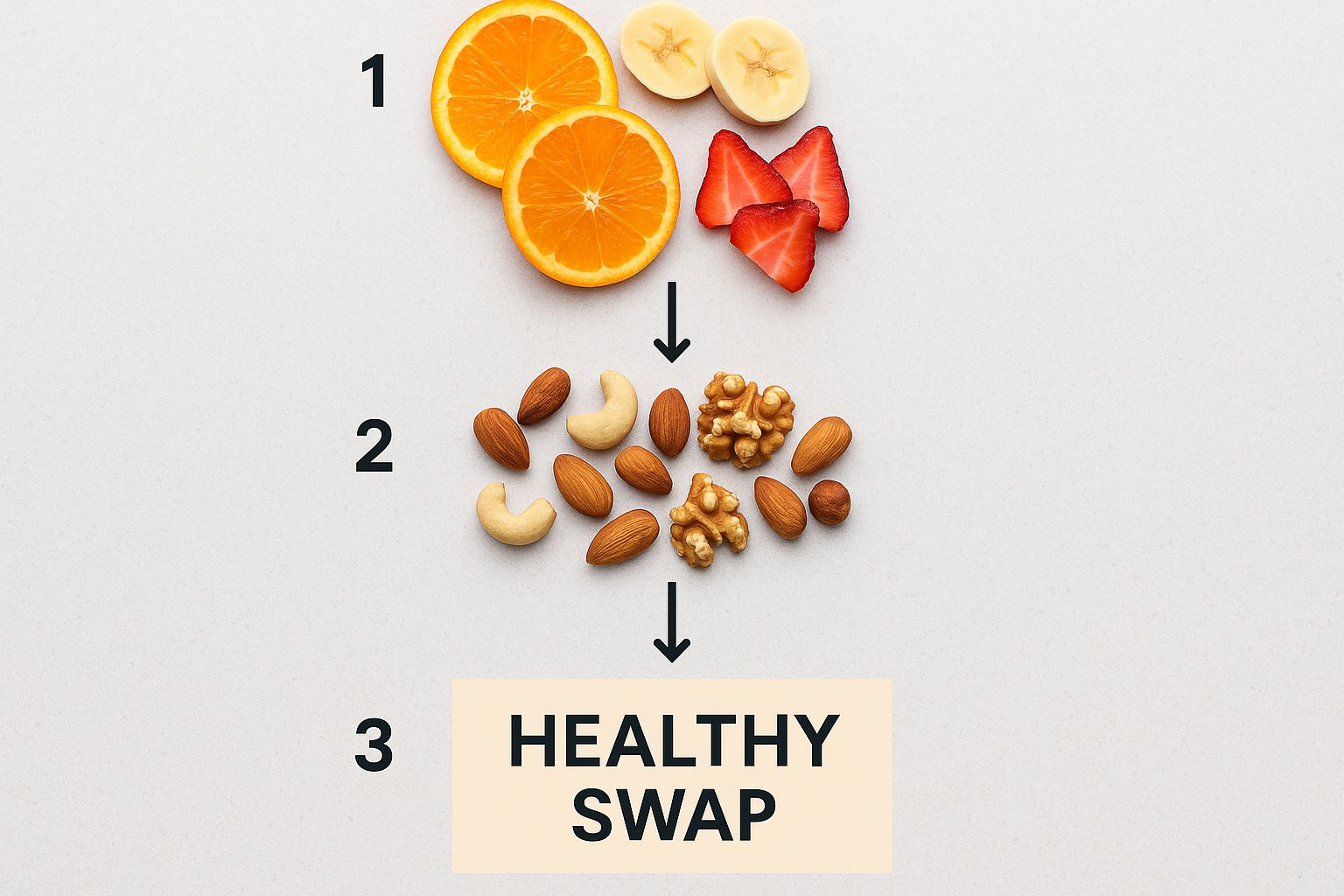
Having a mental picture of satisfying alternatives, like fresh fruit or a handful of nuts, is a great way to remind yourself you have other delicious options when a trigger strikes.
Common Triggers and How to Respond
Once your journal starts revealing your patterns, you can build a targeted plan. Your notes show you the “why” behind the craving, letting you tackle the root cause instead of just wrestling with the symptom.
Tracking your habits transforms cravings from mysterious, overwhelming urges into predictable events. Once you see the clear link, an emotional trigger like stress or a situational one like your afternoon slump can be met with a new, non-food response.
Here are a few common culprits and some fresh ways to handle them:
- Stress or Anxiety: Instead of reaching for sugar, what if you took a 5-minute walk outside? Or tried a few deep breathing exercises? Sometimes, just putting on a calming song is enough to shift your state.
- Boredom: If you know you eat when you’re under-stimulated, have a go-to list of engaging, 10-minute activities. This could be anything from working on a puzzle, reading a chapter of a book, or even just tidying up your desk.
- The 3 PM Slump: This is classic. It’s often a sign your blood sugar is taking a nosedive. Instead of waiting for the crash and grabbing a candy bar, try to get ahead of it. A protein-rich snack like Greek yogurt or a small handful of almonds around 2:30 PM can prevent the slump entirely.
By learning to recognize these moments for what they are, you give yourself the power to make a conscious choice. You’re no longer just reacting on autopilot—you’re breaking the habit loop that keeps you stuck.
Fuel Your Body to Fight Cravings Naturally
Let’s be honest: one of the best ways to beat a sugar craving is to stop it from showing up in the first place. This isn’t about having superhuman willpower. It’s about smart nutrition. When you fuel your body correctly, you sidestep those wild blood sugar swings that send you desperately seeking something sweet.
The whole game is about avoiding the dramatic energy crashes that make a sugary fix feel non-negotiable. This means shifting away from simple carbs that burn out quickly and embracing meals that provide a slow, steady stream of energy. The secret weapon here is a nutritional dream team: protein, fiber, and healthy fats.
The Power Trio: Protein, Fiber, and Healthy Fats
Think of this trio as your personal craving-control crew. When a meal contains a healthy balance of all three, your digestion slows way down. Instead of a firehose of sugar hitting your bloodstream all at once, you get a gentle, sustained release of energy that lasts for hours.
This simple shift prevents that infamous post-meal slump and stops your brain from sending out an SOS for sugar. A bowl of plain pasta, for example, is practically a guarantee for a 3 p.m. energy dive. But add some grilled chicken (protein), toss in some broccoli (fiber), and finish with a little olive oil (healthy fat), and you’ve created a powerhouse plate that keeps you full and focused. It’s this kind of proactive thinking that’s at the heart of learning how to control food cravings for good.
The most powerful mindset shift you can make is moving from deprivation to addition. Instead of fixating on what you can’t have, ask yourself, “What can I add to this meal to make it more balanced and satisfying?” This one question turns restriction into nourishment.
Smart Swaps to Stabilize Your Energy
Putting this into practice is all about making small, deliberate upgrades to what you’re already eating. By consciously adding protein, fiber, or healthy fats to your meals and snacks, you naturally make less room for the junky stuff.
Here are a few real-world swaps you can try today:
- Ditch the Sugary Cereal: A bowl of oatmeal is a fantastic start. To make it even better, top it with berries for fiber and a scoop of walnuts or chia seeds for healthy fats and a bit of protein.
- Swap the Candy Bar: An apple and a handful of almonds will do the trick. The apple gives you that satisfying crunch and natural sweetness, while the almonds deliver the protein and fat to keep you full.
- Upgrade Your Yogurt: Instead of a flavored yogurt loaded with sugar, go for plain Greek yogurt. It’s packed with protein. Then, stir in your own fresh fruit and a spoonful of flaxseeds for a complete snack that crushes cravings.
Why Meal Timing Matters
When you eat is just as crucial as what you eat. Allowing yourself to get ravenously hungry is like rolling out the red carpet for an intense sugar craving. Once your energy tanks, your brain goes into survival mode, screaming for the quickest fuel source it knows: sugar.
Eating balanced meals at regular intervals is your best defense against this. For a lot of people I’ve worked with, this looks like having smaller, more frequent meals instead of three huge ones. If you know that midafternoon slump is your weak spot, plan ahead. A well-timed, protein-rich snack can be the single thing that saves you from a losing battle with the office vending machine. That consistency teaches your body to trust that a steady supply of fuel is coming, so it doesn’t have to panic.
Get Comfortable with Your Cravings Through Mindfulness
So much of our sugar habit is pure muscle memory. The urge pops up, and almost without thinking, we’re reaching for that donut or soda. The key to breaking this cycle isn’t about willpower alone; it’s about disrupting that automatic reaction. This is where mindfulness comes in—it’s your secret weapon for creating a little breathing room between the craving and your response.
One of the most effective mindfulness tools I’ve seen work for clients is something called urge surfing. Forget trying to fight or ignore a craving. That almost never works and usually just makes the urge scream louder. Instead, you simply acknowledge it and watch it.
Think of a craving like an ocean wave. It starts small, builds up to a peak, and then, if you just wait, it naturally fades away. Your goal isn’t to build a wall to stop the wave but to learn how to ride it out until it passes.
Your 5-Minute Craving Meditation
The next time a powerful sugar craving hits, don’t panic. Just try this. You can do it anywhere.
- Stop and Acknowledge: The second you feel it, just pause. Mentally say to yourself, “Ah, there’s a sugar craving.” Don’t judge it or get angry. Just notice it’s there.
- Tune Into Your Body: Close your eyes for a moment. Where is this craving living in your body? Is it a hollow feeling in your stomach? A specific taste in your mouth? A tension in your jaw? Get specific.
- Breathe with It: Take three slow, deep breaths. As you breathe, imagine the air traveling to that exact spot where you feel the craving. You’re not trying to push the feeling out; you’re just sitting with it and being present.
- Observe the Shift: Keep watching that sensation for a couple of minutes. You’ll notice it’s not static. It might pulse, get stronger for a second, then weaker, or even move. Just like a wave, it can’t stay at its peak forever.
Doing this repeatedly teaches you on a deep level that cravings are just temporary signals from your body. They aren’t orders you have to follow. You’re building that crucial muscle of self-control.
The moment you learn to observe a craving instead of just reacting to it, you take back control. You realize an urge is just a feeling, not a command. That small shift in perspective is what makes real, lasting change possible.
Put a 15-Minute Delay on It
Another simple but incredibly powerful trick is the strategic pause. It’s a deal you make with yourself: when a craving strikes, you agree to wait just 15 minutes before you even consider giving in.
That small window of time is often all it takes for the intense, immediate demand of the craving to lose its power. It gives the logical, long-term-thinking part of your brain a chance to catch up to the impulsive part.
But don’t just sit and stare at the clock, white-knuckling it. You have to change your environment and your focus.
- Get up and drink a big glass of cold water.
- Step outside for a quick walk around the block. Even walking to a different room helps.
- Fire off a quick text to a friend, or tackle a small, 2-minute chore like loading the dishwasher.
This short break snaps the hypnotic spell of the craving. I’ve seen it time and time again—by the time the 15 minutes are up, the urge has either completely disappeared or is so weak it’s easy to ignore. You’ve just successfully surfed the wave.
Build an Environment That Fights Cravings for You
Winning the war against sugar cravings isn’t about constant, white-knuckled willpower. In my experience, that’s a losing strategy. The real secret is to stop fighting so many battles in the first place by changing the environment around you.
Your daily habits, your stress levels, and even what’s in your pantry create the “battlefield.” By shifting these foundational pieces, you make healthy choices the easy, default option. You’re not just resisting cravings; you’re building a lifestyle where they barely show up.
Get Serious About Your Sleep
Have you ever had a terrible night’s sleep and woken up with an intense, almost primal urge for donuts or a sugary latte? That’s not a coincidence; it’s your hormones screaming at you.
When you’re sleep-deprived, your body’s hunger signals go haywire. The hormone that makes you feel hungry, ghrelin, spikes. At the same time, leptin, the hormone that tells you you’re full, takes a nosedive. This hormonal cocktail is a recipe for disaster, creating powerful cravings for quick-energy hits, which almost always means sugar. Just one bad night can do it.
To get this under control, you need to prioritize solid sleep hygiene.
- Stick to a Schedule: Try to go to bed and wake up at roughly the same time every day. Yes, even on weekends. This single habit is a game-changer for regulating your body’s internal clock.
- Optimize Your Bedroom: Think cave-like: dark, quiet, and cool. Blackout curtains are worth their weight in gold, and a white noise machine can work wonders if you have noisy neighbors or a snoring partner.
- Power Down an Hour Before Bed: The blue light from your phone, tablet, or TV messes with your brain’s ability to produce melatonin, the sleep hormone. Give yourself a one-hour screen-free buffer. Read a book, listen to a podcast, or just unwind.
Find Better Ways to Handle Stress
Stress is one of the biggest triggers for sugar cravings I see. When you’re frazzled, your body pumps out the stress hormone cortisol, which practically begs your brain for a quick reward. And what’s the easiest, fastest reward our brain knows? Sugar.
If you’ve gotten into the habit of reaching for a cookie every time you feel overwhelmed, you’ve built a powerful feedback loop. The key is to consciously replace that habit with a healthier one.
Instead of eating your stress, find something else that actually soothes it:
- Move a Little: You don’t need a full-blown gym session. A 10-minute walk outside can slash cortisol levels and clear your head.
- Find a Healthy Distraction: What do you love to do? Lose yourself in a good book, put on your favorite playlist, or get your hands dirty in the garden.
- Breathe: It sounds too simple, but it works. When you feel that tension rising, stop and take five slow, deep breaths. This can instantly calm your nervous system and give you the pause you need to make a better choice.
The goal is to build a toolbox of stress-relieving strategies. When you have go-to alternatives, you’re less likely to automatically reach for sugar when life gets tough.
Set Up Your Kitchen for Success
This is the most practical step of all: control what you can control. If your cupboards are overflowing with chips, cookies, and candy, you are setting yourself up to fail. Your willpower is a finite resource, and it’s at its absolute lowest at 9 PM after a long, exhausting day.
Make your healthy choice the path of least resistance. It starts with a simple rule: if it’s not in your house, you can’t eat it. Don’t buy your trigger foods in the first place.
Then, stock your kitchen with things that are both healthy and genuinely appealing. Think pre-cut veggies with hummus, bowls of fresh berries, plain Greek yogurt you can sweeten yourself, or a handful of almonds. When a craving inevitably strikes, having a satisfying and easy alternative right there makes all the difference.
Got Questions About Sugar Cravings? We’ve Got Answers.
When you first decide to cut back on sugar, it’s natural for a million questions to bubble up. Knowing what you’re up against and how to navigate the inevitable bumps in the road can make all the difference. Think of this as your roadmap—it’s about having a plan and being kind to yourself along the way.
Let’s dive into some of the most common questions people ask when they start this journey. Getting these answers straight can help you feel more in control and keep you moving forward.
How Long Until the Cravings Actually Go Away?
This is the million-dollar question, isn’t it? The truth is, it’s a bit of a mixed bag. The most intense, almost primal cravings? Those usually calm down within the first week or so after you make a serious cut to your sugar intake. Your body is adjusting, and that initial period can feel like an uphill battle.
But breaking the psychological habit is a longer game. Your taste buds need time to adjust, and old habits die hard. You might notice that even after the physical urges fade, certain situations—a stressful day at work, a late-night movie—still trigger a desire for something sweet.
Progress is rarely a straight line. You’ll have amazing weeks where you feel unstoppable, followed by days that are a real struggle. That’s not just okay; it’s expected. The goal here is a long-term lifestyle shift, not a quick, temporary fix.
A “slip-up” isn’t a failure. It’s just feedback. It shines a light on your personal triggers, giving you valuable intel to fine-tune your approach for next time. Self-compassion will get you a lot further than trying to be perfect.
So, Is Fruit Off the Table?
Not at all! In fact, whole fruit can be a game-changer. The key is knowing the difference between the natural sugars in fruit and the added sugars hiding in processed foods, candy, and sodas. They are not the same thing.
Think about it: when you eat a handful of berries or a crisp apple, you’re getting so much more than just sugar. You’re also getting:
- Fiber: This is crucial. Fiber slows everything down, preventing the crazy blood sugar spikes and crashes you get from a candy bar.
- Vitamins and Minerals: Fruit is literally packed with nutrients your body needs to thrive.
- Water: Most fruits have a high water content, which helps you stay hydrated and feel satisfyingly full.
This powerful trio makes whole fruit the perfect tool for satisfying a sweet tooth while giving your body something genuinely good. You get the sweetness you’re craving without sabotaging your efforts.
What Happens If I Have a Major Slip-Up?
First things first: take a deep breath and ditch the guilt. One off-plan day doesn’t undo all your hard work and progress. The real danger is falling into the “all-or-nothing” mindset, thinking, “Well, I’ve already blown it, might as well go all out.”
Don’t do that. Your only task after a slip-up is to get right back to your plan with your very next meal. Don’t try to “compensate” by skipping meals—that will just set you up for another blood sugar rollercoaster and even more cravings.
Just get back to it. Build a balanced meal with protein, healthy fats, and fiber. Drink a big glass of water, and remind yourself why you started. This is a journey of consistency over time, not a test of perfection.