 CravingMind AI
Let’s be honest, overeating rarely has anything to do with a lack of willpower. It’s a deeply human experience, driven by a complex mix of powerful psychological reasons. These mental and emotional cues can easily drown out your body’s natural hunger signals, pushing you to eat for reasons that have nothing to do with an empty stomach. Getting a handle on these drivers is the first real step toward changing your relationship with food.
Understanding Why We Eat Beyond Hunger
Ever find yourself staring into the pantry when you’re stressed, bored, or lonely, even though you just ate an hour ago? That’s the mind-body connection in action. The real reasons we overeat often stem from our attempts to manage emotions, our deep-seated habits, and the stories we tell ourselves.
Think of your body’s hunger and fullness cues as a finely-tuned internal compass, always pointing you toward balance. But psychological factors—like a sudden wave of anxiety or a pang of sadness—can act like a powerful magnet, throwing that compass completely off course. In those moments, we’re not eating for fuel; we’re eating to cope.
This is a great visual breakdown of the primary psychological forces at play.
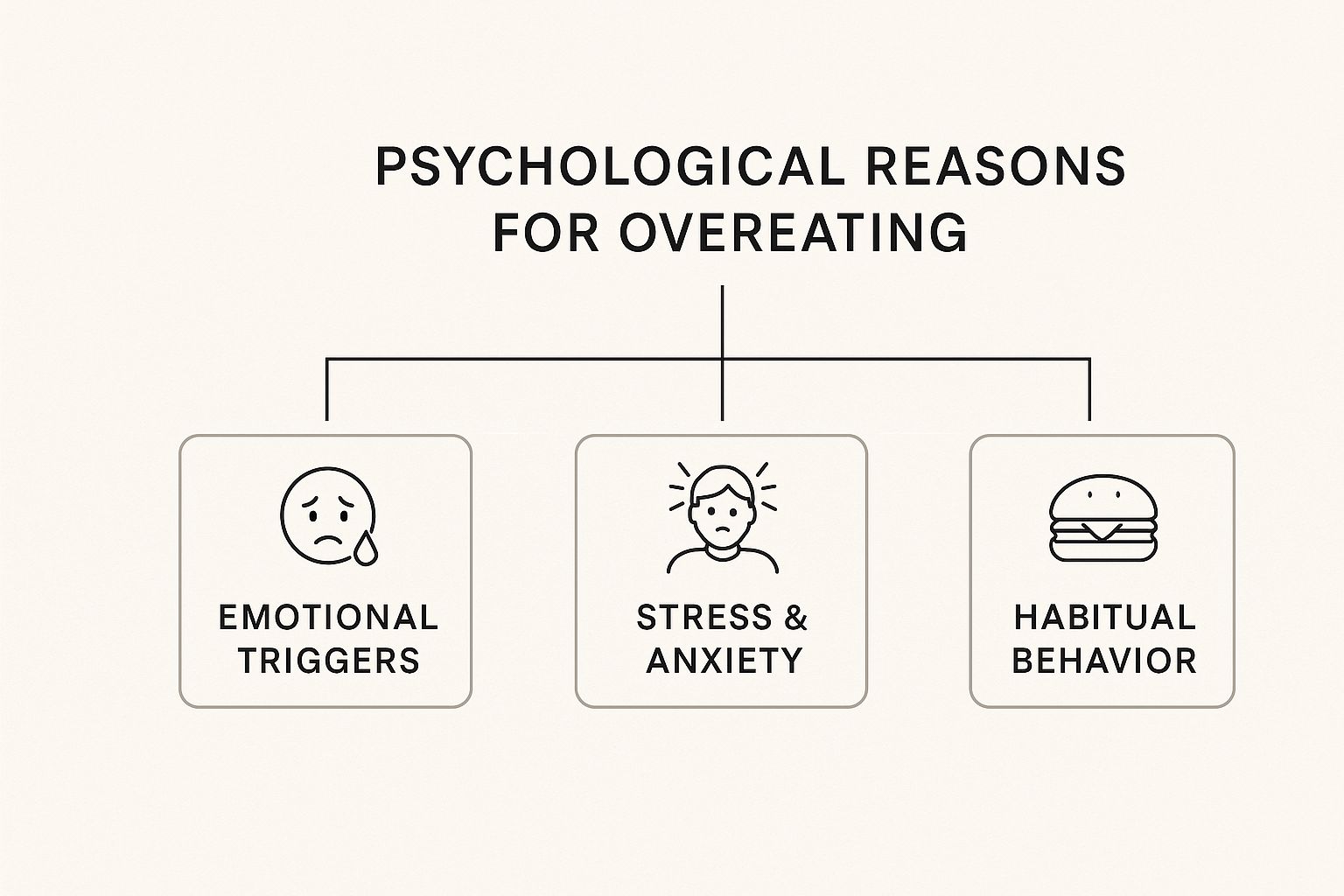
As you can see, these triggers don’t exist in a vacuum. They often feed into each other, creating a cycle that can feel impossible to escape without a new level of awareness.
The Role of Emotional and Cognitive Triggers
Emotional eating is the one we all know. There’s a scientific reason we crave certain foods when we’re down: high-sugar, high-fat foods light up the pleasure centers in our brains, giving us a temporary—but immediate—sense of relief. This creates a potent feedback loop. Feel bad, eat, feel better for a minute. Your brain quickly learns this “solution” and starts prompting you to repeat it. That’s why it’s so helpful to learn more about the difference between emotional hunger vs physical hunger and how to spot them.
But it’s not just about feelings. Our own thoughts can be our worst enemy. The “all-or-nothing” mindset is a perfect example. You have one cookie, and your brain declares, “Well, the day is ruined. Might as well eat the whole sleeve.” This kind of black-and-white thinking completely bypasses the idea of moderation and can turn a small slip into a major binge.
Overeating is often a symptom, not the problem itself. It’s a signal that an underlying emotional or psychological need is not being met. Recognizing this is the first step toward building a healthier relationship with food.
Finally, we have the quiet but powerful force of habit. If you’ve spent years eating popcorn during a movie or grabbing a pastry with your morning coffee, those actions are practically on autopilot. Your brain has created a strong association between the activity and the food, triggering a craving whether you’re hungry or not. These learned behaviors are wired in, making them a real challenge to consciously change.
To help clarify these concepts, here’s a quick-reference table that breaks down the most common psychological triggers.
Quick Guide to Psychological Overeating Triggers
| Psychological Driver | Primary Trigger | Common Manifestation |
|---|---|---|
| Emotional Eating | Uncomfortable feelings (stress, sadness, boredom) | Reaching for comfort foods to numb or distract from emotions. |
| Cognitive Distortion | “All-or-nothing” or perfectionist thinking | A small dietary slip-up leads to a full-blown binge. |
| Habitual Behavior | Environmental or situational cues | Automatically eating while watching TV or during a work break. |
Understanding which of these drivers affects you most can be incredibly empowering. It shifts the focus from “what’s wrong with me?” to “what’s really going on here?”—and that’s where true change begins.
The Powerful Link Between Emotions and Food

More often than not, the urge to eat has absolutely nothing to do with an empty stomach. It’s really about a full heart, a stressed-out mind, or some other feeling we’re trying to manage. This is the heart of emotional eating, one of the biggest psychological drivers behind why we overeat. We start looking to food not just for energy, but for comfort, distraction, or even as a way to celebrate.
Think of food as a quick-fix emotional anesthetic. When you’re overwhelmed with sadness, anxiety, or just plain boredom, that pint of ice cream can feel like a good friend, offering immediate relief—even if it doesn’t last. This isn’t an uncommon quirk; it’s a deeply human behavior. In fact, research shows that emotional eating is a factor for about 44.9% of people trying to manage their weight. That statistic alone highlights just how common this coping mechanism really is. You can explore the full research on emotional eating to see the bigger picture.
This connection isn’t just a bad habit. It’s actually hardwired into our brain chemistry.
The Brain Chemistry of Comfort Food
When you eat something packed with sugar, fat, or salt, your brain gets a nice little hit of dopamine. That’s the neurotransmitter tied to pleasure and reward. This chemical rush brings on a wave of satisfaction and calm, which works wonders for temporarily numbing whatever difficult emotion you were feeling. And our brains are smart; they learn this cause-and-effect relationship almost instantly.
The cycle usually unfolds like this:
- An uncomfortable feeling pops up: Stress from work, loneliness on a quiet evening, or frustration after an argument.
- You grab your go-to comfort food: A bag of chips, a chocolate bar, or a slice of pizza.
- Your brain releases dopamine: You get that momentary hit of pleasure and relief.
Your brain immediately logs this sequence as a win. So, the next time that same feeling surfaces, your brain will trigger a craving for the food that gave it that dopamine boost. This creates a powerful behavioral loop that can feel nearly impossible to break. It’s why you might find yourself reaching for a snack whenever you feel down, almost on autopilot.
Over time, this cycle can weaken your ability to manage emotions without food. Food becomes the default coping mechanism, and the original feeling—whether it’s stress, sadness, or boredom—gets buried under layers of eating.
How to Spot Emotional Hunger
Learning to tell the difference between emotional hunger and actual physical hunger is the first real step toward getting back in the driver’s seat. They can feel weirdly similar in the moment, but they have some key differences.
Physical hunger tends to creep up on you slowly. Emotional hunger, on the other hand, usually hits you like a ton of bricks—sudden and intense. Physical hunger is patient and is usually happy with any number of food options. Emotional hunger is demanding and specific. It doesn’t just want food; it wants that food. One is a biological need, the other is a psychological want.
Here’s a simple breakdown to help you spot the difference in your own life.
| Characteristic | Physical Hunger | Emotional Hunger |
|---|---|---|
| Onset | Develops gradually over time. | Appears suddenly and feels urgent. |
| Food Cravings | Open to a variety of foods to satisfy hunger. | Craves specific, often unhealthy, comfort foods. |
| Sensation | Felt in the stomach (growling, emptiness). | Felt “above the neck” (in your mouth or mind). |
| Satisfaction | Stops when you feel full. | Often continues past fullness, leading to overeating. |
| Aftermath | You feel satisfied and energized. | Often followed by feelings of guilt, shame, or regret. |
Just recognizing these signs gives you the power to pause and question the urge. The next time a sudden, intense craving strikes, just ask yourself: “Am I really hungry, or am I feeling something else?” That simple moment of awareness is the foundation for breaking the cycle and getting to the root of the psychological reasons for overeating.
How Stress Hijacks Your Eating Habits

Stress has a sneaky way of rewriting the rules of hunger and satisfaction, making it one of the most powerful psychological reasons for overeating. When you’re under pressure, your body isn’t just feeling frazzled; it’s physically gearing up to face a threat, triggering a deep-seated biological response that’s often out of sync with modern life.
Think of it as an ancient survival program hardwired into your DNA. When our ancestors were staring down a predator, their bodies flooded with hormones to prepare for “fight or flight.” That system was perfect for short, intense bursts of danger. The problem is, our bodies can’t tell the difference between a saber-toothed tiger and a looming work deadline. We react with the same primal alarm.
When this alarm is constantly ringing, your body stays in a state of high alert. And that’s precisely where the connection to overeating starts.
The Cortisol and Comfort Food Connection
The main hormone orchestrating this response is cortisol, often dubbed the “stress hormone.” During a stressful moment, cortisol courses through your system. Its primary job is to get you to refuel your energy stores once the perceived threat has passed, which it does by cranking up your appetite.
But when stress isn’t a fleeting event—when it’s a chronic, day-in-and-day-out reality—your cortisol levels stay elevated. This keeps your appetite stuck in overdrive, and it doesn’t just make you hungry; it makes you crave specific things: high-calorie, high-fat, and high-sugar foods. Your body instinctively screams for the quickest, most potent energy source available, which explains why you reach for a cookie instead of a carrot.
This biological drive is a remnant of our survival past. Our bodies are wired to seek out energy-dense foods to endure famine or fight off danger. In today’s world, that same mechanism can lead to a cycle of stress-induced overeating.
This isn’t just a hypothesis; it’s a reality for millions. An American Psychological Association survey revealed that 38% of adults admitted to overeating or choosing unhealthy foods because of stress in the last month. The scary part? Nearly half of them did so weekly or more, which shows just how fast this can spiral into a stubborn habit. You can see more of the findings on stress and eating habits yourself.
Why Stress Affects People Differently
While stress is universal, how we cope with it isn’t. The same survey found that women are more likely to turn to food for comfort, with 30% of women reporting this coping mechanism compared to 24% of men.
This difference likely comes from a mix of hormonal factors and learned behaviors. If food was used as a source of comfort or a reward during childhood, that association gets etched into our brains. Over time, a powerful connection is forged: Stress = Eat to Feel Better.
This creates a vicious feedback loop that can feel impossible to break:
- You feel stressed: A trigger—a tough conversation, a bill, a bad day—causes cortisol to rise.
- You crave comfort food: Your brain demands a quick hit of dense energy.
- You overeat: You give in, and the high-sugar or high-fat food delivers a temporary dopamine rush that soothes the stress.
- The guilt sets in: Once that brief relief fades, feelings of shame or regret pile on, increasing your stress levels and kicking the whole cycle off again.
Getting out of this pattern takes more than sheer willpower. It means developing new strategies for managing the root cause. Learning how to stop stress eating is about building healthier ways to deal with stress itself, not just medicating the feeling with food. Once you understand how stress hijacks your biology, you can finally start to untangle the wires and take back control.
How Your Thoughts Can Trick You Into Overeating
It’s not just about what you feel; it’s also about what you think. The conversations we have with ourselves in our own heads have a surprisingly direct impact on our eating habits. Certain ways of thinking can quietly trip us up, even when we have the best intentions.
These sneaky thought patterns are sometimes called cognitive distortions. Think of them like a funhouse mirror for your brain—they twist reality just enough to make you see things in a way that isn’t quite right, often leading you to make choices that don’t actually help you.
The All-or-Nothing Trap
One of the most common and damaging thought patterns is what’s known as the all-or-nothing mindset. It’s a very black-and-white way of looking at things, with zero room for gray areas, flexibility, or, well, being human.
When it comes to food, this mindset is that little voice in your head that can turn a small, harmless slip-up into a complete disaster.
The Vicious Cycle of Food Perfectionism
The all-or-nothing trap usually begins with setting incredibly strict rules for yourself. You might decide, “That’s it, no sugar for me all week,” or “I’m only eating ‘clean’ from now on.” The problem is, these rules create a standard of perfection that’s nearly impossible to maintain.
So what happens the moment you break a rule? Even by a little bit?
That black-and-white thinking kicks in, and it’s harsh. You have one cookie at the office party, and your brain immediately jumps to: “Well, I blew it. The whole day is ruined anyway.” That single thought gives you a permission slip to just give up. Instead of seeing the cookie as a minor blip on the radar, your mind convinces you that you’ve gone completely off the rails.
This is a well-known phenomenon called the “what-the-hell effect.” Once you break one of your own rules, the feeling of failure can be so strong that you think, “What the hell, I might as well just keep going.” And that’s how one cookie suddenly becomes the entire box.
This cycle is precisely why so many super-restrictive diets end up failing. They’re built on a shaky foundation of perfectionism. The pressure to be “perfect” is so intense that one tiny crack can bring the whole thing crashing down, often leading to a round of overeating that’s way more significant than the original “mistake.”
Other Thought Traps That Lead to Overeating
The all-or-nothing mindset isn’t the only cognitive distortion that can mess with our eating. The first step to taking back control is simply learning to spot these automatic thoughts as they pop up.
Here are a few others to be on the lookout for:
Food as the Ultimate Reward: It’s been a long, brutal week. You think, “I’ve earned this entire pizza.” There’s nothing wrong with a treat, of course. But if high-calorie food becomes your go-to reward for getting through tough times, you’re reinforcing the idea that overeating is the best way to celebrate or cope.
Food as Punishment: This is the other side of the coin. Sometimes, food can become a way to beat yourself up. Maybe you feel like you messed up a project at work or fell short of a personal goal. You might find yourself overeating almost as a form of self-sabotage, thinking something like, “I’m such a screw-up anyway, who cares?” This creates a dangerous link between low self-worth and overeating.
Emotional Reasoning: This is the classic trap of assuming your feelings are facts. “I feel it, so it must be true.” You might get a powerful craving and think, “I feel like I desperately need this cake, so I must really need it.” This thought pattern mistakes a passing emotional urge for a real, physical need, which makes it incredibly difficult to ride out the craving.
These thought patterns aren’t signs of weakness—they’re just mental habits we’ve picked up over time. And like any habit, they can be changed. By simply starting to notice these thoughts without judgment, you create a little bit of space. That space is where you can start to make a different choice, one that breaks the automatic connection between a negative thought and the urge to overeat.
When Occasional Overeating Becomes a Disorder

Most of us know what it’s like to eat a little too much. Think of a holiday feast, a birthday party, or just a really rough day that ends with a tub of ice cream. Those moments are pretty normal. But there’s a line, and crossing it can signal that something more serious is going on beneath the surface.
It’s one thing to occasionally overindulge, but it’s another thing entirely to be stuck in a distressing, repetitive pattern. The real difference isn’t about the quantity of food; it’s about the feeling of being out of control and the emotional weight that comes with it.
When that occasional act of overeating morphs into a regular cycle filled with a sense of powerlessness and emotional turmoil, it may be time to consider if it’s an eating disorder.
Defining Binge Eating Disorder
The most common eating disorder in the United States is Binge Eating Disorder (BED). This isn’t just about having a big appetite. BED is a recognized clinical condition, and its defining feature isn’t the overeating itself, but the compulsion behind it—the feeling that you simply can’t stop.
Someone with BED experiences repeated episodes of eating large amounts of food, often quickly and to the point of being painfully full. The key here is that these episodes are paired with a sense of losing control, and unlike other eating disorders, they aren’t followed by actions like purging. Studies have consistently shown that BED increases the risk for metabolic problems like type 2 diabetes. You can explore the health connections and diagnostic criteria in more detail.
Imagine eating in secret, hiding wrappers, or finishing an entire family-sized pizza in one sitting, all while feeling completely overwhelmed by shame and guilt. This experience is incredibly isolating and often creates a cycle of self-blame that can, unfortunately, trigger the next binge.
Recognizing the Warning Signs
Learning to spot the signs of BED is the first step toward getting help, whether for yourself or someone you care about. While a big holiday meal might leave you feeling stuffed, BED leaves you feeling emotionally hollowed out. That distress is a huge part of the diagnosis.
Here are some key indicators that separate BED from typical overeating:
- Loss of Control: A persistent feeling that you can’t stop eating or control what or how much you’re eating.
- Speed and Volume: Eating a much larger amount of food than most people would in a similar situation, and often at a rapid pace.
- Eating in Seclusion: A tendency to eat alone or in secret out of embarrassment about the quantity of food being eaten.
- Eating Without Physical Hunger: Starting a binge when you’re not physically hungry, driven instead by emotional triggers, and continuing to eat until you feel uncomfortably full.
- Post-Binge Distress: Feeling disgusted, depressed, ashamed, or intensely guilty right after an episode.
These patterns are not a failure of willpower. They are symptoms of a complex psychological condition. Things like chronic dieting, poor self-esteem, and body image struggles often go hand-in-hand with BED, creating a vicious cycle where every attempt to restrict food only strengthens the urge to binge. If any of this sounds familiar, the most important thing to know is that this is a treatable disorder, and that understanding is a powerful first step.
Actionable Strategies to Reclaim Your Control
Knowing why you overeat is one thing. But turning that knowledge into real, lasting change? That’s where the hard work—and the magic—truly begins. This is about moving from simply being aware to actively doing things differently. It’s about building new skills that short-circuit that all-too-familiar cycle of eating out of stress, boredom, or sadness.
Two of the most powerful tools in your corner are mindfulness and pattern recognition.
Think of these less as rigid rules and more as ways of tuning back into your body’s own wisdom. You’re about to become a detective of your own habits, learning to respond to your triggers with intention instead of reacting on autopilot.
Cultivating Mindfulness at Mealtimes
At its core, mindfulness is just the simple practice of paying full attention to the present moment, without judging it. When you bring that to the table, it can completely transform eating from a mindless, automatic act into a conscious, satisfying experience. Most importantly, it helps you finally hear what your body has been trying to tell you about hunger and fullness all along.
One of the best ways to get started is with a simple, powerful exercise.
Try the ‘Mindful Bite’ Technique:
- Pause Before You Start: Just before taking that first bite, take a single deep breath. Really look at your food—the colors, the textures, the way it’s arranged. Maybe even take a moment to feel grateful for it.
- Take One Slow Bite: Place a small amount of food in your mouth. Now, here’s the key: put your fork down.
- Engage All Your Senses: If you’re comfortable, close your eyes. What’s the texture like? The temperature? Chew slowly and see if you can pick out all the different flavors.
- Swallow with Intention: Pay attention to the actual sensation of swallowing.
- Check In with Yourself: Before you automatically pick your fork back up, just ask: Am I still physically hungry?
This simple act forces a pause. It breaks the frantic, rushed pace that so often goes hand-in-hand with emotional eating and creates just enough space between an urge and an action for you to make a choice.
Becoming a Detective of Your Habits
You can’t change a pattern you can’t see. Identifying your unique, personal triggers is absolutely essential to breaking the overeating cycle for good. A food-and-mood journal is an incredible tool for this, not for counting calories, but for connecting the dots between your feelings and your food choices.
Try this for just one week. Each time you eat (especially if you feel you’re overeating), jot down a few things:
- What did you eat? (No need for a perfect calorie count, just be honest.)
- What time was it?
- How were you feeling right before you ate? (Stressed? Bored? Lonely? Even happy?)
- What was going on around you? (Just got off a tough work call? Mindlessly watching TV?)
- On a scale of 1-10, how truly hungry were you?
After just a few days, you’ll be amazed. Patterns will literally jump off the page. Maybe you’ll see that you always reach for something sweet after a tense conversation with your boss, or that weekend evenings when you’re feeling lonely are your biggest danger zone. This information isn’t about judgment; it’s about power.
Once you spot a trigger, you can make a plan. If late-afternoon stress is your trigger, your new automatic response could be a five-minute walk outside instead of a trip to the vending machine. By building this toolkit of alternative ways to cope, you’re giving yourself healthier, more effective options for managing life’s challenges without turning to food.
Common Questions About Overeating
It’s easy to get tangled up in questions when you’re trying to understand your eating habits. Let’s clear up some of the most common ones and get to the heart of the psychological side of overeating.
Is Overeating Always a Sign of an Eating Disorder?
Not at all. Everyone overeats sometimes—think Thanksgiving dinner or a special celebration. That’s perfectly normal.
The real concern comes in when it stops being an occasional event and becomes a frequent, compulsive pattern. When you feel a total loss of control, and the eating is followed by a wave of guilt, shame, or disgust, it might be a sign of something more serious, like Binge Eating Disorder (BED). The defining line isn’t just the quantity of food; it’s the emotional chaos that comes with it.
Can My Genes Make Me More Likely to Overeat?
Genetics can definitely play a part, but they aren’t the whole story. Some research shows that certain genes can influence the brain circuits that manage our appetite, mood, and impulsivity. You can think of it as a genetic blueprint that might make you more susceptible.
But genes are never destiny. It’s usually a combination of that genetic predisposition and our environment—like learned family habits or personal coping strategies—that actually pulls the trigger. It’s a classic case of nature and nurture working together.
A family history of disordered eating doesn’t mean you’re doomed to struggle, but it does mean it’s smart to be more mindful of your own patterns and proactively build healthy ways to cope.
Why Do I Crave Junk Food When I Am Stressed?
When you’re under stress, your body pumps out cortisol, a hormone that kicks your appetite and motivation to eat into high gear. At the same time, your brain is looking for a quick win. It knows that high-sugar, high-fat foods deliver a fast, powerful hit of dopamine—the brain chemical that makes us feel pleasure and reward.
This creates an immediate, though temporary, sense of relief. Your brain learns this connection incredibly fast. So, the next time stress hits, it screams for the very foods that gave it that quick fix before. It’s rarely about actual hunger and almost always about your brain chasing a familiar source of comfort.
How Can I Stop Overeating Without Strict Dieting?
The answer is almost always found in building awareness, not in restriction. Strict diets often backfire, creating a tense “all-or-nothing” mentality where one small slip feels like a total failure, leading right back to a binge. A better approach is to get curious about your triggers.
Here are a few strategies that have nothing to do with counting calories:
- Keep a Food and Mood Journal: Don’t just log what you eat; track why you’re eating. You’ll start to see clear patterns connecting your emotions to your food choices.
- Practice Mindful Eating: Simply slow down. Pay attention to the taste and texture of your food. Listen to your body’s signals of hunger and, more importantly, fullness. This simple act can break the spell of mindless eating.
- Find Alternative Coping Skills: When you feel the urge to eat out of boredom or sadness, have a few non-food options ready. Try a five-minute walk, a few deep breaths, or calling a friend.
When you start addressing the core psychological reasons for overeating, you take back control. You’re no longer reacting on autopilot and can finally start building a healthier, more peaceful relationship with food.