 CravingMind AI
Breaking a bad eating habit isn’t just about willpower. It’s about understanding the automatic scripts running in your brain and then consciously rewriting them. The real work involves spotting your triggers, designing new, healthier responses, and setting up your environment to help you succeed.
Why Bad Eating Habits Feel Impossible to Break
Let’s get one thing straight: if kicking a bad eating habit was as simple as deciding to stop, you’d have done it years ago. These patterns aren’t a sign of weakness; they’re actually a sign of your brain’s incredible efficiency. To save energy, our brains create automatic routines for almost everything we do. We call these “habit loops.”
A habit loop has three simple parts: a cue, a routine, and a reward.
- The Cue: This is the trigger that kicks the whole thing off. It could be a specific time of day (that 3 PM energy dip), an emotion (stress after a long meeting), or even just a place (walking past the kitchen pantry).
- The Routine: This is the action you take, like grabbing a bag of chips or pouring a sugary soda.
- The Reward: This is the little hit of satisfaction your brain gets, which reinforces the loop. It might be a quick burst of sugar-fueled energy or just a feeling of comfort.
This whole cycle happens so fast and so automatically that most of the time, we’re not even aware of it. The routine becomes this deeply ingrained, knee-jerk reaction to the cue, making it feel almost impossible to resist.
Unpacking Your Personal Habit Loop
Seeing this cycle for what it is—a neurological shortcut—is the first real step toward taking back control. You’re not fighting some personal flaw; you’re just rewiring a pathway in your brain.
To really change your habits, you have to get curious about the psychological and behavioral patterns driving your food choices. A recent IFIC Food and Health Survey found that 54% of American adults followed a specific eating pattern in the past year, showing a widespread desire for more control. But success often comes down to the strategy you use, not just the desire.
To start, you need to become a detective of your own behavior. Think of it as deconstructing the loop.
Deconstructing Your Habit Loop
| Component | What It Is | Example (Late-Night Snacking) |
|---|---|---|
| Cue | The trigger that starts the behavior. | Sitting down on the couch to watch TV after dinner. |
| Routine | The automatic action you perform. | Walking to the pantry to grab a bowl of ice cream or a bag of chips. |
| Reward | The feeling of satisfaction that reinforces the habit. | A sense of comfort, distraction from boredom, or a satisfying taste. |
By laying it out like this, you can start to see the mechanics behind the habit, making it much easier to dismantle.
This image offers a great visual starting point for tracking your habits and pinpointing those unique patterns.
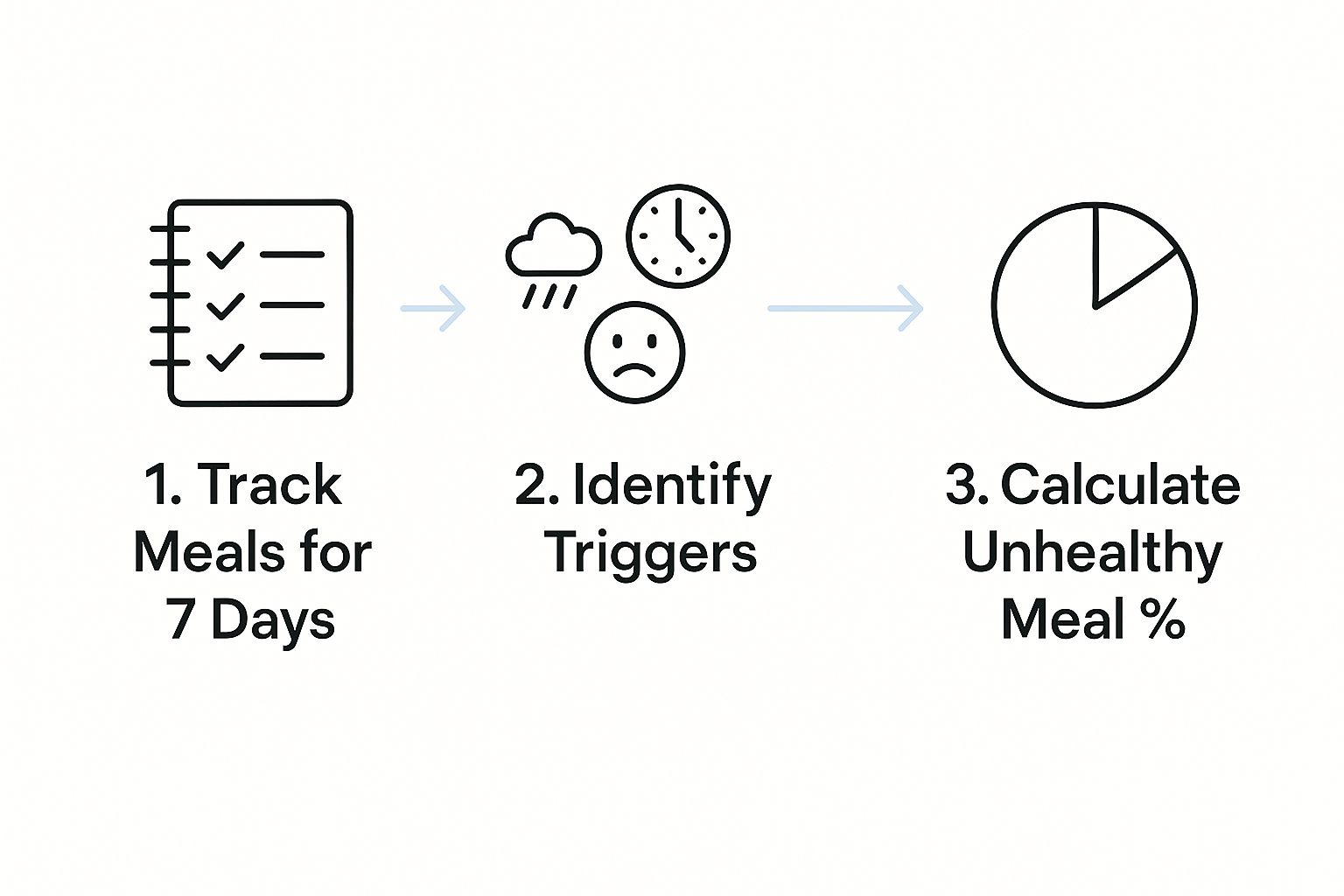
When you track your meals and connect them to what was happening right before you ate, you start to see exactly when and why your unwanted habits show up.
The goal isn’t to judge yourself—it’s to gather data. Once you can clearly see your habit loop in action, you gain the power to interrupt it. Instead of reacting on autopilot, you can choose a different routine.
Let’s say your 3 PM cue is boredom at your desk. Your routine is to hit the vending machine, and the reward is a momentary distraction (and a sugar rush). Once you know that, you can plan a new routine. Maybe a five-minute walk outside or a quick chat with a coworker can give you that same reward—a break from the monotony—without the junk food.
It’s all about being strategic, not just strong-willed.
Pinpointing Your Personal Eating Triggers

If you want to change a habit, you first have to get to know it. This means looking past generic advice and becoming a detective of your own eating patterns. The best tool for the job? A simple food and mood journal.
For just one week, your only goal is to observe and record. Don’t try to change a thing. Just watch what happens. This process is all about turning vague feelings into hard data you can actually use. Every time you eat or feel a craving kick in, take a moment to jot down what’s going on. It’s about more than just the food; it’s about the entire scene.
Asking the Right Questions
Real awareness doesn’t come from judging yourself—it comes from getting curious. Think of your journal as a safe space to explore the moments that lead you to the kitchen.
To get the full picture, try to answer these questions with each entry:
- What did I eat? Be specific. “A handful of almonds” is more helpful than “nuts.”
- When did I eat? Note the time. You might start to see that 3 PM slump is a real thing for you.
- Where was I? At your desk? In the car? On the couch? Your environment is a huge piece of the puzzle.
- Who was I with? We often eat differently alone than we do with family or coworkers.
- How was I feeling? This is the big one. Were you stressed, bored, tired, happy, lonely? Name the emotion.
- Was I actually hungry? Try rating your physical hunger on a scale of 1 to 10. This is key for separating physical needs from emotional urges.
A real-world entry might look something like this: 3:15 PM, at my desk, alone. Ate a whole bag of pretzels. Felt totally overwhelmed by my inbox and bored with this report. Hunger was maybe a 3/10—definitely not stomach-growling hungry.
After just a few days of this, a pattern will start to take shape right before your eyes.
The goal isn’t perfection; it’s pattern recognition. Your journal is a judgment-free zone designed to uncover the hidden scripts that drive your eating habits. This awareness is the foundation for lasting change.
From Data to Actionable Insights
Once you have about a week’s worth of notes, it’s time to connect the dots. You might notice that every stressful meeting sends you straight to the vending machine. Or maybe late-night boredom is a direct flight to the pantry. These are your triggers.
This kind of self-monitoring isn’t just a hunch; it’s incredibly effective. Behavioral research shows that interventions built around tracking and trigger awareness get real results. For example, people who regularly log their meals tend to boost their healthy food choices by approximately 25-30%.
Even just paying more attention to your body’s hunger and fullness signals can slash emotional eating by about 20%—a massive win for anyone trying to break old habits. If you’re interested in the science, you can dig into the latest research on nutrition for healthspan.
Now, instead of feeling vaguely “out of control,” you have a specific problem to solve.
- Problem: “I always raid the fridge when I’m bored at night.”
- Solution Brainstorm: “I could start a new book, call a friend, or pick up that dusty guitar. Anything to engage my mind.”
Pinpointing these triggers is the most important step toward regaining control. It’s how you shift from reacting on autopilot to making conscious, intentional choices about what—and why—you eat.
Building Healthier Routines That Stick
Once you know what sets off your eating habits, the real work begins. The trick to breaking an old habit isn’t just about stopping it cold. It’s about consciously swapping it out for a better one. Every habit we have, good or bad, is there for a reason—it serves some kind of purpose. The goal is to find a healthier action that gives you the same payoff you were getting from the old one.
Take the classic 3 PM slump, for instance. Your cue might be a wave of boredom or fatigue. The routine is grabbing a sugary snack from the vending machine. And the reward? A quick hit of energy and a much-needed mental break. Instead of trying to white-knuckle your way through that craving, you can design a new routine. Maybe a brisk five-minute walk gives you that same energy jolt, or perhaps brewing a cup of herbal tea becomes a calming ritual. Either way, you’re meeting the underlying need without the sugar crash.
Crafting Your Replacement Routines
The whole idea is to make your new, healthier choices as easy—and just as satisfying—as the old ones. Don’t try to tackle everything at once. Just focus on one trigger at a time. If late-night stress is what sends you hunting through the pantry, you need a plan in place before the craving even has a chance to show up.
A little prep work here can make all the difference. Think about trying these strategies:
- Set Your Kitchen Up for Success: Make healthy foods the most obvious and convenient choice. Keep a bowl of fresh fruit on the counter, pre-chop some veggies for easy snacking, and move the junk food to a high shelf (or just get it out of the house).
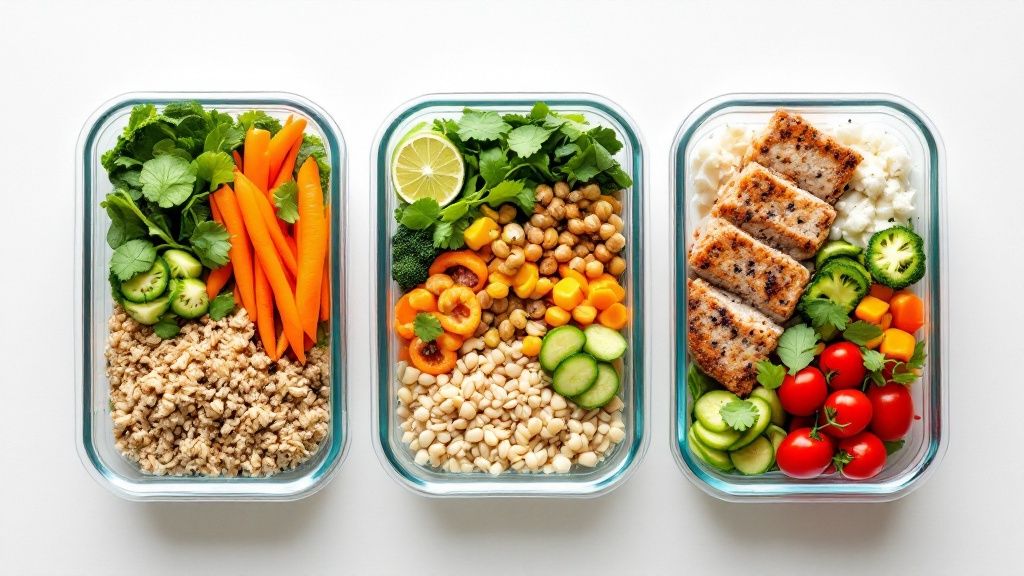
- Give Meal Prepping a Try: Just an hour or two over the weekend can set you up with healthy meals and snacks for the whole week. When a nutritious meal is ready to go, you’re way less likely to hit the drive-thru when you’re tired and hungry.
- Hydrate First: Our brains can sometimes mix up thirst and hunger signals. Before you grab a snack, try drinking a full glass of water and just waiting 15 minutes. You might be surprised to find the craving vanishes.
Real change happens when the healthy choice becomes the path of least resistance. You’re not just relying on discipline; you’re creating a system that naturally nudges you toward better decisions.
Start Small and Build Momentum
Trying to completely change your diet overnight is a surefire way to burn out. A much more sustainable way forward is to set small, manageable goals that you can build on. The aim isn’t a perfect diet, just a slightly better one.
For example, instead of swearing off dessert forever, maybe you challenge yourself to add one vegetable to dinner every night this week. Once that feels like second nature, you can move on to the next small change, like swapping your daily soda for sparkling water.
These little victories create positive momentum and give you the confidence to keep going. This approach is actually a core principle behind many mindful eating techniques that emphasize gradual, non-judgmental progress.
Ultimately, you’re trying to create a new default setting for your brain. By repeatedly choosing the new, healthier routine, you’re strengthening that neural pathway until it feels just as automatic as the old one did. It takes time, for sure, but every small, intentional choice is a solid step toward change that actually lasts.
Redesigning Your Environment For Success

Relying solely on willpower to kick unhealthy eating habits feels like swimming upstream. You expend energy fighting cravings instead of building momentum toward better choices.
A smarter move? Reconfigure your surroundings so the path of least resistance points straight at nutritious options. When you make healthy foods visible and convenient, and tuck away the junk, your environment becomes a silent coach.
Audit Your Food Environment
Start by surveying your key food zones—kitchen, office snack drawer, even the car. What grabs your attention first? If it’s sugary drinks or packaged treats, you’re setting yourself up for constant temptation.
Here’s a quick look at simple swaps that rewire your impulse to grab the unhealthy stuff:
Simple Swaps to Redesign Your Food Environment
| Common Pitfall | A Healthier Alternative | Why It Works |
|---|---|---|
| Processed Snacks On Eye Level | Store Nuts And Seeds At The Front | Nutrient-dense options become the first thing you see and reach. |
| Soda Bottles In The Fridge Door | Keep Sparkling Water Or Herbal Tea | Hydration without sugar is more accessible than soda. |
| Cookie Jar On The Countertop | Display A Bowl Of Fresh Fruit | A colorful fruit bowl nudges you toward fiber and vitamins. |
| Bulk Chips In A Large Bag | Pre-Portion Chips Into Single-Serve Bags | Defined servings curb mindless munching and help control intake. |
By setting up these tweaks, you’re not battling cravings—you’re outsmarting them. Healthy choices start to feel automatic rather than heroic.
Mindful Eating In Your New Space
With your environment primed, you can turn your attention inward and practice mindful eating. This means tuning into real hunger signals instead of reacting on autopilot.
Before reaching for a snack, try this:
- Pause and take three deep breaths to center yourself.
- Ask, “On a scale of 1–10, how hungry am I?”
- If you’re below a 5, consider waiting or distracting yourself for a few minutes.
Mindful eating gives you the space to notice true hunger instead of reacting to your surroundings.
Pairing a supportive setup with these quick check-ins transforms eating from a reflex into a conscious choice. You can learn more about the psychology behind this by exploring the power of your environment on eating habits.
Navigating Setbacks and Staying Consistent
Let’s be realistic: the path to breaking bad eating habits is never a straight line. There will be off days. You’ll face surprise temptations, and moments of intense stress will put your new routines to the test. This isn’t just normal; it’s a guaranteed part of the process. It is absolutely not a sign of failure.
Lasting change isn’t about being perfect. It’s about being resilient. It’s about having the ability to get right back on track after a slip-up, without letting guilt send you spiraling. In the long run, consistency beats perfection every single time.
Preparing for Real-World Challenges
Holidays, office parties, stressful deadlines—these are part of life, and they almost always come with food-related hurdles. Instead of dreading these events, you can build a simple toolkit of strategies to walk into them with confidence.
Think of it like having a game plan before you step onto the field. This puts you in the driver’s seat, so you’re making conscious decisions instead of just reacting to triggers.
Here are a few practical strategies I’ve seen work wonders:
- Eat a Healthy Snack Before You Go: Showing up to a party starving is a surefire way to overdo it. A protein-packed snack like some Greek yogurt or a handful of almonds beforehand can curb that initial hunger, letting you think more clearly.
- Scan Your Options First: When you’re at a buffet or potluck, take a quick walk around to see everything that’s available before you grab a plate. This helps you make mindful choices instead of just loading up on the first things you see.
- Find Non-Food Coping Mechanisms: If stress is your trigger, you need an alternative to comfort food. Brainstorm a list of other things that calm you down—maybe it’s a quick walk outside, putting on a favorite song, or doing a five-minute breathing exercise.
The goal is not to avoid life’s challenges but to face them with a plan. One misstep doesn’t erase all your progress. It’s simply a data point—an opportunity to learn what works and what doesn’t.
The Broader Context of Food Choices
It’s also crucial to remember that for many people, breaking bad eating habits involves more than just willpower. Socioeconomic factors have a massive impact on whether healthy food is even available or affordable.
A staggering UN report revealed that about 2.8 billion people globally can’t afford a healthy diet. This number underscores a huge worldwide challenge and reminds us that real change often needs systemic solutions, not just individual effort. You can dig into the full report on global food security and nutrition to understand the bigger picture.
Ultimately, learning how to break bad eating habits is a deeply personal journey of self-awareness and resilience. Every time you bounce back from a setback, you’re actually strengthening the new, healthier pathways in your brain. So, celebrate your consistency, learn from the slip-ups, and keep moving forward with patience and kindness toward yourself.
Answering Your Questions About Habit Change
Even with a solid plan, you’re bound to hit a few bumps in the road when you’re changing something as deeply ingrained as your eating habits. Let’s tackle some of the most common questions and sticking points I hear from people. Think of this as your practical guide to navigating the real-world challenges.
How Long Does It Really Take to Break a Bad Eating Habit?
Forget the old myth about it taking 21 days. While it’s a nice, neat number, reality is a lot messier. A well-known study showed it can take anywhere from 18 to 254 days for a new behavior to become second nature.
The average? 66 days.
The biggest lesson here is to let go of any rigid timeline. Your journey is unique. Instead of zeroing in on a magic number, just focus on consistency. Every time you choose the healthier option, you’re building and strengthening a new pathway in your brain.
Don’t get discouraged if progress feels slow. True habit formation is a marathon, not a sprint. The goal is steady effort over time, not overnight perfection. Lasting change is built one small decision at a time.
What Should I Do If I Have a Major Slip-Up?
First things first: breathe. A day of eating off-plan doesn’t undo weeks of hard work. The real danger isn’t the slip-up itself, but the “all-or-nothing” thinking that often follows. It’s that voice that says, “Well, I’ve already blown it today, might as well give up.”
Don’t listen to it. Instead, see this as a chance to learn something.
- Acknowledge it, don’t judge it: Okay, it happened. Now, move forward.
- Get right back on track: Your very next meal is your chance for a fresh start. Don’t put it off until tomorrow or next Monday.
- Ask yourself why: What was the trigger? Was it a stressful meeting? A social gathering? Sheer exhaustion?
Pinpointing the root cause is how you get smarter for next time. It’s not a failure; it’s data.
Is It Better to Change Everything at Once?
I’ve seen it a thousand times: someone gets a burst of motivation and tries to overhaul their entire diet overnight. For almost everyone, this approach is a direct path to burnout. It’s just too much, too soon. Willpower is a finite resource, and when it runs low—which it always does—it’s easy to just throw in the towel on everything.
A much more effective strategy is to pick one small, specific habit and master it.
Start with something that feels almost too easy. Maybe it’s just swapping your afternoon soda for sparkling water. Or perhaps it’s adding a handful of spinach to your eggs in the morning. Once that feels completely automatic, you can piggyback on that success and add another small change. This is how you build a solid foundation for change that actually lasts.