 CravingMind AI
When you get down to it, the difference between tracking macros versus calories is pretty straightforward. Calories measure the total energy you get from food, while macros (short for macronutrients) tell you where that energy comes from—specifically, protein, carbohydrates, and fats.
A good analogy is your car: calories are the total amount of fuel in the tank, but macros are the quality of that fuel, which dictates how well your engine actually performs.
Understanding The Core Difference in Nutrition
While they’re obviously connected, looking at your food through the lens of calories versus macros gives you two very different perspectives. Focusing on calories gives you a simple number for your total energy intake, which is the absolute foundation of managing your weight. The basic science holds true: if you eat fewer calories than your body burns, you’ll lose weight.
But that’s not the whole story. The source of those calories has a massive impact on your body composition, how full you feel after eating, and your overall health. That’s where tracking macros comes into play. Each one has a distinct job to do: protein is for building and repairing tissues, carbs are your body’s go-to for quick energy, and fats are crucial for hormone production and keeping your organs healthy.
Tracking Method Breakdown At a Glance
To make it even clearer, here’s a quick table breaking down the fundamental focus and complexity of each approach.
| Tracking Method | Primary Focus | Best For | Complexity Level |
|---|---|---|---|
| Calorie Counting | Total energy intake (calories in vs. calories out). | General weight loss or maintenance. | Low |
| Macro Tracking | The source of the energy (protein, carbs, fat). | Body recomposition, muscle gain, or performance. | Medium to High |
This simple breakdown shows that the right method really depends on what you’re trying to achieve. One isn’t inherently better, just better suited for different goals.
The Math Behind The Methods
Even the federal dietary guidelines nudge us to think about this balance, suggesting that a typical diet should be composed of 45–60% carbohydrates, 20–35% fats, and the rest from protein. The math is simple: both protein and carbs have 4 calories per gram, while fat is more energy-dense at 9 calories per gram. You can find more nutritional insights and health tips like these on the Craving Mind blog.
Ultimately, a solid grasp of both concepts gives you a much more powerful and complete way to manage your nutrition. The debate of macros vs. calories isn’t about finding a winner; it’s about picking the right tool for your unique health and fitness journey.
Why Not All Calories Are Created Equal

You’ve probably heard the old saying, “a calorie is a calorie.” It’s one of the most stubborn myths in nutrition, but it really oversimplifies how our bodies actually work. While a calorie is technically just a unit of energy, where you get that energy from completely changes its impact on your body composition, hunger, and health. This is the whole reason the “macros vs. calories” debate even exists.
Let’s break it down. Think about eating 200 calories of lean chicken breast versus chugging 200 calories of a sugary soda. The chicken is packed with protein, which forces your body to work harder to digest it. This process is called the thermic effect of food (TEF), and it means you actually burn a good chunk of the protein’s calories just breaking it down.
On the flip side, the simple sugars in that soda hit your system almost instantly. You get a quick blood sugar spike, followed by an inevitable crash. This roller coaster often leaves you feeling hungry again not long after, setting you up to eat more calories later in the day.
How Macronutrients Influence Your Body
The kind of calories you eat has a direct line to your hormonal response, which controls everything from fat storage to how full you feel. Each macronutrient sends a different set of signals to your body.
- Protein: It’s a powerhouse for satiety. Protein triggers hormones like peptide YY that signal fullness and can use up to 20-30% of its own energy just for digestion.
- Carbohydrates: The effect really depends on the source. Complex carbs from veggies give you slow, steady energy. Simple sugars, however, can spike insulin—the hormone that tells your body to store fat.
- Fats: Healthy fats from sources like avocados are crucial for hormone production. They’re also incredibly satiating, which helps you feel full for much longer.
This is exactly why a diet built around whole foods and balanced macros consistently outperforms one that just obsessively tracks a single calorie number. The quality of your food is every bit as important as the quantity.
The biggest blind spot of calorie-only tracking is that it completely ignores nutrient density. Your body doesn’t just run on energy; it needs the raw materials—protein, fats, and micronutrients—to function at its best and build a healthy physique.
A Tale of Two Snacks
The difference becomes crystal clear when you look at real-world examples. Let’s say you have a 200-calorie snack budget. You could have a protein bar with 12 grams of protein or a small bag of chips with just 2 grams of protein. The calorie count is identical, but the experience couldn’t be more different. The protein bar will keep you feeling satisfied and support muscle repair, while the chips will likely leave you wanting more.
This distinction is everything. If your goal is to build muscle or lose fat—not just see a number drop on the scale—then understanding where your calories come from is non-negotiable. You can find more great insights into why nutrient profiles are so critical over on Hone Health.
Comparing the Two Tracking Methods
So, we’ve got the definitions down. But how do these two approaches actually stack up in the real world? Deciding between tracking macros and counting calories really boils down to what you’re trying to achieve and what fits your lifestyle. Are you looking for simple, straightforward weight management, or do you need a more fine-tuned approach to really change your body composition?
Let’s dig into a practical, side-by-side comparison to see which method makes the most sense for you.
Precision for Body Composition Goals
Calorie counting is a reliable tool for general weight loss. If you consistently stay in a calorie deficit, you will lose weight. The catch? You have very little say in what kind of weight you’re losing. It could be a mix of fat and, unfortunately, hard-earned muscle.
This is where macro tracking really shines. It offers a level of precision that calorie counting just can’t match. By setting a specific protein target, you can protect—or even build—lean muscle while you’re cutting calories. This ensures that the weight coming off the scale is primarily body fat. For anyone serious about body recomposition, macro tracking is the clear winner.
Macro tracking isn’t just about the quantity of energy you consume; it’s about the quality of the building blocks you give your body. It’s the difference between just getting smaller and actively sculpting your physique.
Flexibility and Food Choices
On the surface, calorie counting seems like the more flexible option. Got 200 calories left for the day? Technically, anything that fits that number is fair game. This “if it fits your calories” mindset can feel liberating, but it can also be a slippery slope toward a diet filled with nutrient-poor foods if you’re not careful.
Macro tracking, by its nature, adds a bit more structure. You’re not just hitting one number; you have three distinct targets to aim for. While this might feel more restrictive at first, it forces you to build more balanced meals. You quickly learn you can’t just fill up on carbs and fat and still hit your protein goal, which naturally improves the overall quality of your diet.
This image breaks down how each macronutrient contributes to your total calorie intake.
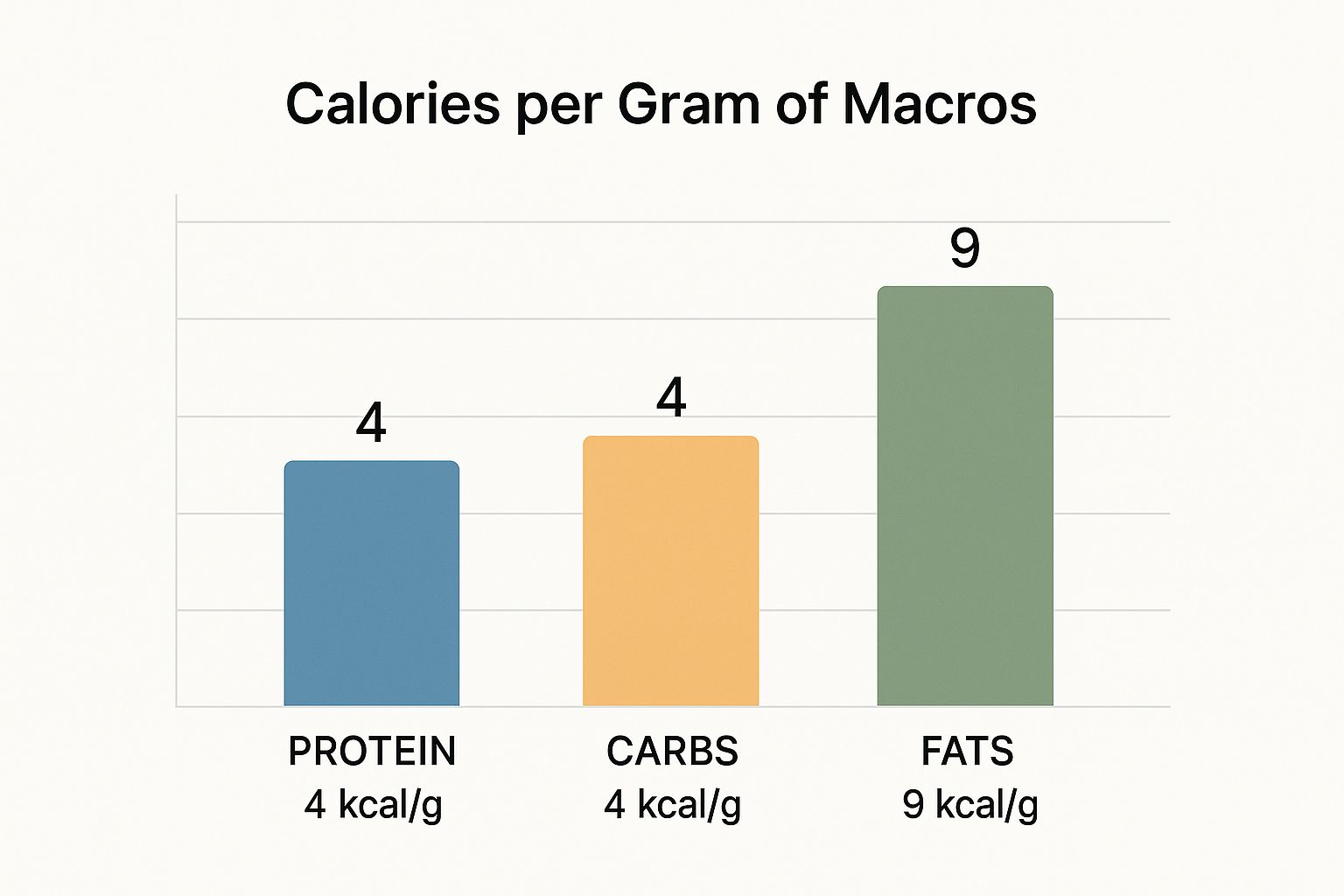
As you can see, fat packs more than double the calories per gram compared to protein and carbs. This little detail is a perfect example of why the composition of your food matters just as much as the total calories.
Time Investment and Mental Effort
Let’s be honest: macro tracking takes more work upfront. There’s a definite learning curve. You have to calculate your specific targets, pre-plan meals to hit those numbers, and be pretty diligent about logging everything. It requires more time and a detail-oriented mindset, especially when you’re just starting out.
Calorie counting is much easier to jump into. You’ve only got one number to worry about, which makes it far less intimidating for a beginner. The mental load is significantly lower, and that simplicity can be the key to staying consistent, particularly for people who are new to tracking or have a packed schedule.
Feature Comparison Calorie Counting vs Macro Tracking
To make things even clearer, here’s a direct comparison of the two methods across a few key features.
| Feature | Calorie Counting | Macro Tracking |
|---|---|---|
| Primary Goal | General weight loss or gain. | Body recomposition (fat loss, muscle gain), and athletic performance. |
| Precision | Low. Doesn’t control the source of calories, which can lead to muscle loss. | High. Allows for precise control over protein, carbs, and fats to sculpt the body. |
| Nutritional Quality | Can be poor if you only focus on the number, not the food source. | Generally higher, as hitting macro targets requires a balanced intake of foods. |
| Effort & Learning Curve | Low. Easy for beginners to start and maintain. | High. Requires more initial calculation, planning, and attention to detail. |
| Flexibility | High in theory (“eat anything that fits”), but can lack nutritional structure. | More structured, but still allows for flexibility within macro targets. |
| Best For | Beginners, individuals focused solely on weight change, or those with limited time. | Athletes, bodybuilders, or anyone with specific physique or performance goals. |
Ultimately, this isn’t about one method being universally “better” than the other. It’s a trade-off. Calorie counting is a simple, effective path for weight management. Macro tracking is a more detailed roadmap for anyone who wants to take control of their body composition and performance. The best method is the one that aligns with your specific goals and, most importantly, the one you can stick with consistently.
When to Prioritize Simple Calorie Counting
While the “macros vs. calories” debate often gives the edge to the precision of macro tracking, there are plenty of times when a simpler approach is not just enough—it’s actually better. Sticking with calorie counting makes the most sense when your main goal is straightforward weight management and you need an entry point that doesn’t feel like a part-time job.
For anyone just starting out, trying to hit specific protein, carb, and fat targets can be a recipe for burnout. Calorie counting cuts through that noise, boiling it all down to the single most important factor for weight loss: energy balance. Its simplicity is its superpower, making it a far more sustainable strategy for people taking their first steps.
Ideal Scenarios for Calorie Counting
A calorie-first approach shines in situations where fine-tuning your body composition isn’t the immediate goal. It’s all about building a solid foundation of awareness without the steep learning curve that macros can demand.
Think about these real-world scenarios:
- General Weight Loss: If your primary objective is simply to see the number on the scale go down for overall health, creating a consistent calorie deficit is the key.
- Building Initial Awareness: For someone totally new to nutrition, the act of tracking total intake is a game-changer. It builds powerful habits and shines a light on portion sizes and food choices.
- Time-Crunched Lifestyles: Let’s be realistic—when life gets crazy, managing one number is far more doable than trying to perfectly align three different macro goals every single day.
Calorie counting is the essential first step in understanding your personal energy needs. It’s a powerful educational tool that demystifies why your weight changes, creating a baseline of knowledge before you even think about adding the complexity of macronutrients.
Avoiding Common Pitfalls
Of course, a calorie-only approach isn’t foolproof. The biggest trap is getting so fixated on the number that you completely ignore the nutritional quality of your food. Hitting a 1,800-calorie target with junk food is a world away from reaching it with nutrient-dense whole foods.
To make calorie counting truly work for you, you still have to pay attention to where those calories come from. Use food labels for more than just the calorie count; glance at the protein, fiber, and micronutrients. A successful calorie-counting plan still requires smart choices to keep you full, energized, and healthy. It perfectly sets the stage for a more detailed approach later on, should your goals change.
When Macro Tracking Is the Superior Choice
While counting calories is a great starting point, the whole macros vs calories debate really changes once your goals get more specific. If you’re looking to do more than just drop a few pounds—say, build muscle, boost your athletic performance, or sculpt your physique—then tracking macros is a much smarter play. It takes you past the simple math of energy in versus energy out and puts you in the driver’s seat of your body composition.
This is especially true for anyone chasing body recomposition, that tricky goal of losing fat while building muscle simultaneously. Pulling this off demands a nutritional balancing act that just counting calories can’t provide. You absolutely need enough protein to repair and grow muscle, enough carbs to fuel tough workouts, and the right amount of healthy fats to keep your hormones in check.
Fueling Specific Performance Goals
Macro tracking isn’t just about looking good; it’s a game-changer for performance. An endurance runner and a powerlifter have completely different nutritional needs, and tweaking macro ratios is how athletes get the right fuel for their specific sport.
Think about it like this:
- The Powerlifter: They’ll need a ton of protein to maximize muscle repair and strength gains, plus plenty of carbs to power through those heavy, explosive lifts.
- The Marathon Runner: Their diet will lean heavily on carbohydrates to keep their energy stores (glycogen) topped off for the long haul.
- The Bodybuilder: This is where it becomes an art form. They manipulate all three macros with surgical precision, often cycling carbs and fats to dial in their physique for show day.
In every one of these cases, simply hitting a calorie number would fall short. The right mix of macronutrients is what truly unlocks their potential and pushes them forward.
When your goal is to change how your body looks and performs—not just what the scale says—tracking your macros is non-negotiable. It’s the difference between steering a ship with just a rudder versus having full control of the engine, the sails, and the navigation system.
Managing Metabolic Health
Stepping away from the gym, macro tracking is also a powerful tool for managing certain health conditions. For anyone dealing with insulin sensitivity or trying to keep their blood sugar stable, controlling carbohydrate intake is everything. A simple calorie target just doesn’t offer that level of detail.
By focusing on a specific macro split—often one that’s lower in processed carbs and higher in protein and healthy fats—people can work toward more stable blood sugar and better hormonal balance. This targeted strategy is a proactive way to manage health that sees beyond a single number, proving that a deeper understanding of the macros vs calories relationship can have a massive impact on your well-being.
A Hybrid Approach for Sustainable Results
The whole macros vs calories debate often paints a false picture, making it seem like you have to choose a side. But from my experience, the smartest, most sustainable nutrition plans don’t pick one over the other—they blend them together. This hybrid approach gives you the best of both worlds: the straightforwardness of calorie counting and the body-composition power of macro tracking.
Think of it as a simple hierarchy. First, you set your total calorie target. This is your energy “budget” for the day, and it’s based on whether you want to lose, maintain, or gain weight. Then, you allocate that budget to your macros, ensuring the quality of your food helps you build muscle, feel full, and perform your best.
Creating Your Personalized Plan
Building a plan that works for you starts with figuring out your energy needs. It’s a two-step process.
- Set Your Calorie Target: First, get a ballpark estimate of your Total Daily Energy Expenditure (TDEE) using an online calculator. To create your daily budget, just tweak that number based on your goal—knock off 15-20% for fat loss or bump it up by 10-15% for muscle gain.
- Define Your Macro Split: Next, divide those calories among protein, carbs, and fat. A great starting point for most people is a 40% carb, 30% protein, and 30% fat split. This balance provides plenty of protein to support muscle, with enough carbs and fats for energy and healthy hormone function.
This approach gives you a structured but flexible framework. It acknowledges the fundamental truth that total energy intake is what drives weight change, but it also respects the fact that where those calories come from is what shapes how you look and feel.
The most powerful nutrition strategies aren’t about rigid rules. They’re about creating a framework that adapts to you. A hybrid approach lets you zoom out to see the big picture (calories) and zoom in to dial in the details (macros).
Looking at historical diet data really drives this point home. Between the early 1900s and 1985, for example, the average daily energy supply stayed pretty consistent at around 3,500-3,600 kilocalories. What changed, though, was where those calories came from. The percentage from carbs fell from 57% to 46%, while fat intake shot up from 32% to 43%. You can dig into these fascinating long-term dietary trends to see for yourself.
This is exactly why paying attention to your macros within your calorie goal is so crucial for long-term health and getting the specific results you’re after. A balanced method like this moves past the simple “macros vs calories” question and gives you a complete system for success that actually lasts.
Answering Your Biggest Questions About Food Tracking
When you first dive into the world of macros and calories, a lot of practical questions come up. Is this something I have to do forever? Can I really hit my goals by just focusing on one or the other? Let’s clear up a few of the most common concerns.
Do I Have to Track My Food for the Rest of My Life?
Absolutely not. Think of tracking as a temporary learning tool, not a life sentence. It’s like using training wheels when you’re learning to ride a bike. You track meticulously for a while to get a real, tangible feel for portion sizes, to understand how different foods affect your energy and mood, and to learn what your body actually needs.
Once that knowledge becomes second nature, you can ease off and transition to a more intuitive approach. The whole point is to build a lasting awareness that sticks with you long after you’ve put the app away. If you’re curious about what that next step looks like, our guide on mindful eating techniques is a great place to start building that sustainable path forward.
Can I Build Muscle by Only Counting Calories?
This is a big one. While you definitely need a calorie surplus to gain any kind of weight, simply eating more doesn’t guarantee that weight will be muscle. This is where protein comes in—it delivers the essential amino acids your body needs to actually repair and build new muscle tissue.
If you only pay attention to hitting a calorie goal but ignore your protein intake, you’ll find it incredibly difficult to build lean mass. For muscle growth, you need both sides of the coin: enough total calories to fuel the process and sufficient protein to provide the building blocks. The two are a team.
Tracking isn’t about restriction; it’s about information. The goal is to use data to make empowered choices that align with your health goals, then gradually internalize those lessons.