 CravingMind AI
If you want to stop emotional eating, the first and most critical skill to learn is telling the difference between real, physical hunger and emotional hunger. It’s all about recognizing your personal triggers—things like stress, boredom, or sadness—and then building a new toolkit of non-food coping skills to handle those feelings.
Essentially, you’re learning to create a moment of pause between feeling an emotion and reacting with food.
Understanding Why You Eat When You’re Not Hungry
Let’s face it: emotional eating goes way beyond just “stress eating.” For many of us, it’s a deeply ingrained coping mechanism we turn to for everything from a tough day at work to feeling lonely on a Friday night. We might even use food to celebrate.
Often, we reach for comfort food almost on autopilot, without even consciously realizing what we’re doing. This habit can feel so automatic that breaking it seems impossible.
The first real step toward changing this pattern is self-awareness. It all starts with tuning in and understanding the different signals your body sends when it actually needs fuel versus when your mind is just looking for a quick comfort fix. For a deeper dive, it’s worth exploring the key differences between emotional and physical hunger.
Physical vs Emotional Hunger Cues
Physical hunger doesn’t just appear out of nowhere. It builds up over time. You might notice your stomach gently rumbling, your energy levels dipping, or finding it a bit harder to concentrate. These are clear, biological signs that your body needs to be refueled.
Emotional hunger, on the other hand, hits you like a truck—it’s sudden, intense, and demanding. It usually comes with a laser-focused craving for a specific comfort food, like a pint of ice cream or a bag of salty chips. Unlike physical hunger, a well-balanced meal won’t satisfy it because it’s not about fueling your body. It’s about trying to quiet an uncomfortable feeling.
The core of emotional eating isn’t about food at all. It’s about using food to self-soothe, distract from, or numb an emotion you’d rather not feel. Recognizing this is the key to regaining control.
Spotting the Difference: Emotional vs. Physical Hunger
To get better at this, you need to become a detective of your own body’s signals. Use this table to recognize the distinct signs of emotional versus physical hunger. This simple act of observation can help you learn to respond to what your body truly needs.
| Characteristic | Physical Hunger | Emotional Hunger |
|---|---|---|
| Onset | Develops gradually over time. | Appears suddenly and feels urgent. |
| Feeling | A gnawing or rumbling in the stomach. | A craving felt in the head or mouth. |
| Food Choice | Open to various food options. | Craves a specific comfort food. |
| Satisfaction | Is satisfied once you feel full. | Often leads to eating past fullness. |
| After-Feeling | You feel satisfied and energized. | Often followed by guilt, shame, or regret. |
By keeping these differences in mind, you can start to question your urges instead of immediately acting on them. It’s a powerful shift.
Common Triggers for Emotional Eating
Once you can spot the what, it’s time to figure out the why. Understanding what triggers your emotional eating is how you untangle the wires connecting your feelings to your food choices. This chart highlights some of the most common reasons people reach for food when they aren’t hungry.
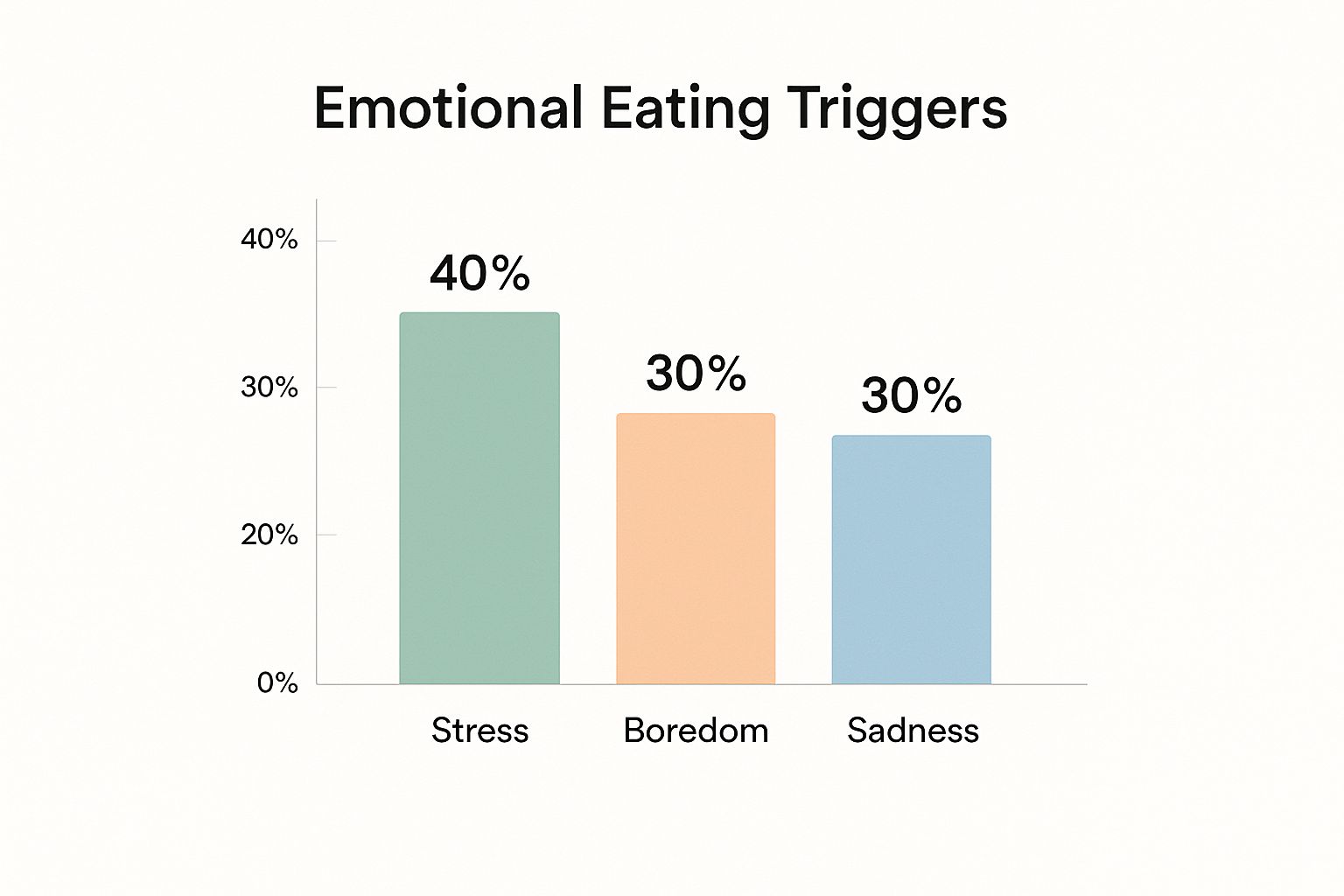
As you can see, stress is the biggest culprit for many, but boredom and sadness aren’t far behind. Your personal triggers might be a mix of these or something else entirely—maybe it’s loneliness, frustration, or even procrastination.
This pattern is especially common in younger people. For instance, research shows that about 30% of US adolescents turn to food to cope with feelings like sadness or anxiety. Over time, this behavior can become a deeply ingrained habit, which is why it’s so important to build healthier coping strategies as early as possible.
Pinpointing what sparks your urge to eat is the foundation for creating real, lasting change.
How to Identify Your Personal Eating Triggers

If you really want to get a handle on emotional eating, you have to become a detective of your own habits. It’s one thing to know that emotions can cause you to eat, but it’s another to pinpoint exactly which emotions, situations, or even people are triggering your specific urges.
Think of it like gathering clues. You’re not judging yourself; you’re simply collecting data to understand what’s really going on. Once you see the patterns clearly, you can stop reacting blindly to cravings and start understanding their source.
We saw this link between mental state and eating habits play out on a massive scale during the COVID-19 pandemic. The widespread mental health struggles directly fueled a rise in emotional eating. In fact, research from that period showed that nearly 27% of people reported anxiety and 42% reported depression. These feelings were strongly tied to using food as a way to cope.
Start a Food and Mood Journal
The single best tool for this detective work is a Food and Mood Journal. This isn’t about counting calories or macros. It’s about uncovering the hidden connections between your feelings and your food choices.
For just one week, make a point to jot down a few notes whenever you eat, especially when it’s an unplanned snack or meal. Your goal is to answer a few key questions each time. Being consistent is what reveals the patterns you’ve probably been missing.
You might discover that you only crave salty chips after a tense call with your boss, or that a wave of loneliness on a Sunday afternoon sends you straight to the kitchen for something sweet. These are the golden nuggets of insight you’re looking for. Our guide on how to stop comfort eating dives deeper into breaking these cycles once you’ve spotted them.
Key Insight: Your triggers aren’t random. They are consistent patterns linked to specific feelings or circumstances. A journal is your tool for decoding them.
What to Track in Your Journal
To make your journal truly effective, you need to capture the context around your eating. This is what helps you connect the dots between what’s happening around you and what’s happening inside you.
Here’s a simple list of what to log:
- What You Ate: Get specific. “Three chocolate chip cookies” is more helpful than “a snack.”
- Time of Day: When did the craving pop up? When did you actually eat?
- Your Hunger Level: Use a quick 1-10 scale. Were you physically hungry, or was it something else?
- Your Emotional State: What were you feeling right before? Bored, stressed, anxious, sad, even happy?
- The Situation: What was going on? Were you alone? “Watching TV by myself,” “after an argument with my partner,” or “during a boring work presentation” are all great examples.
Questions to Ask Yourself
After a few days, take some time to review your entries. This is where the real “aha!” moments happen. Look for the themes that keep popping up.
Ask yourself these questions:
- Do I tend to eat more when I’m around certain people?
- Are there specific times of day when I’m most vulnerable to cravings?
- Which emotion appears most often right before I reach for a comfort food?
- How does my eating change on the weekend versus a weekday?
Answering these questions turns that vague feeling of being an “emotional eater” into a clear, actionable roadmap. You’ll know precisely which situations and feelings you need to prepare for with healthier coping strategies.
Building Your Toolkit of Non-Food Coping Skills

Alright, so you’ve started to identify your triggers. That’s a huge win. But what happens next? When that familiar urge to eat for comfort strikes, what do you do instead of heading for the pantry?
The answer is to build what I call a “Coping Toolkit.” This is your personalized arsenal of non-food alternatives that genuinely soothe, distract, or comfort you. It’s not about mustering more willpower; it’s about being prepared. When you have appealing, easy-to-reach options ready to go, making a different choice becomes so much easier.
Match the Coping Skill to Your Emotional Need
Have you ever seen one of those generic lists of “things to do instead of eating”? They often fall flat because they don’t get to the heart of the matter—the specific feeling driving you to eat. If you’re feeling lonely, organizing your junk drawer isn’t going to cut it. If you’re completely overwhelmed by stress, the idea of calling a friend might feel like one more exhausting task.
The real secret is matching the activity to the emotion. You need to create a go-to menu of strategies that are targeted to the very feeling you’re trying to escape. This is how you learn how to stop emotional eating for good.
Here are a few ideas to get you thinking, broken down by the emotional void you might be trying to fill:
- When you feel stressed or anxious: Your body is running on high alert and needs to calm down. A short, guided meditation from an app like Craving Mind can work wonders. You could also try some gentle stretching or just put on a playlist of calming music.
- When you feel lonely or disconnected: You’re craving connection, not calories. The fix could be as simple as texting a friend you miss, playing with your pet for a few minutes, or even just going to a coffee shop or library to be around the low hum of other people.
- When you feel bored or are procrastinating: What you really need is a hit of stimulation or a small win. Try tackling one tiny five-minute task you’ve been putting off, like sorting the mail. Or, you could fire up your brain with a puzzle, a new podcast, or a chapter in a good book.
Key Takeaway: The best coping skills are the ones that actually solve the underlying problem. Before you reach for food, pause and ask yourself, “What do I really need right now? Comfort? A distraction? Connection?”
Create an In-the-Moment Emergency Plan
When a powerful craving hits hard and fast, you won’t have the mental energy to calmly brainstorm alternatives. It’s in those intense moments that a pre-written “emergency plan” becomes your best friend. Think of it as your emotional first-aid kit.
The idea is to write down 3-5 simple activities you can turn to immediately, without any thought. Keep this list somewhere you can’t miss it—stuck to the fridge, as a note on your phone’s home screen, or on a sticky note by your desk.
Your list might look something like this:
- Delay & Drink: Start a 10-minute timer on your phone and drink a full glass of water. Cravings are often like waves; if you can ride it out for just a few minutes, it will often pass.
- Change Your Scenery: If you’re in the kitchen, walk into another room. If you’re slouched on the couch, step outside for a minute of fresh air. A simple change of environment can be surprisingly effective at breaking a mental loop.
- Engage Your Senses: Do something that engages a sense other than taste. Light a scented candle, rub some nice-smelling lotion on your hands, or wrap yourself in a super-soft blanket. This can be incredibly grounding.
This proactive approach puts you back in control. Instead of feeling like a craving has hijacked your brain, you have a clear, simple plan. It’s a practical step that proves to yourself, one small choice at a time, that you have better ways to handle your feelings.
Using Mindfulness to Break the Habit Loop

Emotional eating can feel completely automatic. One minute you’re fine, and the next, a switch flips, and you’re reaching for a snack without even thinking about it. This isn’t a lack of willpower; it’s a deeply ingrained habit that follows a predictable pattern: the habit loop.
This loop has three parts. First, there’s the cue—your emotional trigger. It could be a stressful work meeting, a sudden wave of boredom on a quiet afternoon, or a pang of loneliness. Next comes the routine, which is reaching for food. Finally, there’s the reward: that temporary comfort or distraction the food provides. This reward is what locks the cycle in place.
The only way to truly break this chain is to create a gap between the cue and the routine. That’s where mindfulness enters the picture.
Mindfulness is simply the practice of paying attention to what’s happening right now, without judging it. It’s the tool that helps you stop running on autopilot and reintroduces conscious choice. With mindfulness, you can finally gain the mental space to see a craving for what it really is—just a sensation—instead of an urgent command you have to obey.
Mindfulness isn’t about fighting your cravings. It’s about changing your relationship with them. You learn to observe the urge to eat without getting swept away by it, which ultimately puts you back in the driver’s seat.
The Power of the Pause
When an emotional craving hits hard, your instinct might be to either give in immediately or try to wrestle it into submission with sheer willpower. Mindfulness offers a third, much more effective option: just pause and get curious.
Instead of reacting, you learn to respond. I’ll be honest, this can feel incredibly uncomfortable at first, especially if you’ve spent years using food to numb difficult feelings. But sitting with that discomfort, even for a few moments, is exactly how you build emotional resilience.
This is the core principle behind apps like Craving Mind. They’re designed to help you check in with yourself during those critical moments, offering guided exercises to help you practice this pause. By logging your mood and cravings, you start to see the patterns with incredible clarity.
The RAIN Method for Difficult Emotions
One of the most practical mindfulness techniques I’ve come across for handling these overwhelming urges is the RAIN method. It’s a simple, four-step acronym that gives you a clear path for moving through a difficult feeling without turning to food.
Here’s how it works:
- Recognize what is happening. Just silently acknowledge it to yourself. “Ah, there’s anxiety,” or “I’m feeling a really strong craving.” Naming it immediately creates a bit of healthy distance.
- Allow the experience to be there. This is the hard part. Don’t try to push the feeling away, fix it, or beat yourself up for having it. Just let it be. Give it some space to exist.
- Investigate with kindness. Gently ask yourself, “What does this actually feel like in my body?” or “What does this feeling truly need from me right now?” The goal isn’t to find a perfect answer, but to bring a gentle curiosity to your inner world.
- Nurture with self-compassion. Offer yourself some kindness. You might place a hand over your heart and say something simple like, “This is a really difficult moment.” This small act can be profoundly comforting and soothing.
Practicing RAIN teaches you how to stop emotional eating because you’re finally giving your emotions the direct attention they’ve been asking for. When you do that, you no longer need to use food to do the job for you.
Designing an Environment That Supports You
Let’s be real—willpower alone is a tough strategy. Lasting change becomes nearly impossible when your own home and social life are working against you. You can start the day with the best intentions, but if your kitchen is a minefield of your biggest temptations and every social event feels like a trigger, you’re constantly fighting an uphill battle.
The goal here isn’t about deprivation or banning foods you love. It’s about being strategic. We’re going to proactively shape your world so that the path of least resistance leads to the choices you want to make.
Food-Proof Your Kitchen
Think of this as an environmental redesign, not a diet. The idea is to make mindless snacking harder and conscious, healthy choices a whole lot easier. You’d be surprised what a simple rearrangement can do.
- Out of Sight, Out of Mind: This old saying is gold. Take those high-temptation foods—the chips, the cookies, the candy—and move them out of your direct line of sight. Put them on a high shelf, in the back of the pantry, or inside opaque containers. Don’t make them the first thing you see when you’re feeling a little stressed.
- Make Healthy Visible: Now, do the exact opposite for the good stuff. Keep a beautiful bowl of fresh fruit on the counter. When you open the fridge, have pre-cut veggies and hummus right there at eye level. When a healthy option is the easiest thing to grab, you’re far more likely to go for it.
- Create “Grab-and-Go” Packs: We’ve all been there—mindlessly eating straight from a giant bag of something. To combat this, pre-portion your snacks. Make single-serving bags of almonds, seeds, or whole-grain crackers. It makes portion control practically effortless.
This kind of proactive setup is a cornerstone of learning how to stop emotional eating because it drastically reduces the number of small, willpower-draining decisions you have to make all day.
Your environment should be your biggest ally, not your saboteur. A few simple tweaks to your kitchen and social calendar can dismantle some of the biggest barriers you face.
Navigate Your Social World
Your social circles are just as influential as your physical space. From office potlucks to family dinners and even well-meaning friends, navigating these situations requires a game plan. It’s all about protecting your progress and setting boundaries while still fully participating in your life.
This is a critical piece of the puzzle, especially when we look at the data. Research consistently shows that individuals who are overweight or have obesity report significantly higher rates of emotional eating than their normal-weight peers. These findings, detailed in research linking emotional eating and weight on PMC, underscore why creating a supportive environment isn’t just a nice idea—it’s a vital health strategy.
So, how do you handle it? Have a few simple, polite scripts ready in your back pocket.
- For the pushy friend: “That looks absolutely delicious, but I’m going to pass for now. I’m really working on listening to my body’s actual hunger signals.” It’s firm, but polite.
- For the office party: This one’s a classic for a reason. Eat a satisfying, healthy snack before you go so you don’t arrive starving. This frees you up to socialize and connect without feeling that magnetic pull toward the snack table.
- For family dinners: Offer to bring a healthy dish you know you love. That way, you guarantee there’s at least one supportive option on the table that you can enjoy without a second thought.
When you deliberately design an environment that backs you up, you’re no longer just hoping for success—you’re engineering it.
Common Questions About Emotional Eating
When you start untangling the knot of emotional eating, a lot of questions pop up. It’s only natural. You might worry about what happens if you have a bad day or how long this journey will actually take. Let’s tackle some of those common concerns head-on so you can move forward with a bit more clarity and a lot less anxiety.
What if I Slip Up and Binge?
First things first: breathe. One slip-up doesn’t erase all your progress. It’s not a failure; think of it as a data point. It’s your brain and body giving you valuable information.
Instead of letting guilt take over, get curious. Ask yourself what was going on right before it happened. Were you completely exhausted? Stressed out from a work deadline? Did you skip lunch? Acknowledging the trigger is the first step. Learn from it, show yourself some grace, and get right back on track with your very next meal or snack.
The goal isn’t a perfect, straight line to success. Real, lasting change comes from learning how to recover from a setback without beating yourself up. That’s the skill that truly matters.
How Long Does It Actually Take to Stop Emotional Eating?
This is the million-dollar question, and the honest answer is: there’s no magic timeline. We’re talking about rewiring a habit that may have been your go-to coping mechanism for years. It’s a personal journey, not a race.
Some people notice a real shift in their awareness and habits within a few weeks. For others, it’s a slower, more gradual unfolding over several months.
The best mindset is to focus on consistency and celebrating small wins. Did you recognize a craving as emotional and go for a walk instead? That’s a huge victory. The goal is always progress, not perfection.
Do I Really Have to Give Up My Favorite Comfort Foods Forever?
Not at all! This isn’t about creating a long list of “bad” foods you can never touch again. That approach often backfires, making you crave those foods even more. The goal is to disconnect food from its role as an emotional crutch.
You can absolutely still enjoy that slice of chocolate cake or bowl of creamy pasta.
The difference is how and why you eat it. The key is to eat it intentionally and mindfully. Plan to have it when you’re feeling relaxed and can actually taste and enjoy it, rather than inhaling it while standing in front of the fridge to numb an uncomfortable feeling. When you eat with awareness, you’re in control. Food becomes a source of true pleasure again, not a secret escape.