 CravingMind AI
Ever wonder why that first bite of a donut feels like pure bliss? There’s a powerful biological reason for that intense satisfaction. Your brain is wired to see sugar as a jackpot, firing up an ancient survival circuit that was originally designed to hunt for high-energy foods. Every time you indulge, you’re essentially pulling the lever on a biological slot machine.
Why Your Brain Sees Sugar as a Chemical Jackpot
At the heart of it all is your brain’s reward system, a survival tool that’s been fine-tuned over millennia. Its job is to encourage behaviors essential for keeping our species going—things like finding food, seeking shelter, and procreating. When you do something that helps you survive, your brain releases a little hit of a neurotransmitter called dopamine, which makes you feel pleasure and motivates you to do it again.
Think of it as an ancient, built-in GPS. Our ancestors lived in a world where calories were scarce. They needed to find energy-dense foods to survive, so when they stumbled upon a rare sweet treat like ripe fruit or honey, their brains released a rewarding burst of dopamine. That signal was a clear message: “Pay attention! This is good. Find more of this.”
This system was flawless for thousands of years. But it was built for a world where sugar was a rare and hard-won prize, not for the modern food environment where hyper-processed sugar is on every street corner.
The Modern Sugar Overload
The amount of processed sugar in a single can of soda or a candy bar today delivers a concentrated blast that our ancestors could never have imagined. This overload triggers a dopamine release that is far more powerful and immediate than the gentle reward from, say, eating a piece of fruit. It’s the difference between finding a single wild berry and hitting a chemical jackpot on a Las Vegas slot machine.
This infographic shows just how quickly this process unfolds in the brain.
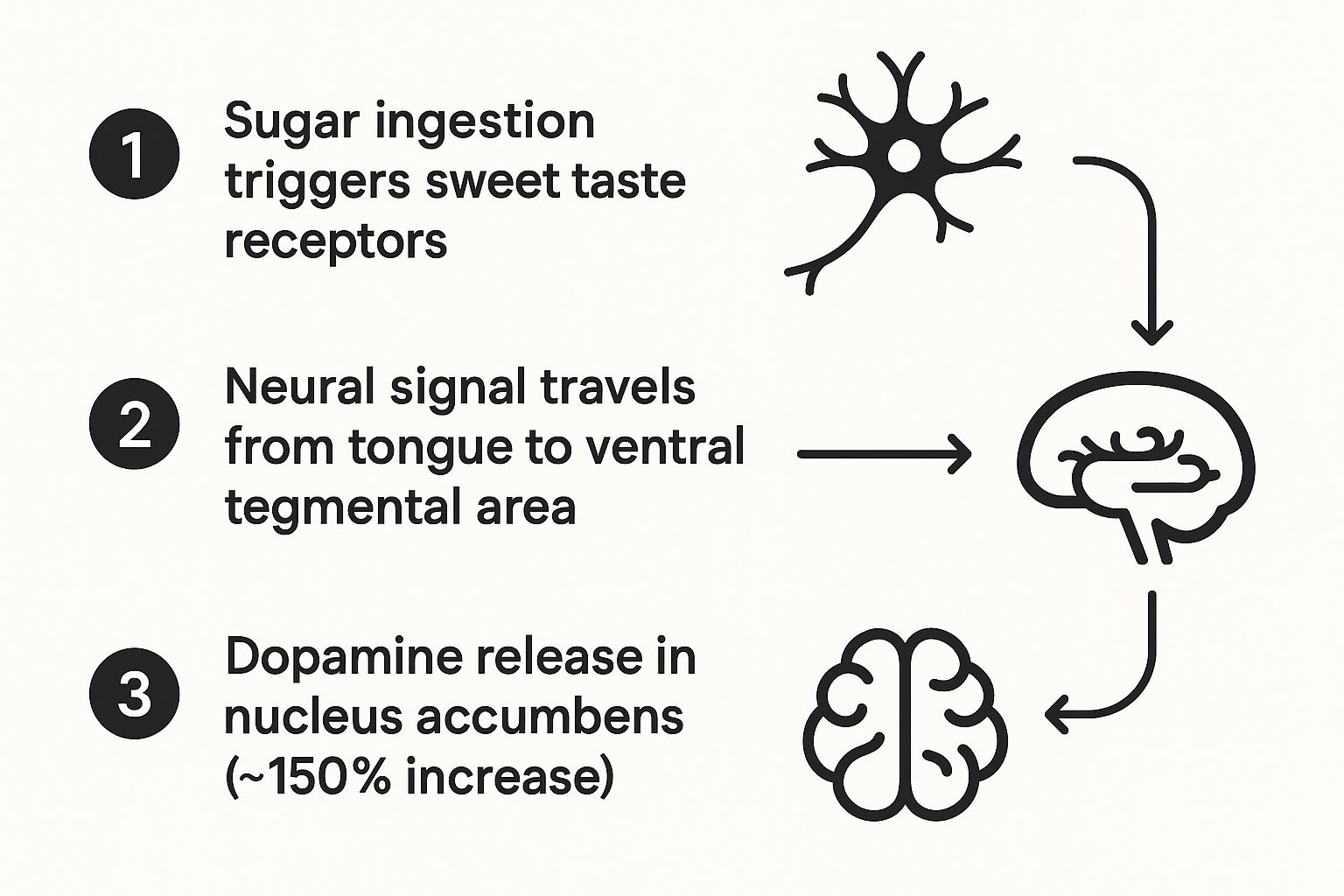
As you can see, the brain’s reaction is both fast and potent. This creates an incredibly strong mental association between sugar and immense pleasure, making it uniquely compelling and difficult to resist.
Let’s break down exactly what happens in your brain from the moment sugar touches your tongue. The process is a fascinating cascade of neurochemical events that reinforces the desire for more.
How Sugar Activates Your Brain’s Reward System
| Step | What Happens in Your Brain | The Feeling or Outcome |
|---|---|---|
| 1. Taste | Sweet taste receptors on your tongue send a signal to your brainstem. | The initial recognition of sweetness begins. |
| 2. Signal Relay | The signal travels to the cerebral cortex, which processes the “sweet” taste. | You consciously perceive the taste as pleasant. |
| 3. Reward Activation | The brain’s reward system is activated. The Ventral Tegmental Area (VTA) releases dopamine. | A wave of pleasure and satisfaction washes over you. |
| 4. Reinforcement | Dopamine floods the Nucleus Accumbens, the brain’s pleasure and motivation hub. | The brain reinforces the link: “Sugar = Good. Do this again.” |
| 5. Craving Loop | The prefrontal cortex registers this pleasurable memory, shaping future decisions. | You start to form a habit and crave the experience again. |
This powerful feedback loop is the neurobiological basis for sugar cravings. Each time you eat sugar, you strengthen this pathway. Over time, the brain can actually adapt to this constant stimulation, a process called neuroplasticity. It might start to require even more sugar to get that same level of pleasure—a cycle that strongly resembles the mechanics of tolerance. You can dive deeper into these neurobiological impacts on BrainFacts.org.
Understanding this isn’t about blaming yourself for having a sweet tooth. It’s not a failure of willpower. You’re simply contending with a brilliant, primitive system that’s doing the job it evolved for, but in a world it was never prepared to handle.
2. A Look Inside the Brain’s Reward Circuitry
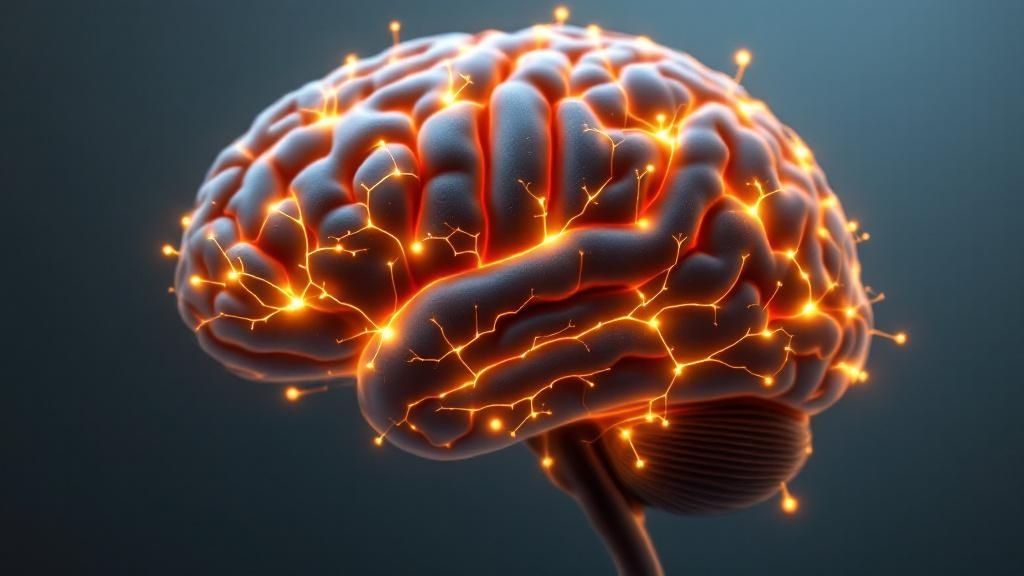
To really understand why sugar feels like a chemical jackpot, we need to take a quick tour of the brain. Think of the brain’s reward system less as a single button and more as a sophisticated communication network. This isn’t just abstract biology; it’s the very wiring that guides your daily choices, from what you grab for a snack to the habits you just can’t seem to kick.
This network is officially called the mesolimbic pathway, but a much better name for it is the “dopamine highway.” It’s a neural superhighway that connects the key players in your reward circuitry, allowing for instant communication when you find something your brain considers valuable—like that piece of chocolate cake. Let’s meet the three main characters running this show.
The Dopamine Factory: The Ventral Tegmental Area (VTA)
Deep in your brainstem, you’ll find a small but mighty region called the Ventral Tegmental Area, or VTA. You can picture the VTA as the system’s main dopamine factory. When you do something your brain likes, the VTA gets the memo and starts shipping out dopamine, the famous “feel-good” neurotransmitter.
This is where the entire reward cascade kicks off. The VTA doesn’t just react, though—it learns. With enough repetition, it starts to anticipate rewards. This is why you might feel a rush of motivation not just from eating a cookie, but from simply seeing the cookie jar or smelling a bakery down the street. That anticipation is a powerful driver.
The Pleasure Headquarters: The Nucleus Accumbens (NAc)
Once dopamine leaves the VTA, its primary delivery address is the Nucleus Accumbens (NAc). Think of the NAc as your brain’s “pleasure headquarters.” When a wave of dopamine washes over this area, you experience that satisfying feeling of pleasure and reinforcement.
The NAc is what stamps the experience with a big, bold “YES!” Its job is to link emotion with action, essentially telling the rest of your brain, “That was amazing. Let’s do it again.” This process is fundamental to how we learn and form habits, both the good ones and the not-so-good ones.
The VTA-to-NAc connection forms the biological core of motivation and desire. It’s what transforms a simple action into a deeply ingrained habit, compelling you to repeat behaviors that bring pleasure.
This powerful duo is brilliant for survival, but it’s also easily hijacked by the intense rewards of our modern world—especially super-tasty, high-sugar foods. But pleasure and motivation are just two pieces of the puzzle. There’s a third player whose job is to step in and weigh the consequences.
The Executive Decision-Maker: The Prefrontal Cortex (PFC)
The final stop for many of these reward signals is the Prefrontal Cortex (PFC), located right behind your forehead. The PFC is the “executive decision-maker,” the CEO of your brain. It’s in charge of complex functions that separate us from other animals:
- Planning and looking ahead: It helps you think about the long-term consequences of your actions.
- Impulse control: The PFC is what gives you the power to say “no” to a second slice of pizza, even when your pleasure center is screaming “yes!”
- Focus and attention: It helps you weigh the pros and cons of a decision and stay on track with your goals.
When your brain’s reward system is balanced, the PFC can effectively hit the brakes on the impulsive signals firing from the VTA and NAc. It puts the immediate pleasure of a donut up against your long-term health goals. However, when the system is constantly flooded with intense dopamine spikes—like those from a diet packed with processed sugar—the PFC’s ability to regulate these urges gets weaker. The scales tip, and resisting that chemical jackpot becomes much, much harder.
How Sugar Hijacks Your Brain’s Reward System
In your brain’s world, not all rewards are treated the same. A well-balanced meal might give you a gentle, lasting sense of well-being, but a sugary donut sets off a full-blown neurological fireworks display. The reason sugar is so potent is that it essentially short-circuits your brain’s reward system, delivering a jolt of pleasure so fast and intense that it can hijack your neural wiring.
Think of it like building a fire. Natural, complex carbs from things like vegetables and whole grains are like a slow-burning log. They break down gradually, releasing energy—and a corresponding dopamine signal—in a steady, predictable stream. Your brain registers this as a reliable, healthy reward.
Processed sugar, on the other hand, is like pouring gasoline on the fire. It hits your bloodstream almost instantly, triggering a massive, immediate surge of dopamine in your nucleus accumbens. This isn’t a gentle nudge; it’s a deafening roar. Your brain wasn’t built for a spike that overwhelming, which is why the experience feels so exceptionally rewarding. It’s a true chemical jackpot.
Your Brain on Sugar: A Physical Remodel
This intense stimulation doesn’t just feel good in the moment; over time, it physically changes your brain. This incredible ability for the brain to reorganize itself based on what we do and experience is called neuroplasticity. When you repeatedly flood your brain with these intense dopamine hits from sugar, the neural pathways linked to that reward get stronger and more efficient.
It’s like forging a path through a grassy field. The first time you walk it, you barely leave a mark. But walk that same route every single day, and you’ll soon wear it down into a deep, clear dirt path. It becomes the easiest, most automatic route to take.
Each time you eat sugar, you’re walking that same neural path, making it deeper and more defined. The connection between seeing the cue (a slice of cake) and getting the reward (that dopamine hit) becomes hardwired. This is neuroplasticity in action, and it’s precisely why cravings can feel so automatic and intensely powerful.
The Unsettling Overlap with Addictive Drugs
The way sugar lights up these reward circuits is startlingly similar to how some addictive drugs operate. While the overall impact and long-term consequences are different, the initial neurological response shares a lot of common ground. Brain imaging studies show that both sugar and substances like cocaine activate overlapping reward networks, especially in that pleasure-focused nucleus accumbens.
In fact, research tracking neural activity in mice found that both sugar and cocaine injections triggered similar patterns of brain activation and synaptic plasticity—the cellular process that’s crucial for learning and forming addiction-related memories. You can dive deeper into these neurobiological parallels in studies published by Nature.
This doesn’t mean sugar is the same as a drug, but it explains why it can feel so uniquely compelling. It taps into your most primitive and powerful motivation system with an intensity few other experiences can replicate.
So, Why Are Natural Sugars Different?
If sugar is the problem, what about the sugar in an apple or a handful of berries? The critical difference is the packaging. Nature provides a built-in delivery system that changes everything.
- Processed Sugar: This is the sugar in candy, soda, and most baked goods. It has been stripped of all its natural fiber. This is what allows for that “rocket fuel” absorption and the dopamine spike that hijacks your reward system.
- Natural Sugar: In whole fruits, sugar comes bundled with fiber, water, and micronutrients. The fiber is the most important part here—it acts like a brake, dramatically slowing down digestion and how quickly the sugar is absorbed.
This natural braking system turns a potential rocket-fuel explosion into a slow, controlled burn. The dopamine release is gentler and more sustained, giving you satisfaction without overwhelming and rewiring your brain’s circuitry.
Understanding this distinction is the key to managing your sugar intake without feeling like you’re depriving yourself. It’s not about banishing all sweetness from your life, but about choosing sources that work with your biology, not against it. This is the kind of mindful approach we focus on at the Craving Mind app.
The Vicious Cycle of Cravings and Tolerance
Hitting that sugar jackpot feels incredible at first, doesn’t it? But what happens when you keep pulling that lever over and over? Your brain, being the master of adaptation it is, notices the constant flood of dopamine and starts to take protective measures. This is where the feel-good loop begins to twist into a frustrating, vicious cycle of cravings and tolerance.
It’s a biological balancing act. An organ as sensitive as the brain simply can’t operate under a state of constant, high-intensity stimulation. To shield itself from the overwhelming surge caused by too much sugar, it starts to turn down the volume on its own pleasure signals.
When Your Brain Turns Down the Volume
This self-preservation mechanism has a name: dopamine receptor downregulation. Think of your dopamine receptors as tiny satellite dishes, perfectly tuned to pick up pleasure signals. When a normal, healthy reward comes along—like a good meal or a hug—they receive the signal loud and clear.
But when you consistently bombard them with the intense dopamine spike from processed sugar, your brain essentially says, “This is too much! We’re getting overloaded.” In response, it physically removes some of those satellite dishes or makes the remaining ones less sensitive. This is a crucial piece of the puzzle in understanding why we have cravings for unhealthy food, as it lays the groundwork for tolerance.
The result of downregulation is profound: the same amount of sugar that once felt like a chemical jackpot now barely registers. The pleasure is muted, the satisfaction feels weaker, and the reward is… well, less rewarding. This isn’t a failure of willpower; it’s a predictable neurochemical adjustment.
This biological shift creates a big problem. To get that original feel-good rush, you now need to eat more sugar. One cookie no longer cuts it, so you reach for two or three. This escalating pattern is the very definition of tolerance, and it’s the engine that drives the vicious cycle.
The Science Behind Escalating Consumption
The brain’s adaptation creates a feedback loop where you always need more just to feel normal. This isn’t just a theory; it’s backed by compelling evidence from animal studies. Research has shown that when rats are given intermittent access to sugar, they start to binge on it, causing repeated dopamine spikes in the brain’s reward center.
This pattern is a startling mirror of the neurochemical signature seen with addictive drugs. What’s more, this kind of sugar consumption can also hijack the brain’s opioid systems. When deprived of sugar, these animals show withdrawal symptoms strikingly similar to opiate withdrawal, including a noticeable drop in dopamine. These findings, which you can read more about from the National Institutes of Health, highlight how sugar can activate both dopaminergic and opioid pathways to create a powerful biological drive for more.
This explains why simply “cutting back” can feel almost impossible. Your brain chemistry is actively working against you, pushing you to increase your intake to compensate for its reduced sensitivity.
Living Through the Sugar Withdrawal Experience
So, what happens when you decide to break this cycle and drastically cut your sugar intake? Your downregulated reward system suddenly finds itself in a state of deficit. With fewer and less sensitive dopamine receptors, your brain struggles to find pleasure in everyday activities, leading to a whole host of withdrawal-like symptoms.
This isn’t just in your head. It’s a real, physical, and emotional response as your brain slowly recalibrates. Common experiences during this phase include:
- Intense Cravings: Your brain screams for the one thing it knows can quickly fix the dopamine deficit—sugar.
- Irritability and Mood Swings: With lower dopamine levels, your ability to regulate mood is compromised, leading to feelings of anger, frustration, and impatience.
- Fatigue and Brain Fog: Dopamine is also tied to motivation and focus. Without its usual stimulation, you may feel mentally sluggish and physically exhausted.
- Anhedonia: This is a fancy term for a reduced ability to feel pleasure from other sources. Things you once enjoyed, like music or time with friends, may feel flat and uninteresting.
Understanding this neurochemical rollercoaster is empowering. It reframes the struggle from a personal failing to a predictable biological process. The moodiness, the headaches, and the powerful urges aren’t signs of weakness—they are the tangible proof that your brain is beginning the difficult but necessary process of rewiring itself back to a state of balance.
Beyond Cravings: How Sugar Impacts Overall Brain Health
We’ve talked about how sugar can feel like hitting a chemical jackpot in your brain’s reward system, but that intense pull is just the beginning of the story. The consequences of a high-sugar diet ripple out far beyond simple cravings. While that dopamine hit feels good in the moment, chronic sugar consumption is quietly chipping away at the very parts of your brain responsible for clear thinking and long-term mental well-being.
This isn’t just about exhausting your reward pathways. The constant flood of sugar directly affects other critical brain regions. That’s why cutting back on sugar isn’t just a matter of willpower—it’s about protecting the intricate machinery of your mind. The effects might be subtle at first, but over time, they build up, subtly altering your ability to think, learn, and even manage your emotions.
Slowing Down Your Brain’s CEO
Let’s start with your brain’s executive decision-maker: the prefrontal cortex (PFC). Think of it as the CEO of your mind, responsible for things like impulse control, focus, and making good judgments. Unfortunately, the PFC is especially vulnerable to the chaos of a high-sugar diet.
Imagine that CEO trying to run a company while a fire alarm—the sugar-induced dopamine surge—is blaring every few hours. It would be nearly impossible to concentrate, make thoughtful long-term plans, or stop yourself from making a rash decision just to quiet the noise. This is what happens to your PFC on sugar. This impairment shows up in real life as:
- Trouble Focusing: Simple tasks that need your full attention suddenly feel like a monumental effort.
- Poor Judgment: You might find yourself choosing instant gratification over what you know is better for you in the long run.
- Wobbly Emotional Control: Irritability and mood swings can become more common as your PFC loses its grip on regulating emotional responses.
Basically, a high-sugar diet makes it harder for your brain’s “CEO” to do its job, leaving you even more vulnerable to the very cravings you’re trying to fight.
The Link Between Inflammation and Memory
The damage doesn’t stop there. It goes deeper, affecting inflammation and memory. A diet high in sugar is a well-known cause of low-grade inflammation throughout the body, and your brain is no exception. This “neuroinflammation” can throw off the delicate chemical balance that keeps your mood stable, and it’s been linked to a higher risk of conditions like depression and anxiety.
Research consistently shows that high-sugar diets can harm the hippocampus, a seahorse-shaped structure vital for learning and forming new memories. Damage to this area can lead to noticeable memory deficits and slower cognitive function.
What this means is the very diet that fuels your sugar cravings could also be making it harder for you to remember your grocery list or learn a new skill. The hippocampus is responsible for weaving the rich tapestry of your life’s memories. Protecting it is fundamental to your long-term brain health, and every conscious choice to moderate sugar is a step toward preserving this crucial brain region.
Ultimately, the story of sugar and your brain is much bigger than the fleeting pleasure of a sweet treat. The cumulative effect of constantly hitting that chemical jackpot is a heavy tax on your cognitive health, impacting your focus, your mood, and your memory. To truly protect your brain, you have to see sugar for what it is: not just a simple treat, but a powerful substance with far-reaching consequences.
Rewiring Your Brain to Manage Sugar Intake
Knowing how sugar hijacks your brain is one thing; taking back the controls is another. The great news is that your brain’s incredible ability to change and adapt—what scientists call neuroplasticity—isn’t a one-way street. Just as eating sugar over and over again carved out a powerful craving pathway, you can consciously forge new, healthier ones.
This isn’t about forcing yourself through a restrictive diet or battling your own willpower until you’re exhausted. It’s about working with your brain’s reward system, not against it. You can gently guide it toward better choices by giving it different kinds of rewards and slowly weaning it off that intense chemical jackpot, making cravings feel less and less urgent over time.
Start by Crowding Out, Not Cutting Out
One of the biggest mistakes people make is trying to go cold turkey on sugar. This all-or-nothing approach usually backfires, creating a sense of deprivation that only leads to stronger, more rebound cravings. A much smarter—and more sustainable—strategy is the “crowding out” method.
Instead of obsessing over what you need to remove, shift your focus to what you can add. When you start packing your meals with nutrient-dense, fiber-rich foods like fresh vegetables, fruits, lean proteins, and healthy fats, you naturally have less room and desire for sugary, processed snacks. This keeps your blood sugar stable, avoiding those dramatic energy crashes that send you scrambling for a quick fix.
Think of it this way: You’re not just fighting an old habit. You’re busy building a new, more satisfying one. Eventually, your brain starts to link that feeling of fullness and well-being with these healthier foods, and the old sugar-reward connection begins to fade.
Become a Hidden Sugar Detective
A huge part of the challenge is that sugar is a master of disguise. Food manufacturers sneak it into a shocking number of products you wouldn’t think of as “sweet,” like pasta sauces, salad dressings, bread, and even yogurt. Getting wise to these hidden sources is a game-changer.
Get in the habit of scanning ingredient lists for added sugars. They go by many names:
- High-fructose corn syrup
- Dextrose or maltose
- Cane juice or cane syrup
- Barley malt
By spotting and reducing these stealthy sugars, you significantly lower your total sugar intake without feeling like you’re depriving yourself of your favorite foods. This simple act gives your reward system a break from the constant, low-grade stimulation, allowing your brain to reset its expectations. For more practical tips, this guide on how to overcome sugar cravings is a great resource.
Activate Your Reward System in Healthier Ways
Your brain is wired to seek out that dopamine hit, but sugar isn’t the only way to get it. You can intentionally trigger your reward system with activities that actually boost your well-being. This satisfies your brain’s need for pleasure while simultaneously building habits that make you feel genuinely good.
Try incorporating activities that deliver a natural dose of dopamine:
- Exercise: You don’t have to run a marathon. Even a brisk walk releases a cocktail of feel-good endorphins and dopamine.
- Music: Putting on a favorite album can light up the pleasure centers in your brain almost instantly.
- Social Connection: Real, quality time with people you care about is one of nature’s most powerful rewards.
- Mindfulness: Practices like meditation help you manage your emotional state, cutting down on the impulse to reach for food out of stress or boredom.
When you deliberately turn to one of these activities, especially when a craving hits, you’re actively teaching your brain that there are better ways to feel good. You’re giving your reward circuitry a new, healthier job to do, gradually rewriting the script from “seek sugar” to “seek well-being.”
Of course. Here is the rewritten section, designed to sound natural, human-written, and expert-led.
Your Questions About Sugar and the Brain, Answered
It’s completely normal to have questions when trying to understand the tricky relationship between sugar and our brains. Let’s clear up some of the most common ones, moving past the myths to get to what’s really happening inside your head.
Can You Really Be “Addicted” to Sugar?
While you won’t find “sugar addiction” listed as a formal medical diagnosis, the way it affects your brain can look and feel a lot like a real dependency. Sugar triggers the very same dopamine pathways in the brain’s reward system that are hijacked by addictive substances. This creates a powerful cycle of pleasure, reinforcement, and craving.
Think about it: you get an intense craving, you eat sugar, and you feel good… for a little while. This can easily spiral into a loss of control, where you find yourself eating more than you intended. Over time, you might even build a tolerance, needing more sugar just to get that same satisfying feeling. For many, the experience is real, even if the clinical label is still up for debate.
How Long Does It Take to Break the Craving Cycle?
There isn’t a single magic timeline, as it really depends on your unique biology and habits. That said, most people notice a significant drop in those all-consuming, intense cravings after just 2-3 weeks of consciously cutting back on added sugars.
The real secret here is consistency. Every time you opt for a healthier choice instead of reaching for sugar, you’re actively weakening that old, worn-out reward pathway and building a new one. It takes time, but over a few months, your brain’s pathways literally begin to change as your dopamine receptors reset.
What About Artificial Sweeteners? Do They Affect the Brain?
This is where things get a bit complicated. Artificial sweeteners trick your taste buds, and because your brain expects sweetness to come with calories, they can cause a small initial release of dopamine. The problem? The expected energy reward never arrives.
This mismatch can confuse your brain’s reward signaling. Some research even suggests that this confusion might make you crave more real sugar to satisfy the reward signal your brain was anticipating. While the science is still developing, they aren’t a simple, problem-free swap for the real thing.
Is the Sugar in Fruit Bad for My Brain, Too?
Not at all, and the reason is simple: packaging. The sugar in a piece of whole fruit comes bundled with fiber, water, and micronutrients.
Fiber is the true hero here. It acts like a brake, slowing down how quickly the sugar enters your bloodstream. This prevents the sudden, massive dopamine spike you get from processed sugar—the one we call the chemical jackpot. Instead, you get a gentle, steady stream of energy that nourishes your brain without overwhelming its reward system. The real culprits are the concentrated, fiber-less sugars found in sodas, candy, and processed foods.