 CravingMind AI
The urge to reach for something sweet when you're stressed out isn't just in your head. It's a powerful biological drive, hardwired into our systems. When life gets overwhelming, your body scrambles for a quick and easy energy source to cope, and sugary foods fit that bill perfectly. The first step to breaking this cycle isn't about having more willpower; it's about understanding the biology behind it.
The Science Behind Stress and Craving

Ever had a brutal day at work, only to find yourself mindlessly reaching for a pint of ice cream the second you get home? You're not alone. This is an incredibly common scenario. Think about it: after a tense meeting or a stressful confrontation, grabbing a cookie doesn't feel like a conscious choice. It feels like an instinct. This isn't a failure on your part—it's a predictable, physiological reaction.
This powerful pull toward sweets is what I call the 'stress-craving loop.' When your brain is under pressure, it looks for the fastest way to feel better, and sugar delivers a temporary surge of pleasure hormones. It’s a quick hit of relief. The problem is, the more you turn to this "fix," the stronger that neural pathway gets, until the habit feels completely automatic.
Why This Cycle Is So Hard to Break
The connection between stress and sugar is deeply rooted in our survival instincts. Back when our ancestors faced a real, physical threat like a saber-toothed tiger, the stress hormone cortisol flooded their system. This hormone’s job was to get them ready for action by demanding quick energy.
Today, our modern stressors—like a looming deadline or a difficult conversation—trigger that exact same primitive response. Your brain doesn't know the difference between a predator and an overflowing inbox. It just knows it's stressed, so it sends you on a mission for the nearest source of fast fuel, which is almost always sugar.
It's crucial to understand that emotional eating is a biological response, not a personal failing. This simple shift in perspective can be a game-changer. It validates your experience and moves the focus from guilt to practical, actionable strategies.
This cycle is playing out on a massive scale. Globally, our reliance on sugar as a coping mechanism is staggering. In the 2023/24 period alone, total consumption hit 177.33 million metric tons, and that number is projected to keep climbing. As you can see from global sugar market trends, this isn't just a personal struggle; it's a worldwide phenomenon.
Recognizing these patterns in your own life is the first real step toward change. Once you can clearly see the line connecting a stressful event to the craving that follows, you can start to intentionally introduce new, healthier responses. That's what this guide is all about—giving you the tools to interrupt the cycle and build a more mindful relationship with food.
The Science Behind Your Stress Cravings
To get a real handle on why you reach for a cookie when you're stressed, we need to peek under the hood at your brain's internal wiring. Think of your brain as having a very powerful, very ancient reward system. It’s a feedback loop designed to keep you alive by encouraging things like eating and seeking safety. The problem is, sugar knows exactly how to hijack this system.
When you're under pressure, your body’s emergency response system kicks into high gear. It all starts with a hormone called cortisol.
You can think of cortisol as your body's built-in alarm system. When that alarm goes off, it sends a clear signal: we need high-octane fuel, and we need it now, to deal with whatever threat is coming our way. Your biology doesn't really care if the "threat" is a looming project deadline or a saber-toothed tiger; the physical response is pretty much the same.
This visual breaks down that connection, showing how the stress you feel in your head directly lights up the desire for sugar, kicking off the emotional eating cycle.
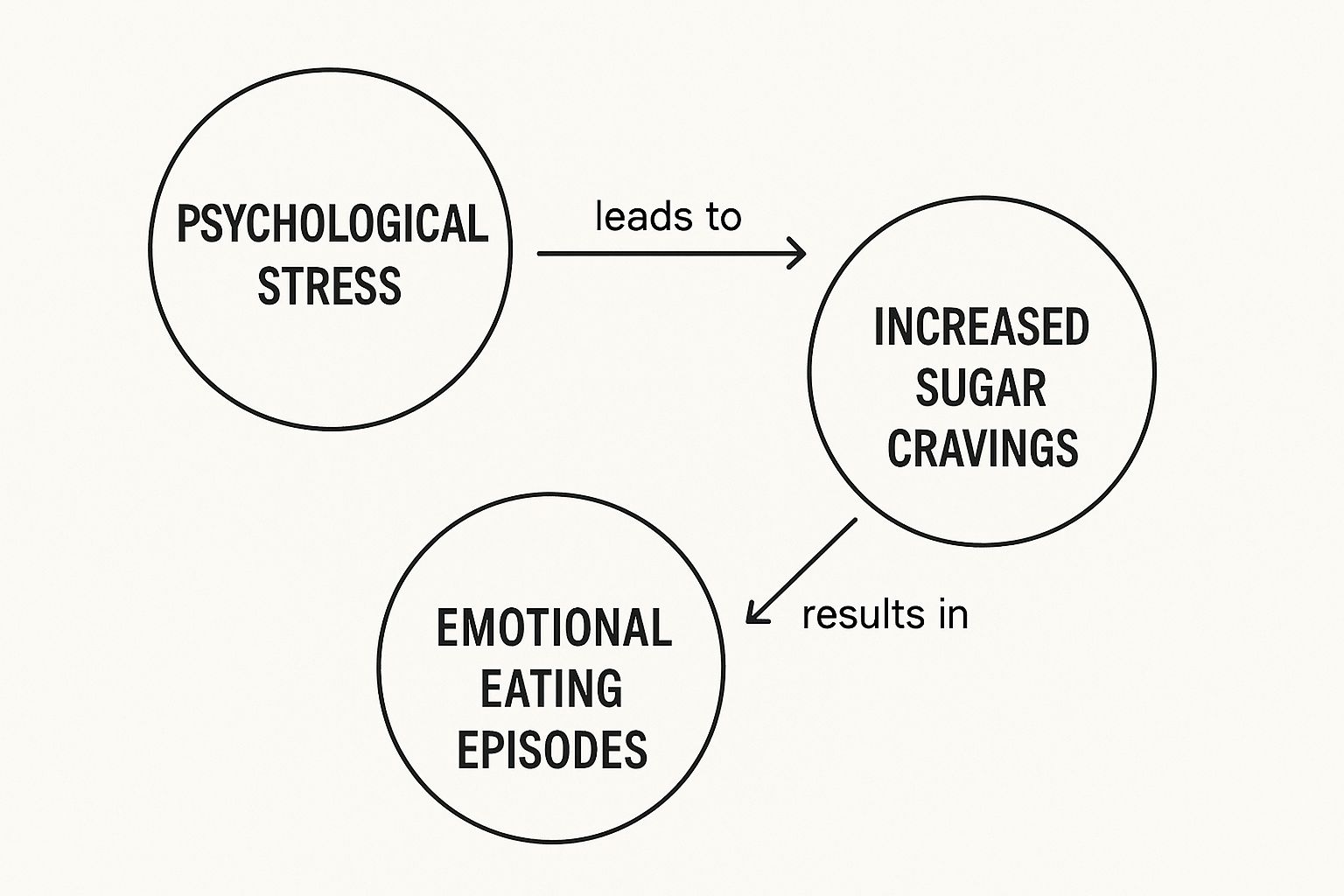
As you can see, it's a reinforcing loop. And it can feel almost impossible to break until you understand what’s actually driving it.
Cortisol’s Call for Quick Energy
When you're in the middle of a stressful situation, cortisol floods your system. Its main job is to get energy into your bloodstream as quickly as possible. This is why you're not suddenly craving a salad; your brain is screaming for glucose—the simplest form of sugar—because it's the fastest fuel source it knows.
This primal drive is why saying "no" to that donut in the breakroom after a tense meeting feels like a monumental struggle. It's not just a lack of willpower. Your own biology is pushing you toward what it sees as a crucial survival tool.
The Dopamine Deception
So, you give in and eat the sugary treat. What happens next? Your brain releases a rush of dopamine, the neurotransmitter that makes you feel pleasure and reward. You get an immediate—but very temporary—sense of relief and calm. And right away, your brain makes a powerful connection: stress + sugar = feels good.
Every time you repeat this, you're strengthening that neural pathway. It’s like carving a deeper and deeper rut in a dirt road. Over time, reaching for sugar becomes less of a conscious decision and more of an automatic, deeply ingrained habit. Your brain has learned that sugar is a quick and reliable way to soothe discomfort, turning a simple craving into an urgent, non-negotiable demand.
Here's the trap: While that donut provides a momentary escape, it does absolutely nothing to fix the actual source of your stress. In fact, the guilt and the inevitable energy crash that follows often make the original stress even worse, firing up the very cycle you wanted to escape.
This whole process gives us a few critical clues for how to fight back:
- This is a biological response. High cortisol creates a real, physical demand for quick energy. The craving isn't just in your head.
- This is a learned behavior. The dopamine hit acts as a reward, training your brain to turn to sugar whenever stress appears.
- This is a self-perpetuating loop. The temporary relief is followed by negative feelings, which often just triggers the cycle to start all over again.
Simply understanding this science is the first, most powerful step toward taking back control. When you can see the forces at play, you can start to put a wedge between the feeling of stress and the automatic reaction to eat sugar.
Identifying Your Emotional Eating Triggers

To really get a handle on the cycle of sugar, stress, and emotional eating, you have to become a detective of your own behavior. It's not enough to know that you crave sugar—the real power comes from understanding what specific situations, feelings, or even times of day are sending you straight to the pantry.
The first, most crucial skill to develop is telling the difference between true physical hunger and its sneaky cousin, emotional hunger.
Physical hunger is patient. It builds slowly, a gentle rumbling in your stomach that’s your body’s way of saying it needs fuel. Just about any food will do the trick. Emotional hunger, on the other hand, is a lightning strike. It feels sudden, overwhelming, and demands a very specific comfort food—that pint of ice cream, that bag of chips—to quiet an uncomfortable feeling.
Physical Hunger vs Emotional Hunger A Quick Guide
Recognizing the difference as it's happening is a game-changer. One is a biological need for energy; the other is a deeply ingrained coping mechanism. Learning to spot the subtle clues gives you a moment to pause and choose how to respond, rather than just reacting on autopilot.
This simple table breaks down the key differences to help you start noticing them in your own life.
| Characteristic | Physical Hunger | Emotional Hunger |
|---|---|---|
| Onset | Comes on gradually over time. | Appears suddenly and feels urgent. |
| Cravings | Open to various food options. | Demands specific comfort foods. |
| Location | Felt in the stomach (growling, emptiness). | Felt as a craving in your head or mouth. |
| Satisfaction | Is satisfied when you feel full. | Often continues even when you're full. |
| Aftermath | You feel neutral or satisfied. | Often leads to guilt, shame, or regret. |
For a deeper dive into this, you can learn more about the differences between emotional vs. physical hunger in our complete guide. Understanding this distinction is the foundation for breaking the cycle.
How to Uncover Your Triggers
So, how do you find the culprits? The most powerful tool is tracking them. Think of it as gathering clues at a crime scene. For the next week, try keeping a simple "Craving Journal." This isn't about counting calories or tracking macros; it's purely about building awareness.
Every time you feel a strong urge to eat something outside of a planned meal, just take a second to pause and write down the answers to a few questions. The goal is to connect the dots between your feelings and your food choices.
Journaling Prompts:
- What did I want to eat? (Be specific: a chocolate bar, salty chips, a cookie)
- What was I feeling right before the craving hit? (Bored, anxious, lonely, stressed about work?)
- What just happened? (Did I have a tense phone call? Finish a big project? Was I just zoning out to TV?)
- How did I feel after eating (or after the craving passed)? (Guilty, relieved for a moment, still stressed?)
After just a few days, you'll start to see patterns emerge from your notes. Maybe you’ll realize that you consistently crave sugar after video calls with a certain coworker. Or perhaps you'll notice that the unstructured boredom of a Sunday afternoon is your biggest trigger.
This isn't about judging yourself. It's about collecting data. Once you have a clear picture of what sets you off, you can finally start to anticipate those moments and build healthier, more intentional ways to manage sugar, stress, and emotional eating for good.
Mindful Techniques to Break the Stress-Eating Cycle
Knowing your triggers is half the battle. The other half? That's about learning how to respond to them in a new way. This is where mindfulness comes in, not as some abstract wellness buzzword, but as a practical set of tools you can use the moment a craving strikes.
Instead of fighting a craving with sheer willpower (which, let's be honest, rarely works long-term), these techniques help you create a tiny but powerful pause. It's a gap between the feeling and the action.
That pause is everything. It’s the space where you get to consciously choose a different path, breaking the cycle of sugar, stress, and emotional eating before it even gets a chance to start.
Practice the Five-Minute Mindful Pause
When a craving hits hard, it feels like an emergency. Your brain screams that you need to eat that thing right now. The Five-Minute Mindful Pause is a simple trick designed to defuse that urgency. You're just giving yourself a few moments to check in before you act.
Here’s how to do it:
- Stop: The second you feel the urge, just stop. Don’t forbid the food; just tell yourself you’ll wait five minutes.
- Breathe: Close your eyes. Take three slow, deep breaths. Really feel the air moving in and out of your body.
- Check In: Gently ask yourself, "What's really going on right now?" Is it stress from that work email? Are you feeling lonely? Bored? Just name the emotion without judging yourself for it.
- Decide: After five minutes, you'll probably notice the craving's intensity has dialed down a notch. Now, you can make a conscious choice. Maybe you still have the snack, but you're doing it with awareness, not on autopilot.
This little exercise starts to rewire your brain’s automatic habits. It's proof that you aren't a hostage to your cravings. You can watch them, learn from them, and then decide what to do next.
The goal isn't to eliminate cravings forever. The goal is to change your relationship with them, transforming an urgent demand into a simple piece of information about your emotional state.
Use a Body Scan to Find True Hunger Cues
Emotional hunger lives in your head; real, physical hunger lives in your body. A Body Scan Meditation is a fantastic way to tune back into your body's signals and figure out what it actually needs. You can do it in just a few minutes, right at your desk or even lying down.
Just close your eyes and bring your full attention to your toes. What do you feel? Warmth, tingling, pressure? Don't try to change anything, just notice. Slowly, move that spotlight of attention up through your feet, your legs, your torso, all the way to the top of your head.
Pay close attention to your stomach. Is there a hollow, empty feeling? Do you hear a growl? Or is it actually pretty quiet in there? This practice rebuilds the connection between your mind and your body, making it much easier to tell the difference between a genuine need for fuel and an emotional cry for comfort.
Embrace Mindful Indulgence
Breaking the stress-eating cycle doesn't mean you can never enjoy a cookie again. In fact, that kind of rigid, all-or-nothing thinking usually backfires, leading to bigger cravings and an eventual binge. Mindful Indulgence is about enjoying the food you want, but doing it slowly and with your full attention—completely guilt-free.
So instead of devouring a bag of chips in front of the TV, take a small handful and put them in a bowl. Sit down without any distractions. Savor each one. Notice the crunch, the salt, the flavor.
When you do this, you often find that a much smaller amount truly satisfies the craving. More importantly, it gets rid of the shame that so often fuels the very next emotional eating episode. This is a huge part of learning how to stop stress eating for good—making treats a conscious part of your life rather than a forbidden temptation.
Emerging Health Trends and Our View of Sugar

The battle with sugar, stress, and emotional eating isn't just your personal fight; it's part of a massive cultural conversation that’s reshaping how we think about health and food. Society's view of sugar is undergoing a seismic shift, moving away from seeing it as a simple treat and toward understanding its complex role in our physical and mental well-being.
You can see this change everywhere—from hard-hitting public health campaigns to the explosion of "low sugar" options lining grocery store aisles. We’re collectively waking up to the fact that intense cravings aren’t just a failure of willpower. They’re driven by powerful biological forces, and this shift in perspective helps validate what so many of us have felt for years.
New Science and Shifting Perspectives
This new way of thinking is making waves in the medical world, too. The emergence of pharmaceuticals like GLP-1 agonists (think Ozempic or Zepbound) offers a fascinating look at just how deeply our biology dictates our cravings. While these medications are designed for specific health conditions, the way they work tells us a lot about the body’s own appetite-control dashboard.
These drugs tap directly into the hormonal signals that manage hunger and fullness, essentially turning down the noise on relentless food cravings. Their success drives home a critical point: the urge to eat is often biochemical, and it can be incredibly powerful.
The very existence of these treatments proves that cravings aren't just in your head. They are rooted in complex biological pathways, which is precisely why the "just say no" strategy fails so many people.
The Bigger Picture on Sugar Consumption
The ripple effects are already being seen on a global scale. Some analysts predict that the widespread use of GLP-1 drugs could fundamentally change sugar consumption, especially in wealthier nations. By dampening appetite and the desire for sweets, these medications are causing a noticeable dip in sugar intake for those who use them. If you're curious about the data, you can explore more about these global sugar trends yourself.
Seeing this bigger picture can be incredibly empowering. It shows that your personal journey isn't happening in isolation. The scientific community is finally digging into the deep-seated reasons behind our eating habits, and it validates that what you’re experiencing is real. You are not alone in this challenge, and a deeper understanding of our own biology is the first step toward finding real, lasting change.
Building Habits That Actually Stick
So, how do you go from a few mindful moments to real, lasting change? It's not about a single win. It's about stringing those wins together, day after day, until a new, healthier way of dealing with your emotions and food becomes second nature. This journey is built on two things: consistency and self-compassion.
The game plan is pretty straightforward, but it’s powerful. First, you get to know your brain’s automatic stress response—that knee-jerk reaction that hijacks your best intentions. Next, you pinpoint your own emotional triggers. What specific feelings or situations send you straight to the kitchen for comfort?
Finally, you put those mindfulness techniques to work, creating that all-important pause between the feeling and the action.
Setting Yourself Up for Success
Individual strategies are great, but they work even better when they're part of a solid, consistent framework. This is where a good tool can make all the difference, acting as a guide to help reinforce what you're learning. Think of it as having a personal coach in your pocket, someone to keep you on track.
An app designed specifically for this can be a game-changer. Take a tool like Craving Mind, for instance. It gives you a structured way to put all these ideas into practice and make them stick. It helps you:
- Log your triggers without any judgment, turning vague feelings into useful data.
- Practice mindfulness exercises right in the moment a craving hits, strengthening that self-regulation muscle.
- Visualize your progress, so you can actually see how far you’ve come on the tough days.
By consistently tracking what’s going on, you start to reframe the entire experience. Moments of sugar, stress, and emotional eating are no longer failures—they become valuable clues on your path to understanding yourself better.
Ultimately, the goal is to build a more resilient and mindful relationship with food for good. When you combine self-awareness with practical support, you give yourself everything you need to not just break the old cycle, but to create a brand new one—one built on intention, understanding, and genuine well-being.
Got Questions? Let's Talk.
It’s completely normal to have questions when you start untangling the web of sugar, stress, and emotional eating. Let's tackle some of the most common ones to help you feel more confident on this path.
How Long Does It Realistically Take To Break This Cycle?
I wish I could give you a specific timeline, but the truth is, everyone’s journey looks different. Some people start to feel a real shift in just a few weeks of practicing mindfulness. For others, it might take a few months to truly rewire those old habits.
The secret isn't speed; it's consistency. Don't try to overhaul everything at once. Instead, focus on small wins, like pausing for just 60 seconds before reaching for a snack. Celebrating these little victories is what builds momentum and keeps you going.
So, Do I Have to Give Up Sugar Forever?
Absolutely not. Let’s be clear: the goal isn't to demonize sugar or banish your favorite foods for good. That all-or-nothing mindset usually backfires, making you feel deprived and often leading to an even bigger binge down the road.
The real aim here is to shift from mindless, emotional eating to mindful, conscious enjoyment.
It's about putting you back in the driver's seat. You get to enjoy a treat because you choose to, not because a powerful craving has hijacked your brain.
What If I Try Mindfulness and It Just Doesn’t Work for Me?
If sitting in silent meditation feels like a form of torture, you're not alone. The good news is that mindfulness is so much more than just formal meditation. It's simply the act of paying attention on purpose.
You can weave it into your day in countless ways. Try one of these:
- Mindful Walking: On your next walk, just focus on the feeling of your feet hitting the pavement.
- Mindful Listening: Put on a song and do nothing but listen. Try to pick out each instrument.
- The Three-Breath Pause: Before you eat anything, take three slow, deep breaths. That’s it.
The point is just to create a tiny gap between the stressful trigger and your automatic reaction. Experiment a little and find what clicks for you. There's no right or wrong way to do it.