 CravingMind AI
If you really want to get a handle on food cravings, you first have to accept they aren’t just a simple case of hunger. They’re complex signals, and cracking the code means looking at the interplay between your brain’s reward system, your hormones, and all those psychological triggers like stress and habit. Once you can pinpoint where the urge is really coming from, you can start to consciously manage it.
Understanding the Real Source of Your Cravings

Ever find yourself rummaging through the pantry just minutes after a perfectly good meal? You know you’re not hungry, but the urge for something sweet or salty is just overwhelming. That’s a classic craving, and it has almost nothing to do with an empty stomach.
These powerful messages are sent straight from your brain, not your gut. They’re wired deep into our biology, tapping directly into the brain’s reward center. When you eat something incredibly tasty—usually loaded with sugar, fat, or salt—your brain gets a hit of dopamine, a chemical that makes you feel pleasure.
This kicks off a powerful feedback loop. Your brain logs that amazing feeling and immediately wants to repeat it, which is why you suddenly need that specific food again. It’s the same neural pathway involved in other rewarding (and sometimes addictive) behaviors. This isn’t a failure of willpower; it’s brain chemistry in action.
Hormones That Drive Your Urges
Beyond your brain’s reward system, hormones are constantly pulling the strings behind the scenes. Two of the biggest players are ghrelin and leptin. Think of ghrelin as the “go” signal for hunger and leptin as the “stop” signal. When these two get out of sync, your cravings can go into overdrive.
Ghrelin: This is your “hunger hormone.” Its levels naturally rise before a meal to fire up your appetite. But things like a bad night’s sleep or a high-stress day can make ghrelin levels spike, tricking you into feeling hungry even when your body doesn’t need the calories.
Leptin: This hormone is supposed to tell your brain when you’re full. But if you’re dealing with insulin resistance (where your cells don’t respond well to insulin), your brain can also become resistant to leptin’s signals. You eat a meal, but the “I’m satisfied” message never arrives, leaving you with nagging urges to eat more.
Seeing this hormonal tug-of-war makes it clear that managing cravings is about more than just what you eat. It involves a bigger picture, including getting enough sleep, managing stress, and looking after your overall metabolic health. For a deeper look at these mechanisms, our comprehensive guide on how to manage food cravings has more detail.
Uncovering Your Psychological Triggers
While your biology sets the stage, your emotions and environment often direct the show. More often than not, a psychological trigger is the immediate spark for a craving. Do you always want ice cream after a rough day at work? Or mindlessly reach for chips while watching TV? These are learned habits.
A food craving is often a response to an unmet emotional need. By identifying the trigger—whether it’s stress, boredom, or sadness—you can address the root cause instead of temporarily soothing it with food.
Think about the common scenarios that might be setting you off:
- Emotional Eating: Using food as a crutch to deal with tough feelings like anxiety or loneliness. That brownie provides a momentary mood boost or a welcome distraction.
- Habitual Cravings: It’s movie night, so of course, you need popcorn. It’s 3 p.m., so it must be time for that cookie with your coffee. These urges are tied to routine, not actual hunger.
- Environmental Cues: Just seeing a pizza commercial or walking past a bakery can trigger a powerful, almost instantaneous desire.
The moment you start recognizing these patterns, you stop being a passive victim of your cravings and become an active observer. The very first step is to simply pause and ask yourself, “What am I really feeling right now?” That one question can be the key to unlocking a new level of control.
Mindful Techniques to Defeat Cravings Instantly
When a food craving hits, it feels like an emergency. It’s loud, demanding, and seems to require your immediate attention. The secret isn’t to fight it head-on with sheer willpower—that’s a battle you’ll eventually lose. Instead, you can outsmart it.
The goal is to create just a tiny bit of space between the craving and your reaction. In that small pause, you get to decide what happens next. These aren’t about restriction; they’re about awareness. You learn to understand what the craving is really saying and ride it out until it quiets down.
Create a Critical Pause
One of the most powerful things you can do is simply wait. It sounds too simple to work, but delaying your response can completely deflate a craving’s power. You’re essentially interrupting the brain’s automatic stimulus-response loop.
A fantastic way to do this is with the ‘5-minute rule.’ When a craving for that chocolate bar or bag of chips pops up, tell yourself you can absolutely have it… in five minutes. More often than not, during that short wait, the intense urge will peak and then start to fade. It’s a game-changer because research shows most cravings only last 3 to 5 minutes.
Use that five-minute window to do something else—anything else:
- Change your scenery. Walk into another room or step outside for a breath of fresh air.
- Engage your brain. Fire off a text to a friend, read a page from a book, or put on your favorite song.
- Tackle a quick task. Tidy your desk, wipe the counter, or water a plant.
That small delay is often all it takes for your rational mind to catch up to your emotional one.
Learn to Surf the Urge
Another brilliant mindfulness practice is known as ‘urge surfing.’ Think of your craving like an ocean wave. It starts small, builds up to a peak, and then naturally breaks and fades away. Your job isn’t to build a wall to stop it; it’s to grab a surfboard and ride it out.
Instead of wrestling with the feeling, just observe it. Get curious. Where do you feel it in your body? Is it a tightness in your chest? A watering in your mouth? A nagging thought? Acknowledge it without judgment. You might even say to yourself, “Okay, this is a craving. It’s just a feeling, and it will pass.”
Urge surfing teaches you that cravings are temporary. By observing them without reacting, you prove to yourself that they don’t control you, which helps rewire your brain’s response over time.
Each time you successfully surf an urge, you’re building resilience. You’re teaching yourself that you can handle the discomfort, and it makes the next wave that much easier to ride.
Reframe Your Inner Dialogue
The story you tell yourself about a craving matters. A lot. When you think, “I need that cookie,” it feels like a fact, and you feel powerless to argue. But what if you could change the story? That’s what cognitive reframing is all about.
First, catch the thought. Instead of letting it run the show, just label it: “I’m having the thought that I want a cookie.” See the difference? That simple shift separates you from the thought itself.
Next, gently question it. Do you really need it, or do you just want it? What’s the worst that will happen if you don’t have it right now? When you start poking holes in the story, it loses its authority.
The key to stopping a craving is understanding where it’s coming from. Is it a true nutritional need, or is it tied to a behavior or emotion?
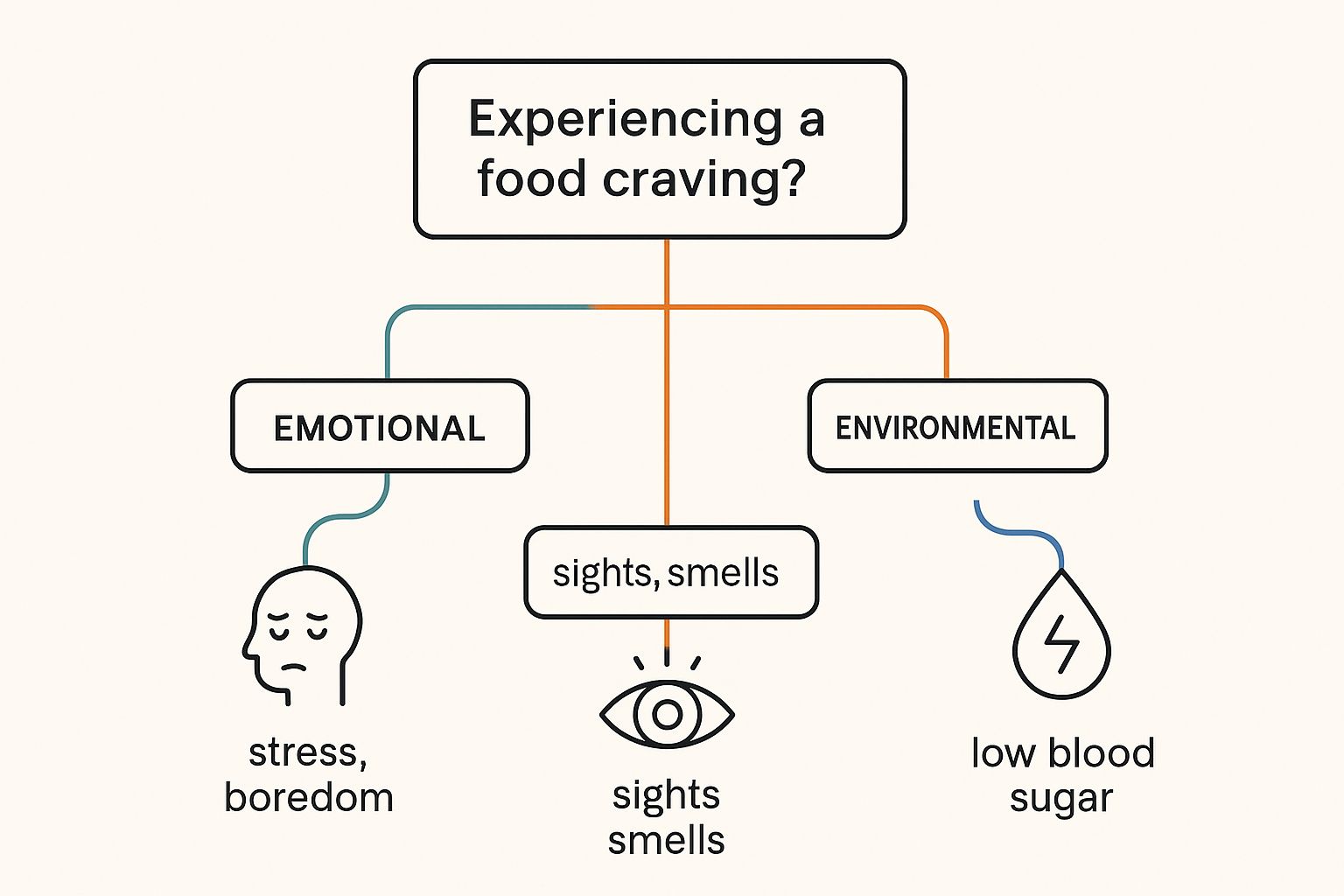
This decision tree shows that a craving is rarely just about hunger. It’s a complex signal pointing to a specific trigger, and your response should match.
Is It Behavioral or Nutritional?
Before you can respond effectively, you need to know what kind of craving you’re dealing with. Is your body asking for nutrients, or is your brain seeking comfort, distraction, or a reward?
Use this quick-reference table to identify the source of your craving and choose the most effective response.
Identifying Behavioral vs Nutritional Cravings
| Trigger Type | Common Causes | What It Feels Like | Effective Strategy |
|---|---|---|---|
| Nutritional | Dehydration, nutrient deficiencies (e.g., magnesium, iron), or genuine hunger. | A gradual, general feeling of hunger. Craving a category of food (e.g., salty, sweet) rather than one specific item. | Drink a glass of water first. Then, eat a balanced mini-meal with protein, fat, and fiber. |
| Behavioral | Stress, boredom, habit (e.g., eating popcorn while watching a movie), or seeing an ad. | A sudden, intense urge for one specific food. Often located “above the neck”—in your mind and mouth. | Use the pause technique or urge surfing. Address the underlying emotion or find a non-food distraction. |
Thinking through this table in the moment can be a powerful way to short-circuit an impulsive reaction and make a more conscious choice.
Design a Craving-Proof Environment
Finally, let’s talk about one of the most practical strategies of all: controlling your environment. Willpower is like a muscle; it gets tired. Relying on it to constantly resist temptation is exhausting and, frankly, not a great long-term plan. The easier route? Remove the temptation.
This is about setting up your home, car, and office for success. If you always reach for chips when you’re stressed, maybe it’s time to stop buying them for a while. Instead, stock your kitchen with healthy alternatives you actually look forward to eating.
- At Home: Put healthy options like fruit, Greek yogurt, and nuts right at eye level in the fridge and pantry. Move the trigger foods out of sight, or better yet, out of the house.
- At the Office: Create a ‘snack drawer’ with things like protein bars, almonds, or jerky. That way, you won’t be at the mercy of the vending machine when the 3 PM slump hits.
- On the Go: Think ahead. If you know you’ll be out running errands and tend to grab a sugary latte, bring a water bottle and a healthy snack with you.
By managing your environment, you cut down on the number of decisions you have to make throughout the day. You save your precious mental energy for the moments that truly matter.
Strategic Snacking to Prevent Cravings
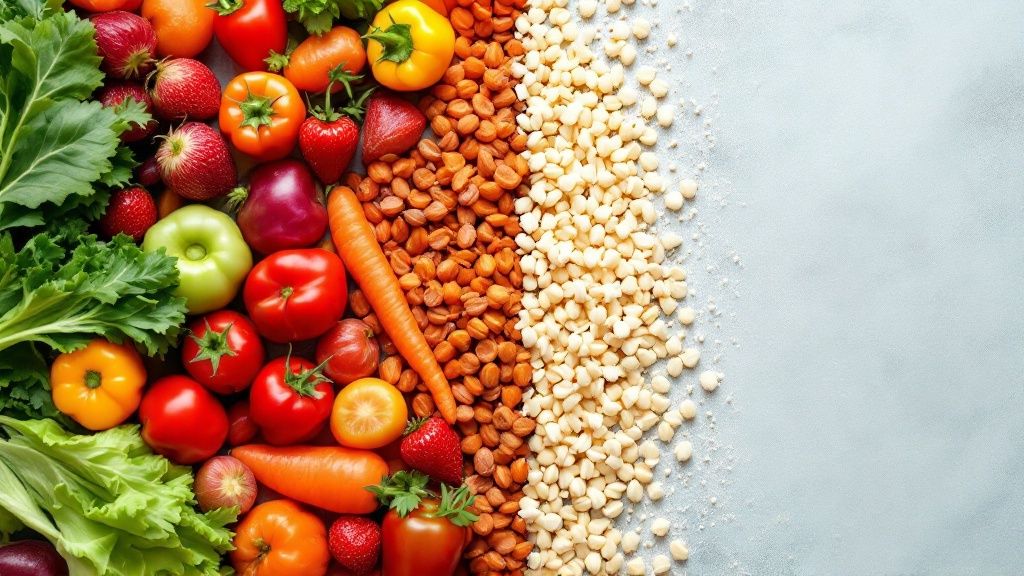
While mindfulness is a fantastic tool for dealing with cravings as they pop up, an even better strategy is to stop them from ever showing up in the first place. This isn’t about restriction. It’s about outsmarting your cravings by giving your body the right fuel to stay balanced and satisfied.
Think of strategic snacking as your first line of defense against those sudden blood sugar crashes that send you scrambling for something sweet or starchy. By making smart choices between meals, you keep your energy steady and your hunger hormones quiet. You’re basically preventing your body from sending out those desperate “feed me now!” signals. It’s a total game-changer, shifting you from reacting to cravings to proactively preventing them.
The Power Duo: Protein and Fiber
When you’re building a craving-proof snack, protein and fiber are your best friends. They work as a team to slow down digestion, which is the secret to stable blood sugar. A sugary donut gives you a quick rush followed by a hard crash, but a snack packed with protein and fiber provides a slow, steady stream of energy.
This sustained energy release is what keeps you feeling full and satisfied for hours. Imagine the difference between burning a piece of paper versus a dense log in a fireplace. The paper (sugar) flares up and is gone in an instant, leaving you cold again. The log (protein and fiber) provides steady warmth for hours. That’s what you’re aiming for.
This isn’t just a niche health trick anymore; it’s going mainstream. Did you know that over 90% of people globally snack every day? And more and more of them are picking snacks that help them manage their health goals. You can see it in the rising popularity of protein bars, meat snacks, and granola. People are catching on that nutrient-dense foods are the key to keeping those between-meal cravings at bay. You can dig deeper into these trends in this global consumer snacking research.
By prioritizing snacks that combine protein and fiber, you’re not just eating—you’re actively managing your body’s chemistry to prevent the biological triggers that lead to overwhelming cravings.
This one simple shift can completely overhaul your relationship with food. It moves you out of a frustrating cycle of craving and indulgence and into a much more empowered place of nourishment and control.
Building Your Go-To Snack Arsenal
The secret to making this work is preparation. Plain and simple. When you have delicious, satisfying options ready to go, you’re far less likely to grab a bag of chips or a candy bar when hunger ambushes you. The goal is to build a personal “snack arsenal” filled with choices you actually look forward to eating.
Here are a few powerful combinations that deliver the protein and fiber punch you need to stop cravings for food in their tracks:
- Greek Yogurt with Berries: The yogurt brings a serious dose of protein, while the berries add fiber and just enough natural sweetness. A sprinkle of chia seeds on top will give you an extra boost of fiber and healthy fats.
- Apple Slices with Almond Butter: This classic combo is popular for a reason. The apple’s fiber and the almond butter’s protein and healthy fats make for a snack that’s both incredibly filling and delicious.
- Hard-Boiled Eggs: So simple, but so effective. They’re portable and packed with high-quality protein. I always keep a few pre-cooked eggs in the fridge for a quick, grab-and-go option.
- Roasted Chickpeas: If you get a craving for something crunchy and salty, these are your answer. Chickpeas are loaded with both plant-based protein and fiber, making them the perfect substitute for chips.
- Cottage Cheese with Sliced Peaches: Cottage cheese is high in casein, a slow-digesting protein that keeps you feeling full for a really long time. Adding some fruit satisfies a sweet tooth and adds a nice dose of fiber.
Having these options on hand takes the decision-making out of the equation when you’re hungry. It’s all about setting yourself up for success by making the healthy choice the easy choice.
Using Technology to Pinpoint Your Craving Triggers
It might sound counterintuitive, but the phone in your pocket can be one of your most powerful tools for getting a handle on food cravings. Instead of just guessing what makes you reach for the cookie jar, certain apps let you collect actual data on your habits. By logging your cravings as they happen, you start to turn vague feelings into real, usable insights.
This isn’t about meticulously counting calories. Far from it. The goal is to capture the context. When a craving strikes, you note what you want, sure, but also what’s going on around you. What’s your mood? Where are you? What time is it? What were you doing just before the urge hit? Over time, this paints a surprisingly clear picture of your personal craving patterns.
From Vague Feelings to Hard Data
Without tracking, you’re basically flying blind. You might think you crave chocolate when you’re stressed, but what if the data shows the real trigger is the mid-afternoon boredom that hits you like clockwork at 3 PM? Tracking helps you finally connect the dots between your environment, your emotions, and what you eat.
It’s like being a detective investigating your own life. Every time you log a craving, you’re collecting a clue. Did it pop up right after a tense meeting? While you were scrolling through food pics on Instagram? When you were home alone with nothing to do? These seemingly small details are where the magic happens.
By consistently logging the context around your cravings, you turn fleeting emotional states into a tangible dataset. This allows you to identify your unique patterns and predict—and prevent—future cravings before they take hold.
This approach lets you get ahead of the game. Instead of just reacting when a craving steamrolls you, you can see it coming and have a plan ready to go.
What to Look for in a Craving-Tracking App
When you’re picking an app, you want one built for pattern recognition and emotional awareness, not just a standard nutrition log. Remember, we’re trying to understand the why behind your cravings, not just the what.
Here are a few features that make a real difference:
- Mood Logging: This is a must-have. The ability to quickly tap whether you’re feeling stressed, bored, anxious, or even happy is the fastest way to uncover emotional eating triggers.
- Contextual Tags: A good app will let you add custom tags for your location (“office,” “car,” “couch”), what you’re doing (“watching TV,” “working”), or who you’re with (“alone,” “with friends”).
- Pattern Analysis: The best tools will actually analyze your entries and show you the trends. You might discover that 70% of your sugar cravings pop up on weekday afternoons when you’re working from home. Now that’s an insight you can work with.
- Photo-Based Logging: Sometimes, just snapping a picture of your food is way faster and feels less tedious than typing everything out. It also creates a visual diary that can be incredibly revealing to look back on.
A great example is an app like Craving Mind, which is built specifically for this. It’s designed to connect the dots between your food photos, how intense your craving feels, and your logged moods, helping you spot patterns you’d never notice on your own.
Turning Those Insights into Action
Once you’ve got a few weeks of data under your belt, the real work starts. The app might show you that your desire for salty snacks goes through the roof on days you get less than six hours of sleep. That isn’t just an interesting tidbit—it’s your cue to start making sleep a real priority.
Or maybe you see a clear link between scrolling social media and suddenly wanting a pastry. The fix could be as simple as swapping that habit for something else, like putting on a podcast or doing a five-minute stretch. This is how you stop fighting cravings and start systematically dismantling the triggers that cause them in the first place.
The Role of Pharmacology in Appetite Control
While mindfulness and behavioral changes are cornerstones of managing cravings, sometimes they aren’t enough. For some people, the battle with appetite is deeply biological, and that’s where medical interventions are changing the conversation. Pharmacological treatments can offer powerful support by working directly with the body’s internal hunger and fullness signals.
We’re seeing major breakthroughs in this area, especially with a class of medications called Glucagon-like peptide-1 (GLP-1) receptor agonists. You’ve probably heard of them. They were first developed for managing type 2 diabetes but have proven to be incredibly effective for weight management and appetite control.
How do they work? In short, they mimic a natural hormone, GLP-1, that your gut releases after you eat. This has a couple of really important effects. It slows down digestion, helping you feel physically full for much longer. At the same time, it sends signals straight to your brain’s appetite center to turn down what many people call “food noise”—that constant, nagging inner monologue about eating.
How GLP-1 Agonists Go After Cravings
These medications are surprisingly sophisticated. They don’t just act as a blunt appetite suppressant; they seem to zero in on the types of cravings that are hardest to fight. Many people who take them report a sharp decline in their desire for highly palatable foods—the stuff packed with sugar, fat, and salt that triggers the most intense urges.
This approach is so effective because it tackles both the physical and psychological sides of appetite. By making you feel full and dialing down the brain’s reward-seeking behavior for junk food, it creates an opening where healthier choices suddenly feel much easier. That overwhelming compulsion for a specific treat can fade into a more manageable, neutral feeling of satiety.
Research has shown that GLP-1 drugs help people feel satisfied sooner and significantly reduce cravings, particularly for high-fat foods, sweets, and even dairy. This has sparked a whole new trend: food companies are now developing “GLP-1 friendly” products high in protein and fiber to complement the medication’s effects. You can read more about the rise of GLP-1 friendly foods from Innova Market Insights.
By targeting the hormonal pathways that govern hunger and reward, these medications can fundamentally change a person’s relationship with food, making craving management less about willpower and more about biochemistry.
For a broader look at different strategies, our guide on how to control food cravings covers both the behavioral and biological angles.
Important Considerations and the Bigger Picture
It’s crucial to understand that these medications are not a magic bullet. They are powerful tools designed for people with specific medical conditions, like obesity or type 2 diabetes, and must be prescribed and monitored by a doctor.
Things like potential side effects, cost, and the fact that they often require long-term use are all part of the conversation you need to have with a healthcare professional. When a person stops taking them, the hormonal effects fade, and the appetite and cravings almost always return. This really highlights why they must be paired with sustainable lifestyle changes.
Think of it as a combined strategy:
- The Medication as a Launchpad: It provides the biological assist needed to break intense craving cycles and get initial weight loss moving.
- Lifestyle as the Foundation: While the medication is working, it’s the perfect time to build durable habits around nutrition, movement, and mindful eating.
- The Synergistic Approach: The most successful outcomes happen when the medication is used as a bridge to help implement and lock in healthier behaviors for the long haul.
Pharmacology offers a promising new frontier in the multifaceted challenge of managing food cravings. It marks a shift toward acknowledging the powerful biological drivers behind our appetites, providing a science-backed option for those who need it most. It doesn’t replace behavioral strategies—it complements them.
Answering Your Biggest Questions About Food Cravings
When you’re in the thick of a powerful food craving, it can feel like your body is sending you confusing, urgent signals. Does that intense desire for chocolate mean you’re low on magnesium? Will this sudden urge for a donut ever go away?
Let’s cut through the noise and get some straight answers to the most common questions I hear about cravings.
“How Long Is This Going to Last?” The Lifespan of a Craving
This is the big one, right? When a craving hits, it feels like it will last forever. But here’s the good news: it won’t.
Research consistently shows that the peak intensity of a typical food craving only lasts for about 3 to 5 minutes. It can feel like an eternity in the moment, but that powerful wave really does pass pretty quickly.
This is exactly why simple delay tactics, like the “5-minute rule,” work so well. You aren’t trying to fight the craving with sheer willpower; you’re just giving it the time it needs to fizzle out on its own.
“Am I Craving This Because I’m Missing a Nutrient?”
This is a very popular theory, but the reality is a bit more complicated. While a severe deficiency can trigger specific urges—the classic example being pica, where an iron deficiency can cause a craving for non-food items like ice—most of our modern-day cravings don’t work like that.
That sudden, overwhelming desire for a bag of salty chips is almost certainly driven by psychological factors like stress, habit, or seeing an ad, not a true sodium deficiency.
Instead of trying to play detective and decode a specific nutrient need from a junk food craving, you’re better off focusing on building a balanced diet. Getting enough protein, fiber, and micronutrients helps keep your body’s systems stable, which naturally dials down the biological drive for those intense, hard-to-ignore urges.
It’s also crucial to remember the global context of hunger. The Global Report on Food Crises highlighted that millions of people face severe food insecurity. For them, a “craving” is about survival—a stark contrast to the emotionally driven urges many of us experience. You can learn more about this important distinction in the World Food Programme’s report.
“Is It Ever Okay to Just Give In?”
Absolutely. In fact, you should. The goal isn’t to become a robot with perfect control over every single food impulse. An all-or-nothing mindset of extreme restriction is a recipe for disaster; it almost always backfires and leads to a vicious cycle of craving, guilt, and bingeing.
Learning to stop cravings for food is about finding a balance and making conscious choices, not about total deprivation. Sometimes, the most mindful thing you can do is simply honor the craving. The trick is to do it with intention.
Giving in to a craving mindfully—savoring the food without guilt and then moving on—is fundamentally different from mindless, impulsive eating. One empowers you, while the other can leave you feeling out of control.
Here’s how to do it in a way that works for you, not against you:
- Serve a Real Portion: Don’t eat straight from the bag or carton. Put a sensible amount in a bowl or on a plate. This simple act creates a boundary.
- Savor It: Put your phone down and pay attention. What does it taste like? What’s the texture? Eat slowly and actually enjoy it.
- Move On: When it’s gone, it’s gone. The experience is over. Let it be a satisfying moment, not a trigger for more grazing or a wave of guilt.
By giving yourself permission, you take away the food’s power. It’s no longer a “forbidden fruit,” which often makes it far less appealing.
“Why Am I Craving Something Right After I’ve Eaten?”
This is easily one of the most frustrating things that can happen, but it’s also a fantastic clue. If you’ve just finished a balanced, satisfying meal and a craving for something else immediately pops up, it’s a near-certainty that you aren’t physically hungry.
This is your signal to look for a psychological trigger. It’s time to ask a few questions:
- How am I feeling? Am I bored, stressed, tired, or maybe a little anxious?
- Is this a habit? Do I always want something sweet after dinner, just because that’s what I do?
- What was happening around me? Did I just see a food commercial? Was I scrolling through delicious-looking food pics on Instagram?
Once you recognize the urge is coming from an emotion or a habit, you can address the real issue. Instead of reaching for more food, maybe you could try a short walk, call a friend, or do a five-minute mindfulness exercise. This is how you start to break the cycle for good.