 CravingMind AI
In an age of constant notifications and endless to-do lists, finding a moment of peace can feel impossible. But what if you could access a state of calm and clarity, not by escaping your life, but by tuning into it more deeply? This is the promise of mindfulness, a simple yet profound practice of paying attention to the present moment without judgment. It’s not about emptying your mind, but about observing its activity with gentle curiosity.
This guide is designed as a practical starting point, offering a roundup of eight foundational mindfulness exercises for beginners. Each entry is crafted to be accessible and effective, providing step-by-step instructions to help you integrate these practices into your daily routine. We will explore simple techniques that can be done anywhere, from your desk to your daily walk, requiring no special equipment or extensive time commitments.
You will learn how to reduce stress, improve focus, and cultivate a more intentional relationship with your thoughts, emotions, and even your daily meals. Whether you have two minutes or twenty, there’s a practice here to help you begin your journey toward a more present, peaceful, and grounded life. Let’s dive into your first steps.
1. Breath Awareness Meditation: The Foundation of Focus
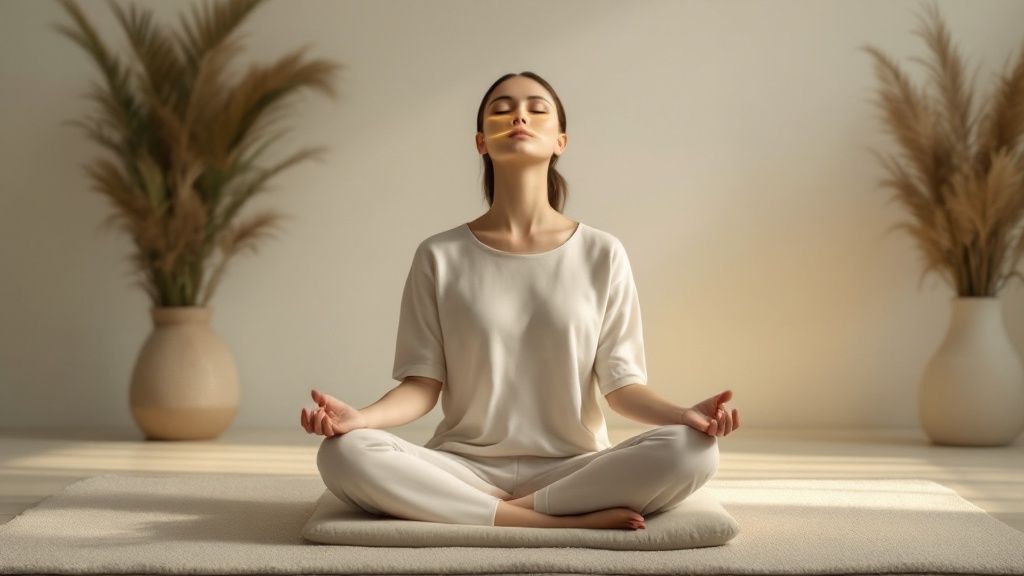
Breath awareness meditation is the quintessential starting point for anyone exploring mindfulness exercises for beginners. It involves anchoring your attention to the natural rhythm of your breath. The goal isn’t to control or change your breathing but simply to observe it as it flows in and out, moment by moment. This simple act of observation trains your mind to stay in the present, building a foundation of focus essential for all other mindfulness practices.
This foundational technique has been integrated into numerous high-impact programs. For example, Google’s “Search Inside Yourself” leadership program teaches breath awareness to enhance employee emotional intelligence and resilience. Similarly, NHS England often recommends simple breathing meditations as a primary tool for managing stress and anxiety, highlighting its clinical credibility.
How to Practice Breath Awareness
Follow these simple steps to begin your practice:
- Find a Comfortable Position: Sit in a chair with your feet flat on the floor or on a cushion on the ground. Keep your back straight but not stiff.
- Gently Close Your Eyes: You can also lower your gaze if that feels more comfortable.
- Tune Into Your Breath: Bring your attention to the physical sensation of breathing. Notice the air entering your nostrils, filling your lungs, and then being released.
- Observe Without Judgment: Your mind will inevitably wander. When it does, gently acknowledge the thought and guide your focus back to your breath. This is the core practice, not a failure.
Key Insight: The true exercise is not in maintaining perfect focus, but in the gentle and repeated act of returning your attention to the breath each time it strays.
Tips for Success
- Start Small: Begin with just 3-5 minutes a day. Consistency is more important than duration.
- Use an Anchor Point: Focus on the sensation of air at the tip of your nostrils or the rise and fall of your abdomen.
- Try Counting: To improve concentration, silently count each exhale from one to ten, then start over.
- Build a Habit: Practice at the same time each day, like right after you wake up, to make it a routine.
2. Body Scan Meditation: Connecting Mind and Body

Body scan meditation is a grounding practice that systematically guides your attention through your entire body, from the tips of your toes to the top of your head. The intention is not to change or fix anything but to simply notice the physical sensations present in each part, whether it’s warmth, tingling, tension, or even a lack of sensation. This exercise is powerful for beginners as it cultivates a deep connection between mind and body, enhancing physical awareness and promoting profound relaxation.
This technique is a cornerstone of Jon Kabat-Zinn’s highly respected Mindfulness-Based Stress Reduction (MBSR) program, used worldwide in hospitals and clinics for pain and stress management. Institutions like the UCLA Mindful Awareness Research Center provide free guided body scans used in clinical studies, and Veterans Affairs medical centers often incorporate the practice to help veterans manage symptoms of PTSD. This widespread adoption underscores its effectiveness as a therapeutic and mindfulness tool.
How to Practice Body Scan Meditation
Follow these steps to begin reconnecting with your body:
- Lie Down Comfortably: Find a quiet place where you can lie on your back, on a mat or bed, with your arms resting by your sides. You can also practice this sitting in a chair.
- Bring Awareness to the Body: Gently close your eyes and bring your attention to the feeling of your body against the surface you’re on.
- Scan Systematically: Start by focusing on the toes of your left foot. Notice any sensations without judgment. Slowly move your awareness up your foot, ankle, calf, and thigh, and then repeat on the right side.
- Continue Upward: Progressively scan through your pelvis, abdomen, chest, back, hands, arms, neck, and face, bringing a kind, curious attention to each area.
Key Insight: The practice is not about feeling a certain way; it’s about being willing to feel whatever is present. Noticing numbness or a lack of sensation is just as valid as noticing tingling or warmth.
Tips for Success
- Use a Guide: Initially, follow a guided meditation. Apps like Insight Timer or resources from UCLA offer excellent free body scan tracks.
- Start Short: Begin with a 10-15 minute session and gradually increase the duration as you feel more comfortable with the practice.
- Embrace Sleepiness: It’s common to feel drowsy or fall asleep. If this happens, try practicing while sitting in a chair instead of lying down.
- Stay Curious: Approach each sensation with gentle curiosity. Your only job is to observe what is already there, not to create or change feelings.
3. Mindful Walking: Integrating Awareness into Movement
Mindful walking transforms the simple, everyday act of walking into a powerful meditation. Instead of walking to get somewhere, you walk to be fully present with each step. This practice involves bringing your complete attention to the physical sensations of movement, your connection to the ground, and your surrounding environment. It’s an excellent way to integrate mindfulness into daily life, breaking the barrier between formal seated meditation and your active routine.
This dynamic form of meditation is a cornerstone of teachings by Zen Master Thich Nhat Hanh at Plum Village monasteries worldwide. It has also been adopted in various modern contexts, from corporate wellness programs that encourage mindful walking breaks to reduce stress to Japanese “forest bathing” (Shinrin-yoku) programs that use it to enhance the connection with nature. Its accessibility makes it a versatile tool for grounding and presence.

How to Practice Mindful Walking
Follow these steps to turn your walk into a mindfulness exercise:
- Find a Suitable Space: Choose a location where you can walk back and forth for about 10-20 steps, like a hallway, a quiet path, or even your living room.
- Stand Still and Center Yourself: Before you begin, stand for a moment and feel your feet firmly on the ground. Take a few conscious breaths.
- Walk Slowly and Deliberately: Begin to walk at a much slower pace than usual. Pay close attention to the sensation of lifting one foot, moving it through the air, and placing it back down.
- Notice the Sensations: Feel the heel, the ball of the foot, and the toes connecting with the ground. Observe the subtle shifts in balance and weight as you transfer from one foot to the other. When your mind wanders, gently guide it back to the feeling of your feet walking.
Key Insight: Mindful walking isn’t about the destination. It’s about embodying the journey, finding presence and stability in the simple, rhythmic act of each step.
Tips for Success
- Start Indoors: Begin in a controlled, distraction-free environment to get comfortable with the practice.
- Focus on One Sensation: Isolate your focus on a single aspect, like the feeling of your soles on the floor or the movement of your legs.
- Link Breath to Movement: You can coordinate your breath with your steps, for example, inhaling as you lift one foot and exhaling as you place it down.
- Gradually Increase Pace: Once you are comfortable with slow walking, you can practice being mindful at your normal walking pace outdoors.
4. 5-4-3-2-1 Grounding Technique: A Sensory Anchor to the Present
The 5-4-3-2-1 grounding technique is a powerful sensory awareness exercise designed to pull your attention away from overwhelming thoughts or anxiety and anchor it firmly in the present moment. It systematically guides you through your five senses, forcing your brain to focus on the immediate environment rather than internal distress. This method is one of the most practical mindfulness exercises for beginners because it can be done anywhere, anytime, without anyone knowing.
Its effectiveness is widely recognized in clinical settings. Cognitive Behavioral Therapy (CBT) and Dialectical Behavior Therapy (DBT) practitioners frequently teach this technique to help clients manage panic attacks and emotional dysregulation. It is also a core tool used by first responders and healthcare workers to manage acute stress during high-pressure situations, proving its utility in real-world crises.

How to Practice the 5-4-3-2-1 Technique
Follow this sequence to ground yourself using your senses:
- Acknowledge 5 things you can SEE: Look around and mentally name five distinct objects. Notice details like color, shape, and texture.
- Acknowledge 4 things you can TOUCH: Bring your awareness to physical sensations. This could be the feeling of your feet on the floor, the texture of your clothing, or an object you can hold.
- Acknowledge 3 things you can HEAR: Listen for three distinct sounds in your environment, both near and far. It could be the hum of a computer, birds chirping, or distant traffic.
- Acknowledge 2 things you can SMELL: Try to identify two different scents. This might be the smell of coffee, soap, or even the subtle scent of the room itself.
- Acknowledge 1 thing you can TASTE: Focus on one thing you can taste. This could be the lingering taste of your last meal, or you can take a sip of water and notice its sensation.
Key Insight: This technique works by interrupting anxious thought loops and redirecting your mental bandwidth to concrete, neutral sensory information, which calms the nervous system.
Tips for Success
- Be Specific: Instead of just “chair,” notice “the smooth, cool wooden armrest of the blue chair.”
- Practice When Calm: Familiarize yourself with the exercise when you are relaxed, making it easier to recall and use during moments of high stress.
- Combine with Breathing: Take a slow, deep breath between each sensory step to enhance the calming effect.
- Adapt as Needed: If you can’t find items for one sense, simply spend more time on another or adapt the numbers (e.g., 3-3-2-1).
5. Loving-Kindness Meditation: Cultivating Compassion from the Heart
Loving-kindness meditation, or Metta, guides you to generate goodwill toward yourself and others through repeated phrases or intentions. You start by silently offering kind wishes to yourself, then to a loved one, a neutral person, a difficult person, and finally all beings. This practice not only soothes self-criticism but also strengthens emotional resilience—essential for mindfulness exercises for beginners.
This method has earned scientific backing from Stanford’s Center for Compassion and Altruism Research, where participants showed measurable increases in empathy. Mindful Schools teaches Metta to help children navigate stress, while corporate programs report reduced workplace conflict. Healthcare settings use loving-kindness to improve patient–provider rapport, and prison-based compassion training has even lowered recidivism rates.
How to Practice Loving-Kindness Meditation
Follow these steps to begin:
- Settle In: Sit comfortably with a straight spine and relaxed shoulders.
- Choose Your Phrases: Pick intentions that resonate—“May I be happy,” “May I live with ease.”
- Direct Toward Yourself: Recite your chosen phrases inwardly, feeling each word.
- Expand Gradually: Offer phrases to a loved one, someone neutral, a difficult person, then all beings.
- Return to Self: Conclude by focusing again on your own well-being and openness.
Key Insight: Repeating compassionate intentions rewires habitual patterns, making kindness your natural response.
Tips for Success
- Begin with Someone Easy: Offer Metta to a close friend before moving to harder targets.
- Personalize Intentions: Swap in words that feel authentic—“May I be at peace” versus generic lines.
- Visualize the Recipient: Picture the person receiving your goodwill as you chant.
- Let Emotions Surface: Don’t force warmth—allow genuine feelings to emerge over time.
- Establish Routine: Even 5 minutes daily can transform emotional awareness and support mindful eating habits.
6. Mindful Eating: Transforming Meals into Meditation
Mindful eating applies core mindfulness principles to the simple act of eating by bringing slow, deliberate attention to colors, aromas, textures and flavors. Rather than rushing through a meal, you savor each bite as a sensory experience. This practice helps cultivate a healthier relationship with food, supports digestion and uncovers emotional triggers that drive overeating.
Organizations and healthcare providers worldwide have integrated mindful eating into their programs. Google’s employee wellness offerings include guided mindful eating workshops. Hospitals use it in diabetes management to improve blood sugar control. The raisin exercise popularized by Jon Kabat-Zinn in MBSR programs trains participants to explore a single raisin as a full meditation. Even restaurants and weight management clinics are creating “mindful dining” menus to help clients curb binge eating. Learn more about mindful eating techniques in our guide: Mindful Eating techniques on CravingMind.app
How to Practice Mindful Eating
- Choose a Small Portion: Begin with one bite or sip in a quiet setting.
- Pause Before Eating: Look at the food’s shape, color and aroma.
- Chew Thoroughly: Notice changing textures and the flavor release.
- Put Utensils Down: Rest your fork or spoon between bites.
- Check In on Hunger Cues: Pause mid-meal to assess fullness and satisfaction.
Key Insight: By treating each bite as a moment of meditation you retrain automatic eating patterns into conscious, nourishing choices.
Tips for Success
- Start with just one mindful bite or sip per meal
- Eliminate distractions like TV, phone or reading material
- Use all five senses to explore each mouthful
- Reflect on hunger and fullness before and after eating
- Build consistency by practicing at the same meal each day
7. Mindful Breathing with Counting: Sharpening Your Anchor
Mindful breathing with counting is an enhanced version of basic breath awareness designed to give a wandering mind a more concrete task. This technique involves silently counting each exhale, typically from one to ten, and then starting over. By adding this simple, repetitive anchor, you provide your brain with a gentle structure that makes it easier to notice when your attention has drifted, sharpening your ability to stay in the present moment.
This structured approach is a cornerstone of many modern mindfulness programs because it provides a clear and accessible entry point. Popular meditation apps like Headspace and 10% Happier feature guided counting meditations as foundational lessons. Furthermore, Zen meditation centers have long taught this method to beginners to build the concentration needed for deeper practices, while therapists often recommend it as a practical tool for managing acute anxiety.
How to Practice Mindful Breathing with Counting
Follow these steps to integrate counting into your breathwork:
- Settle into Your Position: Find a comfortable seated posture, either in a chair or on a cushion, with your spine upright but relaxed.
- Close Your Eyes and Breathe Naturally: Allow your breath to flow at its own pace without trying to control it.
- Begin Counting on the Exhale: After your first inhale, silently count “one” as you exhale. On the next exhale, count “two,” and so on.
- Repeat the Cycle: Continue counting up to ten, and then simply begin again at one. If your mind wanders and you lose count, gently and without judgment, just start over at “one.”
Key Insight: The goal is not to reach ten perfectly every time. The practice lies in compassionately noticing you’ve lost count and beginning again, strengthening your mindfulness muscle with each reset.
Tips for Success
- Count Only Exhales: Focusing the count on the exhale promotes relaxation and simplifies the task for your brain.
- Start Over Gently: When you notice you’ve lost your place or your mind has wandered, treat it as a success-you became aware. Simply restart at one.
- Let Go of Perfection: Don’t worry about reaching ten. The number is just a tool to anchor your attention.
- Feel the Breath: While you count, continue to notice the physical sensations of your breath moving in and out of your body.
8. The STOP Technique: A Mindfulness Reset Button
The STOP technique is a powerful, in-the-moment mindfulness exercise for beginners designed to create a pause between a trigger and your reaction. The acronym stands for Stop, Take a breath, Observe, and Proceed. This micro-meditation acts as a mental reset button, allowing you to break out of automatic, often unhelpful, behavioral patterns and make more conscious choices throughout a hectic day.
This practical tool has been widely adopted in high-stress environments. Microsoft, for instance, teaches the STOP technique in its employee wellness programs to help manage workplace pressure and improve decision-making. Similarly, healthcare professionals use it to center themselves between demanding patient interactions, ensuring they can provide compassionate care without succumbing to burnout.
How to Practice the STOP Technique
Follow this simple four-step process anytime you feel overwhelmed, stressed, or reactive:
- S – Stop: Whatever you are doing, just pause for a moment. Physically stop moving, talking, or typing.
- T – Take a Breath: Take one deep, conscious breath. Feel the air enter your body and then release it slowly. This simple action helps calm your nervous system.
- O – Observe: Briefly check in with yourself. Notice your thoughts, feelings, and bodily sensations without judgment. Are you tense? Is your mind racing? What emotion is present?
- P – Proceed: Having checked in, make a conscious choice about how to move forward. This might mean continuing your task with renewed awareness or choosing a different, more skillful response.
Key Insight: The power of the STOP technique lies in creating a brief but crucial “gap” of awareness, transforming a knee-jerk reaction into a mindful response.
Tips for Success
- Set Reminders: Use your phone or sticky notes to prompt you to practice STOP at regular intervals throughout the day.
- Use Transitions as Cues: Practice STOP before starting a new meeting, right after a phone call, or before eating a meal.
- Practice When Calm: Don’t wait for a crisis. Practicing when you’re relaxed makes the tool more accessible when you’re under stress.
- Notice the ‘Proceed’ Step: The final step is vital. Consciously choose your next action, whether it’s addressing a food craving or responding to a difficult email. Learning to manage these moments can be a key part of behavioral change; you can learn more about how to control cravings with mindfulness and other mindful responses.
Mindfulness Exercises Comparison Guide
| Meditation Technique | Implementation Complexity | Resource Requirements | Expected Outcomes | Ideal Use Cases | Key Advantages |
|---|---|---|---|---|---|
| Breath Awareness Meditation | Simple, beginner-friendly | None | Reduces stress, improves focus | Beginners, anytime practice | Accessible anywhere, foundation for others |
| Body Scan Meditation | Moderate, requires longer attention | Comfortable space, often lying down | Physical relaxation, body awareness | Stress relief, sleep improvement | Identifies tension, good for physical focus |
| Mindful Walking | Simple, involves physical movement | Safe walking space | Mindfulness in motion, reduces restlessness | Those who struggle sitting still | Combines exercise with mindfulness |
| 5-4-3-2-1 Grounding Technique | Very simple, quick sensory exercise | None | Immediate anxiety relief | Acute anxiety, panic moments | Fast, effective, no training needed |
| Loving-Kindness Meditation | Moderate, involves emotional focus | Quiet space recommended | Increased compassion, emotional resilience | Emotional growth, relationships | Builds empathy, reduces self-criticism |
| Mindful Eating | Simple, mindful attention during meals | Food or drink available | Better eating habits, improved digestion | Those addressing emotional eating | Integrates mindfulness into daily routine |
| Mindful Breathing with Counting | Simple, adds counting to breath focus | None | Improved concentration | Beginners needing focus structure | Enhances focus, easy to track progress |
| STOP Technique | Very simple, micro-meditation | None | Reduces reactive responses | Stressful moments, busy lifestyles | Quick, practical, easy to remember |
Integrating Mindfulness into Your Daily Rhythm: Your Journey Forward
You have now explored a practical toolkit of eight powerful mindfulness exercises for beginners. From the foundational simplicity of Breath Awareness Meditation to the sensory engagement of the 5-4-3-2-1 Grounding Technique, each practice offers a distinct entry point into the present moment. The path forward is not about mastering every exercise overnight, but about embracing curiosity and discovering which ones resonate most deeply with your personal lifestyle and needs.
The true power of mindfulness unfolds when it transitions from an isolated activity into an integrated part of your daily rhythm. You don’t need to set aside an hour each day to see profound benefits. The journey begins with small, intentional moments woven into the fabric of your existing routine.
Making Mindfulness a Sustainable Habit
To transform these exercises from a list you’ve read into a lived experience, focus on consistency over duration. The goal is to build a sustainable practice that supports you through life’s inevitable challenges and joys.
- Start Small and Be Specific: Commit to just three minutes of Mindful Breathing with Counting each morning before checking your phone. Or, dedicate your walk from the car to your office door as a Mindful Walk.
- Link to Existing Routines: Practice Mindful Eating for the first five bites of your lunch. Use the S.T.O.P. Technique right before you join a video call. Attaching a new mindfulness habit to an established one dramatically increases your chances of success.
- Choose Your Anchor: Select one or two exercises that feel most accessible to you right now. Perhaps the Body Scan Meditation helps you unwind before sleep, or the Loving-Kindness Meditation brings a sense of warmth to your afternoon. Focus on these until they feel natural.
The Value of Consistent Practice
Integrating these mindfulness exercises for beginners into your life is an investment in your well-being. By consistently returning your attention to the present, you are not just calming your nervous system in the moment; you are fundamentally rewiring your brain’s response to stress, enhancing your emotional regulation, and fostering a deeper connection with yourself.
For those specifically navigating the complex relationship between emotions and eating, this practice is transformative. When you pause to mindfully observe a craving, you create a space between impulse and action. In this space, you can gain invaluable insight into your true needs, moving from reactive patterns to conscious, nourishing choices. This is where self-awareness becomes a powerful tool for holistic health.
Your journey into mindfulness is a personal exploration, not a race to a finish line. There will be days when your mind feels scattered and days when focus comes easily. The practice is simply to begin again, with kindness and without judgment. Each breath, each step, each moment you choose to be present is a victory. Take the first step today. Your future self will thank you for it.