 CravingMind AI
We’ve all been there. You’re doing great with your eating habits, feeling totally in control, and then a holiday party or a birthday celebration pops up on the calendar. Suddenly, all bets are off. This isn’t a personal failure or a lack of willpower; it’s a completely normal response to the powerful link between festivities, emotions, and food.
Figuring out why these events trigger emotional eating is the first real step toward handling them with confidence.
Why Celebrations Can Derail Your Eating Habits

Celebrations create a perfect storm for emotional eating. They blend high-stakes emotions with an overwhelming amount of delicious, tempting food. Social gatherings are rarely just about eating, right? They’re about connecting with people, reminiscing, and often, dealing with a bit of social pressure. This unique mix can easily short-circuit our best intentions for mindful eating.
Think about a typical holiday get-together. It might stir up wonderful feelings of joy and nostalgia. But it can also bring up old family tensions or even a sense of loneliness in a crowded room. For many of us, food becomes the easiest way to cope with these complicated feelings.
The Emotional Triggers at Parties
The reasons we find ourselves reaching for another slice of cake or an extra helping are deeply personal, and often, we don’t even realize we’re doing it. It’s about more than just seeing a fantastic spread of food; it’s about what that food represents in that specific moment.
Parties and celebrations tend to create emotional scenarios that lead us straight to the buffet table.
- Social Anxiety: Do you ever hold a plate of food just to have something to do with your hands? Or use it as an excuse to step away from a conversation? That’s a classic move when we feel awkward or overwhelmed.
- Reward and Justification: The little voice in your head that says, “It’s a special occasion, I deserve this!” That thought gives us permission to overeat without feeling guilty, at least in the moment.
- Nostalgia: Sometimes we eat certain foods simply because they transport us back to happy childhood memories. Eating becomes an act of seeking comfort and security.
- Boredom or Discomfort: When you don’t know many people or the conversation hits a lull, what’s the easiest thing to do? Head back to the food table.
The real issue here is that during celebrations, food stops being about nourishment and becomes an emotional tool. Getting a handle on this shift is the key to regaining control.
The Science Behind the Cravings
This connection isn’t just in your head; there’s a biological reason for it. Emotional eating is literally defined as overeating in response to emotional cues, and it’s a common theme at celebrations where we’re surrounded by sugary, high-fat comfort foods.
In fact, a 2023 study highlighted a strong link between emotional eating and a higher intake of these energy-dense snacks, a pattern that was even stronger in certain groups. You can learn more about these emotional eating findings and what they mean.
Ultimately, this isn’t about blaming yourself. It’s about recognizing a very human reaction to a tricky situation. Once you understand the triggers, you can start to see these events not as potential pitfalls, but as opportunities to practice making mindful choices.
Pinpoint Your Personal Celebration Triggers

Before you can change your habits around celebrations and emotional eating, you have to become a bit of a detective. Real, lasting change starts with self-awareness—getting past the generic advice and figuring out what specifically makes you turn to food when your stomach isn’t actually empty.
These triggers are deeply personal, tied to your unique history, relationships, and how you process emotions. It all starts with learning the difference between physical hunger, which is that slow, gentle rumbling in your stomach, and an emotional craving, which often feels sudden, intense, and aimed at a very specific food. One is a biological signal; the other is a habit we’ve learned to cope with feelings.
Digging Deeper Than ‘I’m Stressed’
It’s easy to just say, “I eat because I’m stressed at parties.” But that’s not specific enough to be useful. We need to get granular. What exactly is making you feel stressed? Is it the pressure to make small talk with strangers? The dread of running into a certain family member? Or maybe it’s that subtle pang of loneliness you feel even when you’re surrounded by people.
Those nuanced feelings? Those are your real triggers.
Think about it this way: the urge to grab a handful of chips isn’t really about the chips. It’s a gut reaction to your aunt asking—for the third time—when you’re going to settle down. The trigger is that feeling of being judged or put on the spot, and the chips become a momentary distraction.
Recognizing these precise moments is where your power lies. This isn’t about judging yourself. It’s about getting curious. When you can name the specific feeling, you can start to deal with it directly instead of eating over it.
Building Your Personal Trigger Map
To start connecting the dots, you need a simple tool. I like to call this creating a personal ‘trigger map’—a clear picture of the patterns between your emotions and your food choices at parties and events.
A pre-event journal works wonders here. Before you walk out the door, just take five minutes to quickly jot down answers to a few questions.
- How am I really feeling about this event? (Excited, anxious, maybe just obligated?)
- What situations or people might be a challenge for me tonight?
- What’s one thing I can look forward to that has nothing to do with food?
This simple act of reflection primes your brain to be more mindful. You’re no longer walking into a situation cold; you’re going in with a solid awareness of your emotional state.
To help you see these connections even more clearly, I’ve created a simple log you can use after an event. It’s designed to help you identify patterns between what you felt and what you ate.
Mapping Your Celebration Eating Triggers
A simple log to help you identify patterns between your feelings and food choices during celebratory events.
| Celebration/Event | My Dominant Emotion (e.g., Anxious, Excited, Lonely) | Food I Craved/Ate | Was I Physically Hungry? (Yes/No) |
|---|---|---|---|
| Office Holiday Party | Overwhelmed by small talk | Cheese and crackers, multiple times | No |
| Family Birthday Dinner | Sad about a recent memory | Extra slice of cake | No, I was already full |
| Friend’s Wedding | Lonely and a bit left out | Fried appetizers from the bar | No |
After filling this out a few times, you’ll start to see the patterns jump off the page. This clarity is exactly what you need to start building new, healthier ways to navigate these events.
Of course. Here is the section rewritten to sound human-written, natural, and expert-driven, based on your detailed instructions.
Master the 3-Step Strategy for Mindful Holiday Eating
Heading into a big celebration, it’s easy to feel like you’re walking into a minefield of food triggers. The key isn’t to avoid every tempting dish but to go in with a solid game plan. I’ve found that a simple, three-step approach can make all the difference between feeling out of control and feeling empowered.
It starts with a bit of detective work before you even leave the house.
First, Identify Your Triggers
We all have them. Maybe it’s the sight of your aunt’s famous seven-layer dip that brings back warm childhood memories, or perhaps it’s the stress of navigating conversations with certain family members that sends you straight to the dessert table. These are your emotional eating triggers.
Recognizing them is the first, most crucial step. Think back to past parties. What situations, feelings, or even specific people tend to spark the urge to eat when you’re not physically hungry?
Common triggers at celebrations often include:
- Social anxiety or feeling awkward in large groups.
- Family-related stress from complex dynamics or conversations.
- Nostalgia, where certain foods are deeply tied to positive memories.
- A feeling of celebratory permission, where you think, “It’s a special occasion, so I can eat whatever I want.”
Jot these down. Simply being aware of what sets you off can drain much of its power.
Next, Plan Your Mindful Choices
Once you know your triggers, you can plan your response. This isn’t about rigid rules; it’s about making conscious choices that align with your well-being.
Before the event, decide what a “win” looks like for you. Is it enjoying a small slice of cake without guilt? Is it filling your plate with nutritious options first before sampling the richer stuff? Or maybe it’s focusing more on the conversations than the food.
Here’s a practical way to approach this:
- Eat a small, protein-rich snack before you go. Arriving ravenous is a recipe for overeating.
- Scan the entire food spread first. Before putting anything on your plate, take a lap. See what’s available and decide what you truly want to enjoy.
- Practice the “Three-Bite Rule” for desserts. Want to try that decadent chocolate torte? Savor three mindful bites and really focus on the taste and texture. Often, that’s enough to satisfy the craving.
This proactive approach puts you back in the driver’s seat.
Finally, Use In-the-Moment Tools
Even with the best plan, unexpected feelings can pop up. That’s when having a tool right in your pocket becomes a game-changer. The Craving Mind app is designed for these exact moments.
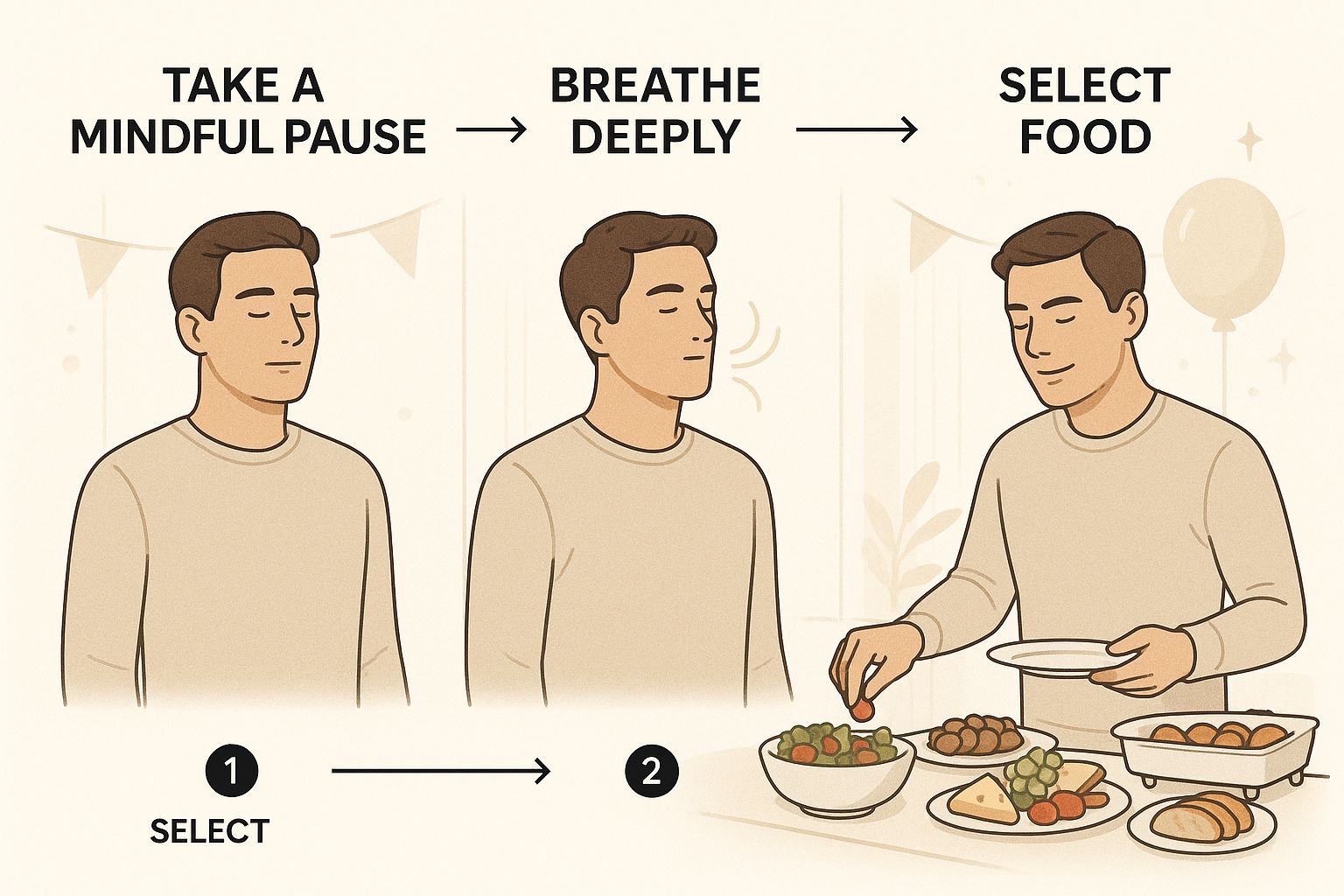
When you feel an emotional craving hit, don’t just react. Pause. Open the app.
Here’s how its features can support you:
- Check-In Feature: Quickly log how you’re feeling—stressed, bored, happy. This simple act creates a crucial space between the feeling and your response, helping you understand why you want to eat.
- Guided Meditations: If social anxiety is your trigger, step away for just 5 minutes. A short, guided meditation can calm your nervous system and help you re-center before heading back to the party.
- Craving Journal: Use the journal to note what’s happening. What did your cousin just say that made you want to grab another cookie? Documenting the trigger in real-time provides powerful insights for the future.
The goal isn’t perfection; it’s progress. Every time you pause and make a conscious choice, you’re strengthening your mindful eating muscles and building a healthier relationship with food, one celebration at a time.
What to Do When You’re Actually at the Party
You’ve done the prep work, you have a plan, but let’s be real—life happens. What do you do when you’re smack in the middle of the celebration and feel that familiar pull of anxiety, stress, or just plain old social awkwardness? This is where your in-the-moment toolkit comes in.
These aren’t rigid rules meant to make you feel restricted. Think of them as discreet, powerful little tricks to keep you grounded when things get overwhelming. The whole point is to create just a tiny bit of space between an emotional trigger and your automatic reaction. That sliver of a pause? That’s where you find your power.
First, Do a Quick “Buffet Scan”
Before you even think about grabbing a plate, take a slow, intentional walk around the food table. I call this the “buffet scan,” and it’s a game-changer. It instantly shifts your brain from a reactive, grab-whatever’s-closest mode into a more thoughtful, proactive one.
As you browse the spread, silently ask yourself a few questions:
- What here looks genuinely, mouth-wateringly good to me right now?
- Which of these options will actually make me feel good after I’m done eating?
- Is there a special holiday dish I only get once a year that I really want to enjoy?
This isn’t about restriction; it’s about intention. You’re simply helping yourself make choices based on what you truly desire, not just what’s easiest to grab when you feel anxious.
Try the S.T.O.P. Method
One of the most effective tools I’ve ever used for managing celebrations and emotional eating is the S.T.O.P. method. It’s a mental checklist you can run through in under a minute, and no one around you will have a clue you’re even doing it.
The next time you feel an overwhelming urge to eat for emotional reasons, here’s the drill:
- S – Stop: Just for a second, freeze. Don’t move, don’t reach for anything. Just pause.
- T – Take a Breath: Inhale slowly and deeply, then let it out. This little action is surprisingly powerful for calming your nervous system and hitting the brakes on that automatic reaction.
- O – Observe: Do a quick mental check-in. What am I really feeling? Is it boredom? Loneliness? Am I even physically hungry? What’s going on around me that might be triggering this?
- P – Proceed: Now, with that information, you can make a conscious choice. Maybe you decide you do want a small portion of that cheesy dip. Or maybe you realize you’d rather grab a glass of water and find a friend to talk to.
The S.T.O.P. method is all about creating that crucial gap between the impulse and the action. It puts you back in the driver’s seat.
Mindful techniques aren’t about telling yourself “no.” They’re about empowering you to give a confident “yes” to the choices that truly serve your well-being.
Wake Up Your Senses
Let’s be honest, most emotional eating happens on autopilot. We’re often so checked out that we barely taste the food we’re inhaling. The best way to counter this is to become fully, completely present with every single bite.
A simple but incredibly effective way to do this is to physically put your fork down between bites. It sounds almost too easy, but it works.
In that small pause, tune into the actual experience. Notice the flavors. Is it salty? Sweet? A little bit of both? What about the textures? Is it crunchy, creamy, or smooth? This simple habit forces you to slow down, giving your brain a chance to catch up and register fullness. You’ll find you get far more satisfaction from less food, and you’ll actually enjoy the celebration’s flavors instead of just numbing your feelings with them.
Build Healthy Coping Habits That Aren’t Food
When a big celebration rolls around, do you find yourself automatically drifting toward the food table when you feel anxious, a little lonely, or even just overly excited? If so, you’re not alone. It’s a deeply human thing to do, but it’s also a sign that your emotional toolkit could use a few more options.
The goal isn’t to take away the joy of celebratory food; it’s to build a wider range of go-to responses for when emotions run high, so food isn’t your only comfort.
This is a massive challenge for so many people. A major systematic review found the weighted average prevalence of emotional eating was a staggering 44.9% among overweight and obese populations across the globe. That means for nearly half the people trying to manage their weight, emotional eating is a frequent reality, especially during high-stakes social events.
Create Your In-the-Moment Toolkit
Your new coping strategies don’t need to be grand, life-altering gestures. Honestly, the best ones are simple, discreet, and something you can pull off in the middle of a loud party without anyone even noticing.
Think of these as your personal “pattern interrupters”—small actions that break the direct line from feeling overwhelmed to reaching for a snack.
- Take a Five-Minute Fresh Air Break: Is the noise and chatter getting to be too much? Just politely excuse yourself and step outside. You don’t need a long time—just five minutes of focusing on the cool air and taking a few slow, deep breaths can be a total game-changer. It’s a quick reset for your nervous system.
- Engage in a Meaningful Conversation: Make it a mini-mission to find a friend or relative and start a real conversation, intentionally moving away from the buffet line. Ask them about something going on in their life and just listen. Shifting your focus from your own internal storm to someone else is an incredibly powerful way to get out of your own head.
- Use a Quick Mindfulness App: Your phone can be a fantastic ally here. An app like Craving Mind has guided breathing exercises or short meditations you can do in just a few minutes. Slipping away to a quiet corner (or even your car) for a quick session can make all the difference.
Building these new habits is like exercising a muscle. It feels a little clunky and unnatural at first, but with repetition, turning to one of these skills will start to feel just as automatic as reaching for the chips once did.
The Power of a Support Buddy
Trying to navigate celebrations and emotional eating feels so much less daunting when you have someone in your corner. Find a trusted friend or partner who can be your “support buddy” for the event.
Give them a heads-up beforehand that you might shoot them a text for a quick reality check. A simple message like, “SOS, feeling the urge to set up camp by the dessert table!” is often all it takes to break the spell.
Their reply—whether it’s a quick “You’ve got this!” or just a funny GIF—creates a moment of connection. It reminds you that you have support that isn’t found on a plate. This small check-in helps validate what you’re feeling while giving you the strength to make a different choice. Knowing what’s happening inside your body is also a huge help; you can learn more about the role of insulin and blood sugar swings in our detailed guide.
Your Questions About Parties and Emotional Eating, Answered
Navigating the food scene at a big celebration can feel like a minefield when you’re working on your relationship with food. It’s totally normal to have questions and feel a little overwhelmed. Let’s tackle some of the most common hurdles so you can walk into your next event feeling prepared and confident.
What if I Mess Up and Overeat?
First, take a deep breath. One night of overeating doesn’t cancel out all the hard work you’ve put in. It’s so easy to see a slip-up as a total failure, but it’s really not. Think of it as a learning opportunity.
Self-compassion is your best friend after a slip-up. Beating yourself up only makes things worse.
Instead of spiraling, try this:
- Take a moment to think about what was going on. Were you feeling anxious? Did you get caught up in the excitement? Pinpointing the trigger is the first step.
- Decide on one small thing you can try differently next time. Maybe that means having a glass of water between helpings or stepping away from the buffet table to chat.
- Get right back to your normal routine with your very next meal. No “making up for it” or skipping food. Just get back on track.
If you want to dig deeper into this, our guide on how to stop emotional eating has a ton of practical tips.
How Do I Deal With People Pushing Food on Me?
Ah, the “food pusher.” We all have one in our family or friend group. Their intentions are usually good—they’re just trying to show love or hospitality! But it can be incredibly stressful when you’re trying to be mindful. The key is having a few polite, firm responses ready to go.
Here are a few phrases you can use:
- “That looks amazing! I’m just so full right now, but thank you.”
- “I’m going to save some room for a little later, thanks!”
- “Honestly, I’m just really enjoying the conversation right now.”
It might feel awkward at first, but practicing these lines out loud can make a huge difference. You’ll sound much more natural and confident when the moment arrives.
Should I Just Avoid All My Favorite ‘Bad’ Foods?
Going into a party with a long list of “forbidden” foods is often a recipe for disaster. When you tell yourself you can’t have something, what happens? You usually end up wanting it even more.
A much better approach is to give yourself permission to enjoy a treat, but to do it mindfully.
Here’s a little game plan:
- Scan the options and pick the one thing you really want—the one that feels special and worth it.
- Give yourself a small, reasonable portion. Then, put all your focus on it. Savor every single bite without distraction.
- Make sure to fill the rest of your plate with things like protein and veggies first. This helps you feel satisfied without needing to go overboard on the less nutritious stuff.
This way, you get to participate in the fun of the celebration without feeling deprived or guilty. It’s all about finding that balance.
A Few More Tips for Staying Mindful
Sometimes it’s the smallest habits that make the biggest impact at a busy event.
- Grab a Smaller Plate: Using a dessert or salad plate instead of a giant dinner plate is a classic trick for a reason. It naturally helps you manage portion sizes without even thinking about it.
- Make Conversation Your Goal: Instead of hovering around the food, make a point to seek out a few people for a real, meaningful conversation. Shift your focus from grazing to connecting.
- Do a Quick Sensory Check-In: Before you take that first bite, just pause. What does the food smell like? What colors and textures do you see? This simple act grounds you in the moment and makes the experience more satisfying.
“At my cousin’s wedding, I grabbed a small salad bowl instead of a dinner plate. It completely changed my focus. I spent more time catching up with family instead of constantly thinking about what to eat next.” – Jenna
That little trick from Jenna is gold. It’s not about restriction; it’s about shifting your mindset. What’s one small swap you could try at your next get-together? Each tiny adjustment helps build that mindful eating muscle.
Remember, the goal isn’t perfection. It’s about making conscious choices that leave you feeling good, not guilty. Celebrate your wins, and if you have a non-food treat planned for yourself afterward—like a relaxing bath or watching your favorite movie—even better.