 CravingMind AI
Your body has its own language, and it’s talking to you all the time. Those little signs—feeling drained for no reason, sudden cravings, or even mood swings—aren’t just random annoyances. They’re messages. Think of them as a secret language your body uses to tell you exactly what it needs to thrive.
Learning Your Body’s Secret Language
Imagine your body as a highly intelligent system, constantly sending you status reports. That persistent fatigue, those brittle nails, or that sudden, intense urge for a specific food? These are biological signals, specific dispatches about your internal health that often point directly to a nutritional gap. This guide is your decoder ring for that intricate language.
We’ll dig into how our modern lifestyles and eating habits can accidentally leave us short on key nutrients, making it more important than ever to tune in and listen. When you learn to interpret what your body is telling you, you can stop just reacting to symptoms and start proactively giving it what it actually needs.
From Global Progress to Personal Awareness
Paying attention to these signals is incredibly relevant today. While we’ve made huge strides globally in tackling severe nutrient deficiencies, the more subtle ones are still pretty common in our day-to-day lives.
For instance, between 1990 and 2021, the worldwide rate of nutritional deficiencies plummeted by an amazing 54.9%, with death rates dropping by over 72.2%. That’s incredible progress. But those big-picture stats don’t change the fact that your individual health still hinges on recognizing your own biological signals. You can explore more about these global health trends00474-5/fulltext) to see the bigger picture.
This shift empowers you to move beyond a one-size-fits-all approach to health. Instead of guessing, you begin to build a responsive, dynamic relationship with your body, using its feedback to guide your wellness journey.
This is where true health management begins. It’s about seeing the connection between how you feel and what you eat, turning everyday symptoms from frustrating mysteries into valuable data.
Decoding Common Deficiencies and Their Telltale Signs
Think of your body as an incredibly smart, self-regulating system. It’s always trying to maintain balance, and when something is off, it sends out signals. Just like a plant’s yellowing leaves are a clear cry for more nitrogen, your body has its own language for telling you what it needs.
These messages are far more nuanced than a rumbling stomach. They’re the subtle, persistent cues woven into your daily life—your energy slumps, your moods, even the condition of your skin and nails. Learning to interpret these nutritional deficiencies and biological signals is the first real step toward giving your body exactly what it’s asking for.
The Iron Story: More Than Just Fatigue
Iron is the ultimate workhorse mineral. It’s the key component of hemoglobin, the protein in your red blood cells responsible for chauffeuring oxygen from your lungs to every single cell in your body. When you’re low on iron, that oxygen delivery service grinds to a halt, which is why the most famous sign is a deep, bone-crushing fatigue that sleep just can’t seem to fix.
But the story doesn’t stop there. Other clues are often hiding in plain sight:
- Pale Skin and Lower Eyelids: Less hemoglobin means less red pigment, which can leave your skin looking washed out. A quick pull-down of your lower eyelid is a classic tell; if it’s more pale pink than a healthy red, your iron might be low.
- Spoon-Shaped Nails (Koilonychia): In more chronic cases of deficiency, your fingernails can become soft, thin, and even develop a distinct concave, spoon-like dip.
- Weird Cravings: An intense, unusual urge to eat non-food items like ice, clay, or dirt—a condition called pica—is a strange but surprisingly strong indicator of severe iron deficiency.
This condition, anemia, is a massive global health issue. It’s a biological signal that affects more than 570 million women and girls of reproductive age worldwide, highlighting an insufficient supply or poor absorption of iron, folate, and B12. As detailed in the 2021 Global Nutrition Report, this isn’t just a health problem; it’s a drag on productivity and well-being everywhere.
This image shows just how direct the body’s messages can be, with things like pale skin or brittle nails often pointing to deeper nutritional needs.
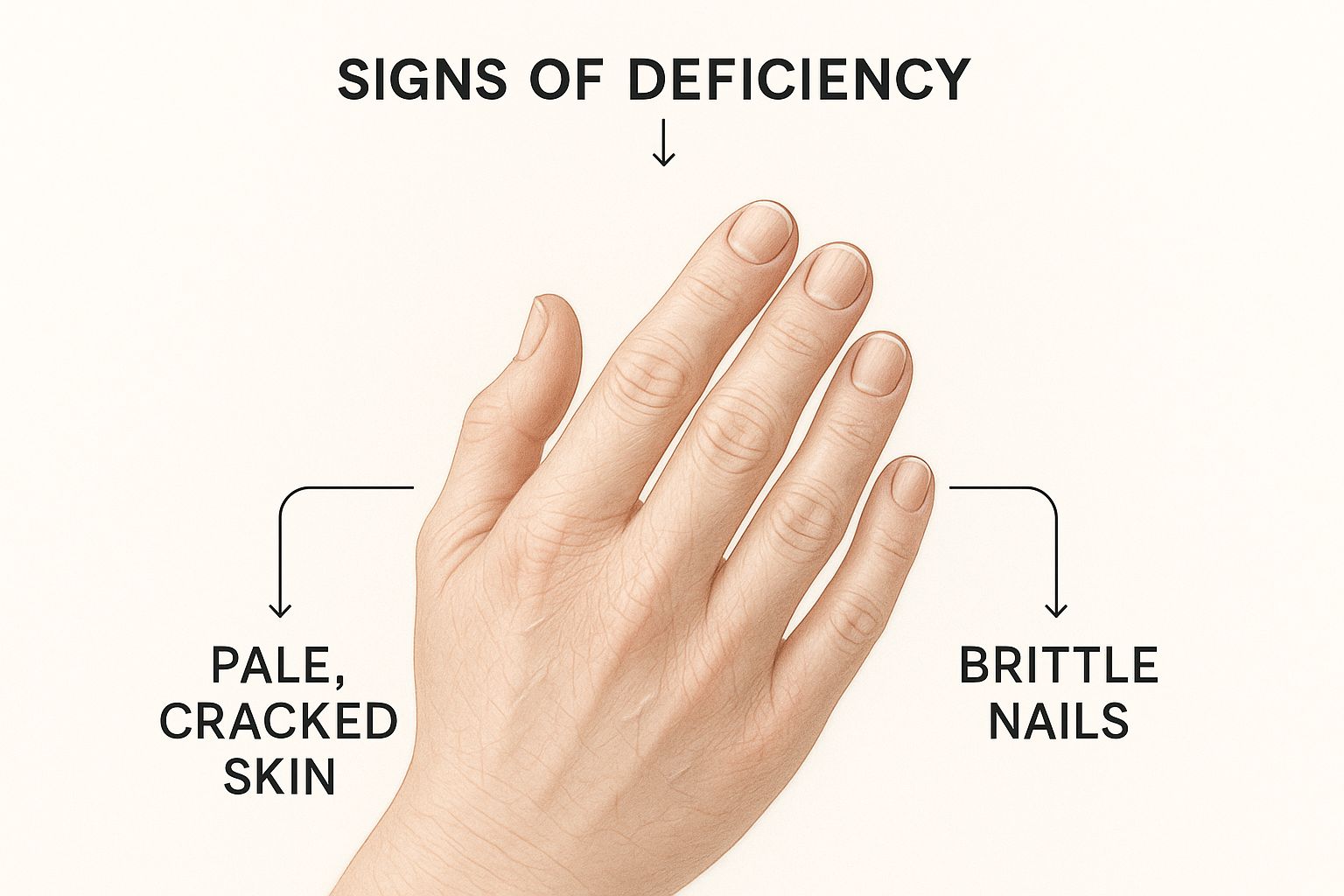
It’s a great reminder that the signs on the outside of our bodies are often a direct reflection of what’s happening on the inside.
Connecting Common Deficiencies to Their Biological Signals
To make this easier to track, I’ve put together a quick-reference table. It connects some of the most common nutrient shortfalls to the physical and mental cues your body might be sending you.
| Nutrient | Common Biological Signals | Potential Dietary Sources |
|---|---|---|
| Iron | Deep fatigue, pale skin, spoon-shaped nails, shortness of breath, strange cravings (pica) | Red meat, lentils, spinach, fortified cereals, beans |
| Magnesium | Muscle twitches and cramps, anxiety, poor sleep, irritability, fatigue | Almonds, spinach, black beans, avocado, dark chocolate |
| Vitamin D | Low mood (especially seasonal), frequent illness, bone and back pain, fatigue | Sunlight exposure, fatty fish (salmon, mackerel), fortified milk, egg yolks |
| Vitamin B12 | Brain fog, memory issues, numbness or tingling in hands and feet, fatigue, mood changes | Clams, beef liver, fish, meat, dairy, fortified cereals |
| Folate (B9) | Fatigue, mouth sores, irritability, changes in skin or hair color, gray hair | Leafy greens (spinach, kale), lentils, asparagus, Brussels sprouts |
| Vitamin C | Bleeding gums, slow wound healing, frequent bruising, rough or bumpy skin | Citrus fruits, bell peppers, strawberries, broccoli, kiwi |
This table isn’t for self-diagnosis, of course, but it can be a powerful starting point for paying closer attention to your body’s unique patterns.
Magnesium: The Relaxation Mineral
Magnesium is the unsung hero of our internal chemistry, involved in over 300 different bodily processes. Its primary role? To help things relax. Think of it as the body’s natural “off switch” for your muscles and nervous system.
When you’re running low on magnesium, that switch gets stuck in the “on” position, and things can start to feel a bit haywire.
Without enough magnesium, your nervous system can become over-excited, leading to a cascade of physical and mental signals. It’s the mineral that helps you unwind, both physically and mentally.
Some classic signs that your magnesium levels might be dipping include:
- Muscle Twitches and Cramps: Those annoying, involuntary eyelid twitches or late-night leg cramps are textbook examples.
- Trouble Sleeping: Magnesium plays a key role in calming the brain down for rest. A deficiency can leave you feeling restless and staring at the ceiling at 2 AM.
- Anxiety and Irritability: By helping to regulate key neurotransmitters, magnesium is vital for a stable mood. When it’s low, feelings of edge and unease can creep in.
Vitamin D and B Vitamins: Your Mood Regulators
Vitamin D, affectionately known as the “sunshine vitamin,” actually acts more like a hormone in the body, and its influence on mood and immunity is huge. Low levels are strongly linked with Seasonal Affective Disorder (SAD) and general feelings of depression. If you notice your mood takes a nosedive every winter, it could be a clue.
The B vitamins, especially B12 and folate (B9), are the brain’s best friends. They are essential for producing energy and maintaining the health of your nervous system.
When there’s a shortfall, you might experience:
- Brain Fog and Memory Lapses: These vitamins are needed to maintain the protective myelin sheath around your nerves. Without enough, communication in the brain gets fuzzy.
- Mood Swings and Depression: B vitamins are crucial for creating the “feel-good” neurotransmitters like serotonin and dopamine that keep your mood balanced.
- Cracks at the Corners of Your Mouth: A specific sign called angular cheilitis is often tied directly to a lack of B vitamins, particularly riboflavin (B2).
The Science Behind Your Body’s Signals
Have you ever wondered why you get a twitch in your eye when you’re stressed, or why brain fog hits you like a ton of bricks? It’s not random. These are direct messages from your body, rooted in complex biochemical processes. When you learn to decode them, these signals stop being simple annoyances and become invaluable data about what’s happening inside.
Think of it like this: your body is a high-tech factory, and micronutrients are the specialized workers on the assembly line. Each vitamin and mineral has a very specific job. If one of them doesn’t show up for their shift, the whole production line starts to glitch. Those glitches are the symptoms we feel and see.
Magnesium: The Body’s “Off Switch”
Magnesium is a fantastic example. This mineral is a powerhouse, involved in over 300 different processes in the body, but one of its most important jobs is to act as a natural relaxant for our muscles and nervous system.
Picture your muscle cells with tiny gates. Calcium rushes through these gates to make the muscle contract—that’s the “on” switch. Magnesium is the bouncer at the gate, pushing the calcium back out so the muscle can relax. It’s the “off” switch.
When you’re low on magnesium, you don’t have enough bouncers to get the calcium out. The “on” switch gets stuck, and you start to experience those tell-tale signals:
- Involuntary muscle twitches (like that annoying eye twitch)
- Painful leg cramps, especially at night
- A general feeling of physical tension you just can’t shake
The same idea applies to your nervous system. Magnesium has a calming effect on your nerve activity. Without enough of it, your system can get stuck in an “on” state, leaving you feeling anxious, irritable, and struggling to switch off for a good night’s sleep.

B Vitamins: Your Brain’s Communication Crew
The B vitamins—especially B12 and folate—are the dedicated maintenance crew for your entire nervous system. They’re crucial for making neurotransmitters, the chemical messengers that govern everything from your mood to your ability to focus. They also play a vital role in maintaining the myelin sheath, a fatty, protective coating that insulates your nerve fibers.
A good analogy for the myelin sheath is the plastic insulation around an electrical wire. When that coating is healthy and intact, nerve signals zip along quickly and efficiently. But if a B vitamin deficiency causes that insulation to wear thin, you can get “short circuits” in your brain’s wiring. That electrical interference is what shows up as signals like:
- Brain fog and a frustrating inability to concentrate
- Noticeable memory lapses
- A strange numbness or tingling sensation in your hands and feet
Understanding this mechanism shows that brain fog isn’t just a vague feeling of being “off.” It’s a tangible biological signal of compromised neural pathways, directly linked to a lack of specific nutrients.
Vitamin D: The Mood-Influencing Hormone
Here’s an interesting one: Vitamin D functions less like a classic vitamin and more like a hormone. It has a hand in everything from bone health to immune response, but its link to our mood is especially powerful. Vitamin D is directly involved in producing serotonin, the famous “feel-good” neurotransmitter.
It’s no coincidence that many people feel lower during the winter. Less sun exposure means our bodies produce less Vitamin D. That dip can directly torpedo our serotonin levels, which helps explain the low mood and fatigue that come with seasonal changes. Of course, nutrient absorption is also tied to your overall metabolic health; you can learn more about how insulin and blood sugar swings impact your body in our detailed guide.
Ultimately, learning this helps you see your mood not just as a fleeting emotion, but as a biological response to your current nutritional state.
What’s Really Causing Your Nutrient Gaps?
You can follow a picture-perfect diet and still come up short on key nutrients. It’s a frustrating reality. Even when you’re diligently eating all the “right” things, hidden factors can quietly drain your nutritional reserves, leaving you with confusing signals from your body. To really get to the root of a deficiency, we have to look beyond just what’s on your plate.
Think of your digestive system as a highly selective gatekeeper. If it’s not working at peak performance, even the most nutrient-dense foods can be denied entry. Issues like low stomach acid, an imbalanced gut microbiome, or inflammation in the intestines can seriously sabotage your body’s ability to pull vitamins and minerals from what you eat.
The Factors Beyond Your Food
It’s not just about what you eat, but what your body is doing with it. Your lifestyle and even your current stage of life can dramatically ramp up your need for certain nutrients or get in the way of absorbing them.
Here are a few major players that often contribute to nutrient gaps:
- Chronic Stress: When you’re constantly in fight-or-flight mode, your body burns through essential minerals like magnesium and B vitamins at a much faster rate to keep up.
- Common Medications: Many everyday prescriptions can have unintended consequences. Acid blockers, for example, can hinder vitamin B12 absorption, while certain diuretics can deplete your body of calcium and magnesium.
- Life Stages: Your nutritional needs are not static. Pregnancy creates a huge demand for folate and iron. Later in life, our ability to absorb nutrients like B12 naturally declines, making deficiencies more common.
Long-term malnutrition has devastating consequences, particularly during crucial periods of growth. Around the world, an estimated 149 million children under five suffer from stunting because they haven’t gotten the nutrients they need. While that’s a huge improvement from the 40% rate seen in 1990, it’s a stark reminder of how fundamental nutrition is for human development. You can dig deeper into this global health issue by exploring the World Bank’s data on nutrition.
The Surprising Power of Chewing
Here’s a factor most people completely overlook: the simple act of chewing. This is digestion’s very first step. It’s the mechanical process that physically breaks down food, giving your digestive enzymes a fighting chance to get in there and unlock all the nutrients.
When chewing is a problem—often due to dental issues like missing teeth or poorly fitting dentures—malnutrition risk skyrockets. If it’s difficult or painful to chew, you’ll naturally start avoiding tougher, nutrient-packed foods like fibrous vegetables or quality proteins in favor of softer, less nutritious options.
This seemingly small mechanical failure can trigger a cascade of problems, creating nutritional deficiencies and biological signals that appear to have nothing to do with your teeth. Studies have confirmed a strong connection between poor chewing ability and a higher risk of malnutrition, especially in older adults. It’s a powerful lesson in just how interconnected our bodies are; even something as basic as a good bite is foundational to your nutritional health.
A Practical Guide to Tracking Your Biological Signals

Learning to recognize your body’s signals is a huge first step. But the real magic happens when you turn those observations into positive, lasting change. That journey requires a solid framework—one that takes you from just noticing symptoms to taking meaningful action. It’s all about building a proactive, personalized approach to your health.
The best way to begin is by becoming a mindful detective of your own body. You don’t need fancy gadgets or complicated spreadsheets. It can be as simple as keeping a daily journal to start connecting the dots between what you eat, how you feel, and what your body is doing.
This simple act transforms vague feelings into concrete data. By jotting down these details, you’ll start to see patterns emerge that were invisible before. Suddenly, the link between nutritional deficiencies and biological signals becomes much clearer.
Building Your Personal Health Blueprint
To get started, you only need to focus on a few key areas each day. This creates a simple but surprisingly powerful log of your body’s unique language.
- Log Your Food and Drink: Forget counting calories for now. Just write down what you ate and when. This can help you spot trigger foods or identify times of day when your energy soars or crashes.
- Note Your Symptoms: Did you get a headache at 3 PM? A muscle cramp after dinner? Jot down any physical signal, no matter how small it seems.
- Track Your Energy and Mood: Use a simple 1-10 scale to rate your energy and mood throughout the day. You might be surprised by the links you find between your diet and your mental state.
- Record Your Cravings: Pay close attention to what you’re craving and when it hits. A sudden, intense desire for a specific food is a valuable clue. If this is a constant battle, learning https://cravingmind.app/how-to-control-cravings/ can give you some extra tools.
The point of this practice isn’t perfection; it’s awareness. Every entry is another piece of the puzzle, helping you understand your body’s needs on a much deeper level and empowering you to make better-informed decisions.
Turning Observations Into Action
Once you’ve been tracking for a little while, you’ll start to see connections. Maybe you notice you’re always exhausted after a certain type of meal. That’s your cue to experiment with different food choices and see if it makes a difference.
If your tracked signals point toward a specific deficiency—like muscle twitches suggesting low magnesium—you can mindfully add more magnesium-rich foods to your plate. Think almonds, spinach, and avocados. This approach lets you respond to your body’s needs in real time.
It’s also worth considering factors that might not seem obvious. For instance, even your ability to chew properly can have a massive impact. Research shows a clear link between poor chewing ability and a higher risk of malnutrition, simply because it can cause people to avoid nutrient-dense foods that are harder to eat.
Partnering with a Professional
While tracking your symptoms is incredibly valuable, it’s a tool for awareness, not self-diagnosis. Think of your journal as the perfect conversation starter for a visit with a healthcare professional or a registered dietitian.
They can help you make sense of your findings, order the right lab tests to confirm any suspected issues, and help you build a safe, effective plan to get back on track. This blend of mindful self-awareness and expert guidance is the surest path to addressing the root cause of your symptoms and achieving a genuine sense of well-being.
Your Nutritional Health Questions, Answered
Diving into the world of nutritional health can feel a bit like learning a new language—your body’s language. As you start tuning in, it’s totally normal to have questions pop up. Let’s tackle some of the most common ones you might be wondering about.
Can I Really Diagnose a Deficiency Just from Symptoms?
It’s tempting, but it’s not a good idea. While the signals your body sends are powerful clues, they’re rarely the whole story. Think about it: things like constant fatigue or your hair thinning can point to a dozen different issues, so trying to self-diagnose can be a real shot in the dark.
The best approach? Use those physical and mental signs as your conversation starter with a doctor or a registered dietitian. They have the tools to run specific tests, confirm what’s really going on, and make sure you’re not overlooking another health condition.
Your symptoms are like the check engine light in your car. It tells you something needs attention, but you still need a mechanic to plug in the diagnostic tool and find the specific fault code.
This way, you can be sure you’re treating the actual root cause, not just guessing.
How Long Does It Take to Fix a Nutritional Deficiency?
That’s the million-dollar question, and the honest answer is: it depends. The timeline for getting your levels back to normal can vary wildly based on the nutrient in question, how low your levels are, and even how well your individual body absorbs things.
For a minor dip, you might start feeling better within a few weeks of making consistent changes to your diet or starting a supplement. But for something more serious, like severe iron-deficiency anemia, it can easily take several months to fully build back your body’s reserves. The keys here are patience and consistency, guided by professional advice.
Are My Cravings Trying to Tell Me I’m Deficient in Something?
Sometimes, yes! But it’s not a one-to-one relationship. There are some classic, well-documented links. For example, an intense and unusual urge to chew ice (a condition called pagophagia) is a surprisingly common sign of a significant iron deficiency.
However, most of our day-to-day cravings are driven by a mix of other factors:
- Emotional Triggers: We’ve all been there. Stress, boredom, or just old habits can have you reaching for that bag of chips or slice of cake.
- Blood Sugar Swings: That afternoon slump that sends you running for a sugary snack? That’s often your blood sugar taking a nosedive and screaming for a quick fix.
- Your Gut Health: The trillions of bacteria living in your gut can actually influence what foods you crave. It’s a fascinating and complex connection.
So, instead of taking every craving literally, think of it as just one data point. When you start tracking them in an app like Craving Mind alongside your mood, energy, and other physical symptoms, you start to see the real patterns emerge. That’s when you get a much clearer picture of what your body is actually asking for.